Author: DIY Renewable Energy & Electrical Engineering Team
With rising electricity costs and an increasing desire for grid independence, building a homemade renewable energy generator is an exciting pursuit for many DIYers. You may have seen videos claiming you can build a “free energy generator” using old speaker tools and copper wire. However, the reality requires a deeper understanding of physics and engineering.
In this guide, we will explore how to build a DIY 6000W generator grounded in real science. By abandoning the free energy generator myth and focusing on solid mechanical-to-electrical energy conversion, you can create a highly functional off-grid power generator.
Disclaimer: This guide is an educational overview of a DIY engineering project. A true DIY 6000W generator requires substantial mechanical energy input and involves dangerous high voltages. Results will vary based on material quality and construction. There is no such thing as a “free energy generator”—this device converts mechanical energy into electricity and is not a perpetual motion machine.
Ready to Build Your Own Off-Grid Power System?
The number one reason DIY magnetic generators fail isn’t the physics—it is a lack of precision tools. Don’t drill a single hole or twist a single wire until your workspace is set up like a professional energy lab. Grab our free 17-page blueprint covering the exact tools, safety gear, and air-gap instruments you need to succeed on your first try.
Key Takeaways
- Science, Not Magic: Generators do not create energy from nothing; they convert mechanical force (wind, water, engine) into electrical power.
- Speaker Magnets Fall Short: While old speaker magnets work for small science experiments, a 6000W system requires powerful neodymium permanent magnets.
- Mechanical Input is Vital: Generating 6000W requires immense torque, typically supplied by a large wind turbine or micro-hydro system.
- Safety First: A 6000W output is capable of powering a home but poses serious shock and fire hazards if not regulated correctly.
What Is a 6000W Electromagnetic Induction Generator?
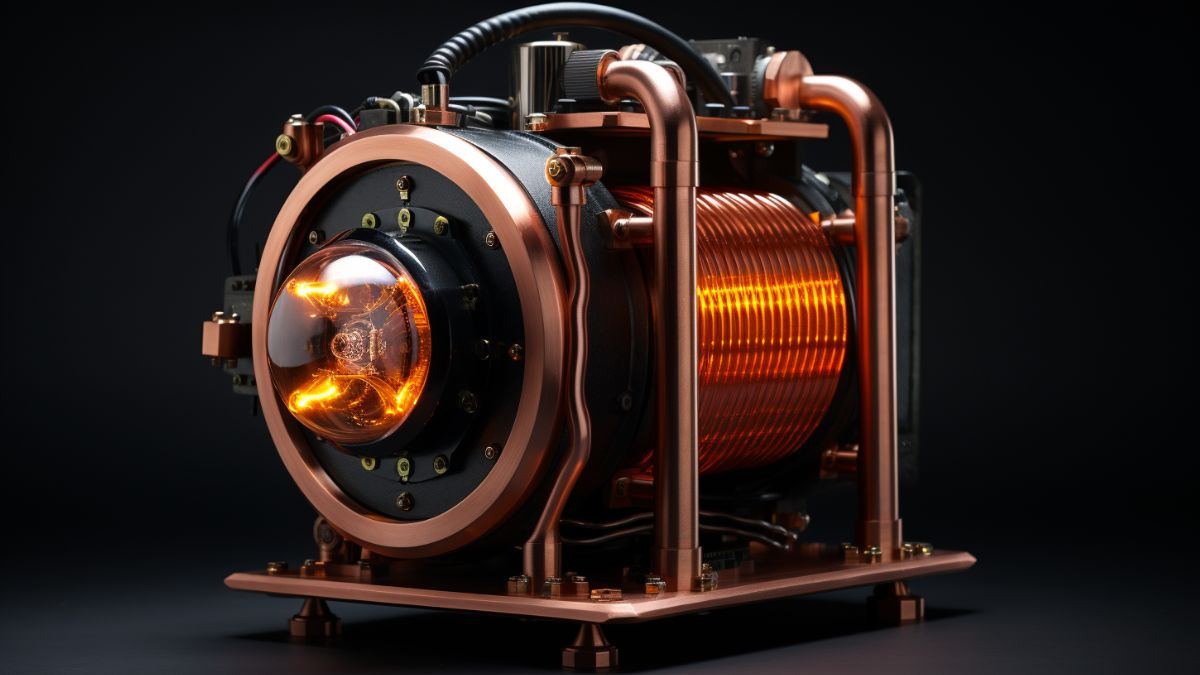
An electromagnetic induction generator is a device that transforms kinetic (mechanical) energy into electrical energy. At a 6000W capacity, this is not a small tabletop device. It is a robust piece of machinery capable of powering large appliances, charging deep-cycle battery banks, and providing serious off-grid power.
To reach this output, most builders rely on a permanent magnet alternator (PMA) design. Unlike standard induction motors that require an outside power source to create a magnetic field, a PMA uses strong permanent magnets to generate electricity the moment the rotor starts spinning.
How It Works: The Science of Electromagnetic Induction
The foundation of any copper wire generator is Faraday’s Law of Electromagnetic Induction. Discovered by Michael Faraday in 1831, this law states that moving a magnetic field across a conductor (like copper wire) induces a voltage in that conductor.
When the mechanical input (such as wind or water) spins the generator’s rotor, the attached magnets pass closely over stationary coils of copper wire on the stator. The changing magnetic field pushes electrons through the wire, creating an alternating current (AC). The faster the rotor spins and the stronger the magnets, the higher the electrical output.
Components and Materials Needed
Building a reliable DIY 6000W generator requires high-quality components. While upcycling is encouraged, achieving high efficiency (typically 85–95% for well-built generators) requires specific materials.
Rotor Assembly
The rotor is the spinning heart of the generator. While older DIY guides suggest using ferrite speaker magnets, they simply lack the flux density for a 6000W build.
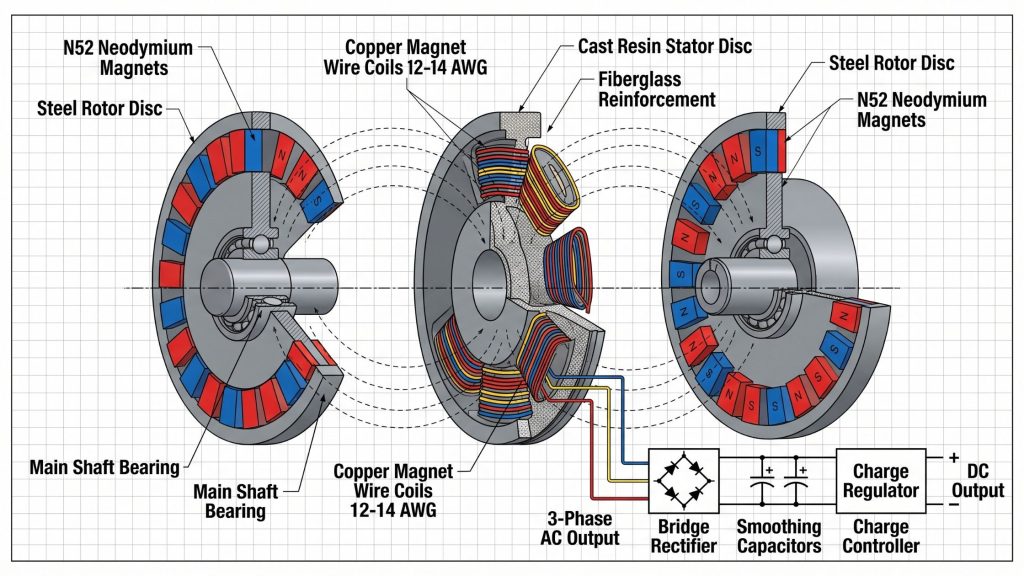
- Neodymium Magnets: N52 grade rare-earth magnets are standard for high-output PMAs.
- Steel Rotors: Thick steel plates to mount the magnets and contain the magnetic field.
- Heavy-Duty Bearings: Essential for handling the immense rotational torque.
Stator and Copper Wire Windings
The stator holds the coils of wire where the electricity is actually generated. In a copper wire generator, the winding pattern is critical.
- Copper Magnet Wire: 12 to 14 AWG enameled copper wire is typically required to handle the high amperage without overheating.
- Casting Resin: Used to cast the copper coils into a rigid, weatherproof stator disc.
- Fiberglass Cloth: Added to the resin for structural integrity.
Transformer and Voltage Regulation
The raw AC power produced by the generator fluctuates with the wind or water speed. It must be tamed before it can power your home.
- Diode Bridge Rectifier: Converts the wild 3-phase AC power into usable DC power for battery charging.
- Capacitors: Help smooth out voltage spikes.
- Charge Controller/Voltage Regulator: Prevents your battery bank from overcharging.
Step-by-Step Construction Overview
- Design the Stator: Calculate the number of coils and the exact winding turns required based on your target RPM. Wind the copper wire using a coil winder.
- Cast the Stator: Arrange the coils in a circular mold, wire them in a 3-phase configuration (Star or Delta), and cast them in high-temperature epoxy resin.
- Build the Rotors: Carefully attach the neodymium magnets to the steel plates using strong adhesives, alternating North and South poles.
- Assemble the Alternator: Mount the stator securely between the two spinning magnetic rotors, ensuring an extremely tight air gap (usually 1-2mm) to maximize magnetic flux.
- Wire the Electronics: Connect the 3-phase AC output to your heavy-duty bridge rectifier, passing the resulting DC power to your charge controller.
Applications and Use Cases
A homemade renewable energy generator of this scale is incredibly versatile. Because it requires significant mechanical to electrical energy conversion, it is best paired with:
- Wind Turbines: Mounted on a tall tower to catch consistent, high-speed winds.
- Micro-Hydro Systems: Attached to a Pelton wheel in a fast-flowing stream for continuous 24/7 power.
- Gas/Diesel Engine Retrofits: Driven by an existing mechanical engine for emergency backup power.
Read: Small Wind Electric Systems: A U.S. Consumer’s Guide.
Realistic Performance Expectations and Limitations
It is vital to leave the free energy generator myth behind. A 6000W generator will not power your house while sitting idle on a workbench. To produce 6000 watts of electrical power, you need roughly 8 to 10 horsepower of mechanical energy driving the shaft.
Furthermore, efficiency losses (through heat and friction) mean your mechanical input must exceed your electrical output. A well-built axial flux PMA will operate at about 85% to 90% efficiency. If the wind isn’t blowing or the water isn’t flowing, the generator produces nothing.
Advantages Over Traditional Energy Sources
Despite the hard work required, building your own off-grid power generator offers massive benefits:
- Energy Independence: You control your power source, reducing reliance on the failing grid.
- Cost Savings: Building a PMA from scratch is often a fraction of the cost of buying commercial wind turbines.
- Repairability: Because you built it, you know exactly how to fix it if a bearing fails or a wire burns out.
Safety Considerations and Maintenance
Operating a DIY 6000W generator is hazardous. 6000 watts at 48 volts produces 125 amps of current—more than enough to cause lethal shocks or start electrical fires.
Always use properly sized wiring, install inline DC breakers between the generator and the battery bank, and ensure the system is properly grounded. Maintenance includes inspecting the rotor for rust, greasing the bearings annually, and checking the stator resin for signs of heat degradation.
Related Post: How to Build a Magnetic Generator to Power Your Home.
Frequently Asked Questions (FAQ)
Can a DIY generator really produce 6000W?
Yes, a DIY generator can produce 6000W, but only if it is built with high-grade neodymium magnets, thick gauge copper wire, and driven by a very powerful mechanical source like a large wind turbine or a micro-hydro wheel.
What is the difference between a free energy generator and a renewable energy generator?
A “free energy generator” is a pseudoscientific myth claiming to create energy from nothing. A renewable energy generator is a real device that converts existing natural kinetic energy (like wind or flowing water) into electricity.
How does electromagnetic induction work in a homemade generator?
It works based on Faraday’s Law. When the rotor stator design is set into motion, permanent magnets pass over stationary coils of copper wire. This moving magnetic field pushes electrons through the copper, creating an electrical current.
What materials do I need to build a copper wire generator?
Key materials include 12-14 AWG enameled copper magnet wire, heavy steel plates, neodymium magnets (N52), a central steel shaft, industrial bearings, epoxy casting resin, and a diode bridge rectifier.
Is a DIY 6000W generator safe to use at home?
It can be safe if built and wired to proper electrical codes. However, 6000W is a massive amount of power. It requires heavy-duty wiring, circuit breakers, and safe grounding to prevent fatal shocks and electrical fires.
Ready to Take Your Off-Grid Setup to the Next Level?
Building a DIY 6000W electromagnetic induction generator is a challenging but deeply rewarding project. By understanding the real science of Faraday’s Law and sourcing the right materials, you can create a reliable, robust power source that will keep your lights on when the grid goes down.
Ready to Build Your Own Off-Grid Power System?
The number one reason DIY magnetic generators fail isn’t the physics—it is a lack of precision tools. Don’t drill a single hole or twist a single wire until your workspace is set up like a professional energy lab. Grab our free 17-page blueprint covering the exact tools, safety gear, and air-gap instruments you need to succeed on your first try.