In my fifteen years of designing, auditing, and installing off-grid power systems across North America, I have seen every imaginable approach to achieving self-reliance. The dream of severing ties with the utility grid is a powerful motivator. Unfortunately, this intense desire for total autonomy makes the prepper and off-grid communities prime targets for predatory marketing.
The most persistent and damaging of these scams is the promotion of free energy generators. Whether marketed as zero-point energy machines, permanent magnet motors, or suppressed government secrets, these devices promise infinite electricity from nothing. They do not work.
I have evaluated dozens of these blueprints brought to me by hopeful clients. None of them function as advertised. Believing in these hoaxes does not just waste your hard-earned money; it compromises your family’s safety by leaving you without power during critical situations.
Energy independence is absolutely achievable today. However, it requires a foundation built on verified engineering, not internet mythology. In this comprehensive guide, I will deconstruct the physics that invalidate free energy claims. Then, I will outline the precise specifications required to build a resilient, physics-compliant off-grid power system that will genuinely sustain your homestead for decades.
Ready to Build Your Own Off-Grid Power System?
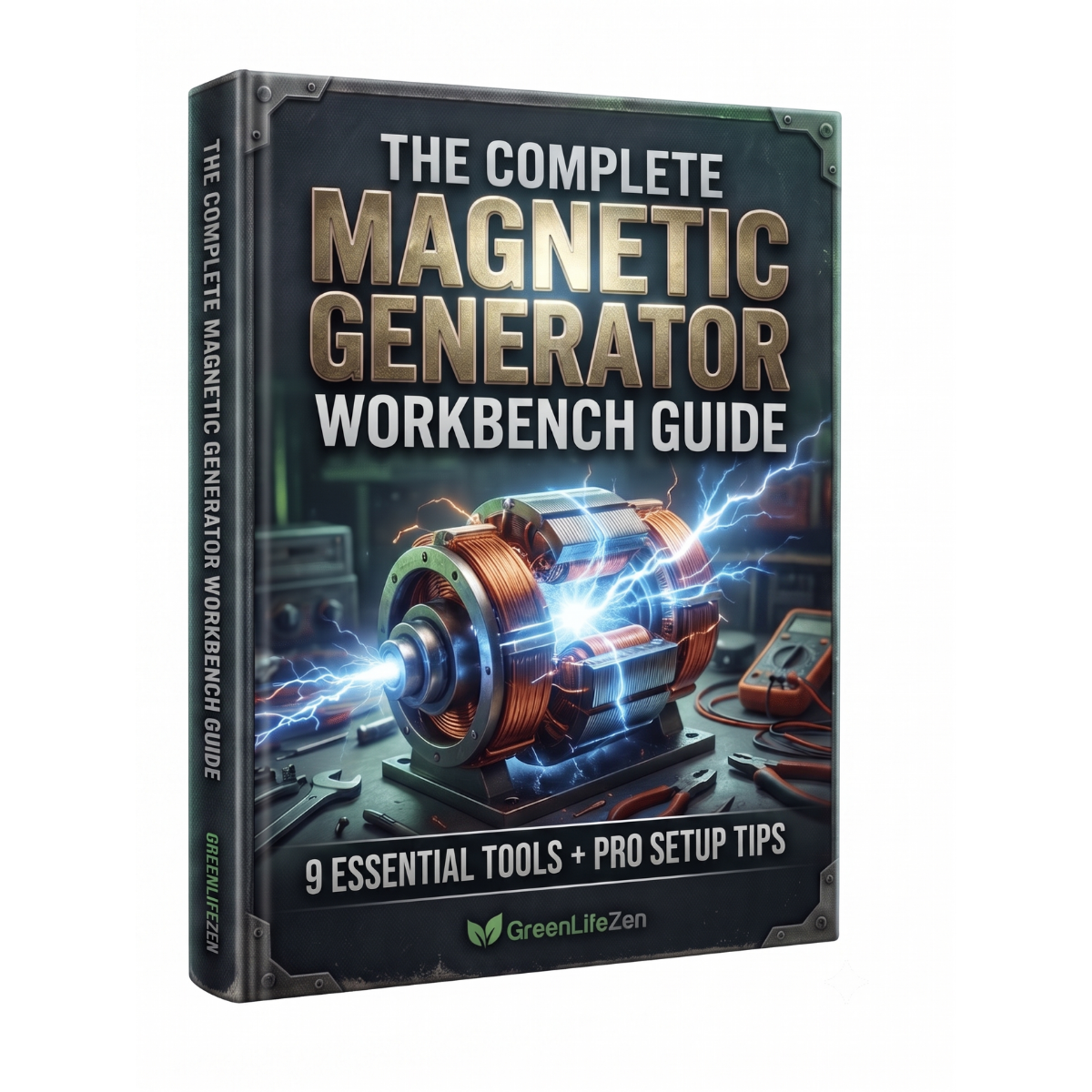
The number one reason DIY magnetic generators fail isn’t the physics—it is a lack of precision tools. Don’t drill a single hole or twist a single wire until your workspace is set up like a professional energy lab. Grab our free 17-page blueprint covering the exact tools, safety gear, and air-gap instruments you need to succeed on your first try. (PDF format, No email needed)
Why Free Energy Generators Defy the Laws of Physics
The scientific community does not suppress free energy generators; the fundamental laws of the universe simply prohibit their existence. To understand why these devices fail, we must look directly at established thermodynamics. Devices that claim to output more energy than they consume are classified as overunity devices.
These concepts collapse immediately when subjected to peer-reviewed scientific scrutiny. Any system generating electrical power must follow the strict, mathematically proven rules of energy conversion.
The First and Second Laws of Thermodynamics
The First Law of Thermodynamics states that energy can neither be created nor destroyed; it can only be transferred or converted from one form to another. The mathematical expression of this fundamental truth is ΔU = Q − W.
In this equation, ΔU represents the change in internal energy of a closed system, Q is the heat added to the system, and W is the work done by the system. If you want a generator to perform electrical work (W), you must input energy (Q) in the form of sunlight, wind, falling water, or combustible fuel. You cannot extract work from a closed system without depleting its internal energy.
The Second Law of Thermodynamics dictates that entropy in an isolated system always increases. In practical engineering terms, this means that every energy conversion process involves inevitable losses, usually as waste heat or mechanical friction. Because of the Second Law, a machine can never operate at 100% efficiency. Overunity devices claim operating efficiencies of 101% or higher, which is a mathematical and physical impossibility.
The Delusion of the Magnetic Free Energy Generator
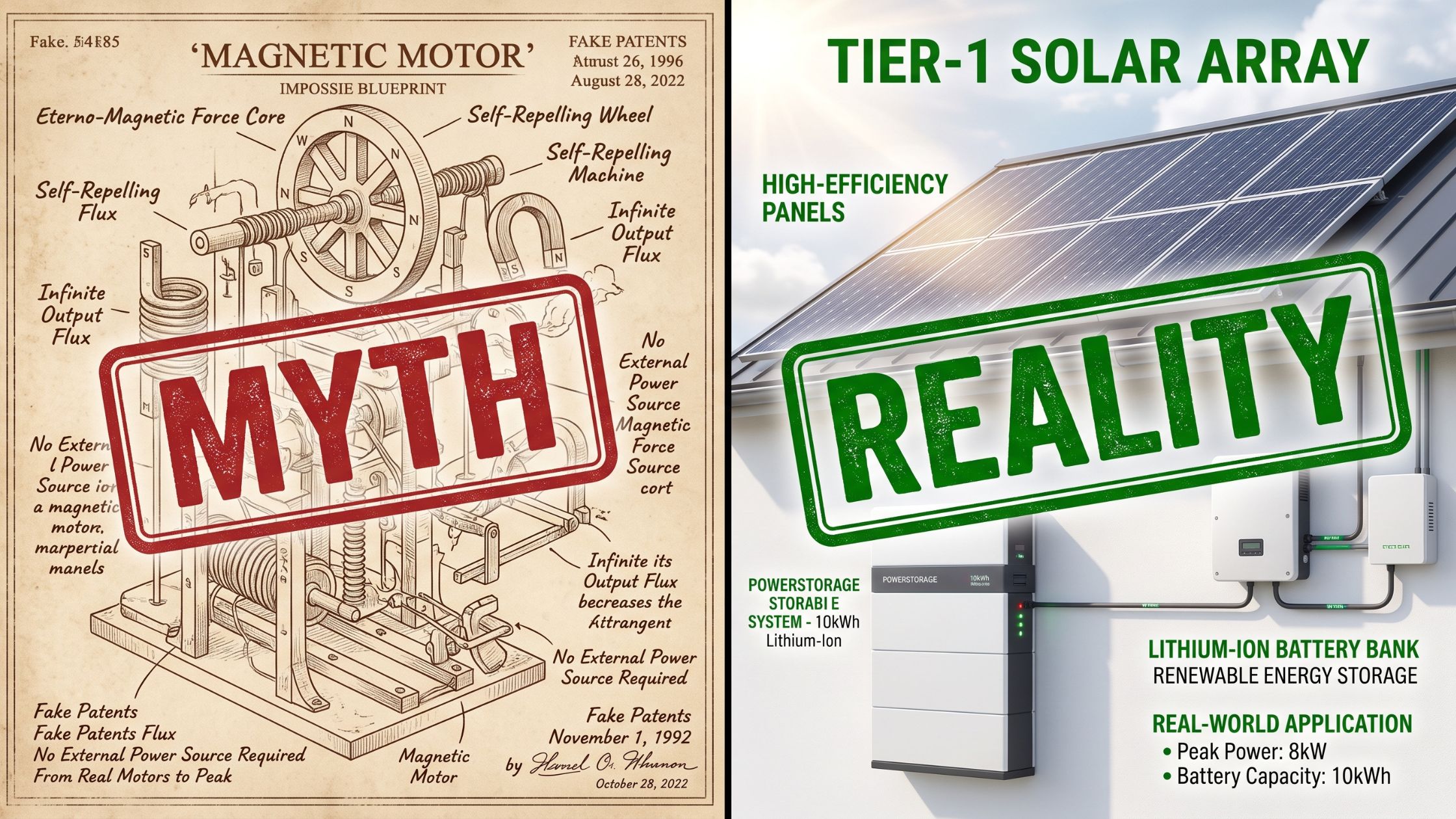
One of the most common scams targeting DIYers is the magnetic free energy generator. These schematics suggest that by arranging neodymium permanent magnets in a specific geometric pattern, the repelling forces will spin a rotor indefinitely, generating limitless electricity.
This fundamental misunderstanding of physics ignores the concept of magnetic equilibrium. A magnetic field is a conservative field. The total work done moving a mass through a closed loop in a conservative field is exactly zero.
Magnets do not contain reservoirs of free energy; they simply possess a static force field. When magnets are arranged to push a rotor, they eventually lock into a state of magnetic equilibrium where the opposing forces balance perfectly. The rotor stops spinning. Furthermore, applying an external load to extract electrical power creates electromagnetic drag, halting the motor even faster. Permanent magnets also degrade over time through a process called spontaneous demagnetization, proving they are not infinite energy sources.
Correcting the Misrepresentation of Nikola Tesla
Purveyors of free energy generators frequently invoke the name of Nikola Tesla to legitimize their claims. They point to his Wardenclyffe Tower project as proof that he invented a way to pull free electricity from the ionosphere, only to be shut down by greedy industrialists.
This is a complete fabrication of historical and scientific fact. Tesla’s true genius was the development of alternating current (AC) induction motors and the polyphase AC power grid. His Wardenclyffe Tower was an experiment in wireless transmission of power, not the generation of free power. He intended to broadcast energy generated by a conventional coal or hydroelectric plant. He never claimed to have defied the First Law of Thermodynamics.
What Genuinely Works for True Energy Independence
Once you discard the fantasy of overunity, you can focus on the incredible reality of modern renewable energy engineering. We live in an era where harnessing abundant environmental energy is cheaper and more efficient than ever before.
The U.S. Department of Energy (DOE) and the National Renewable Energy Laboratory (NREL) track the Levelized Cost of Energy (LCOE) across all generation sectors. Their data proves that generating your own off-grid power is now a highly viable economic decision. The key to true energy independence is capturing existing kinetic or radiant energy and converting it efficiently.
Proven Renewable Technologies
To sever ties with the utility grid, you must rely on technologies that obey thermodynamic laws. The three pillars of genuine off-grid power generation are:
- Solar Photovoltaic (PV): Converting solar radiation directly into direct current (DC) electricity using semiconductor materials.
- Wind Turbines: Converting the kinetic energy of moving air masses into mechanical rotation, which drives an alternator.
- Micro-Hydroelectric: Harnessing the gravitational potential energy of falling water to spin a turbine.
The cost curves for these technologies, particularly solar PV and lithium-based energy storage, have plummeted over the last decade. You no longer need to hope for a miraculous magnetic free energy generator to avoid utility bills. You simply need to engineer an off-grid solar system sized correctly for your specific loads and geographical location.
Designing a Real Off-Grid Solar System
Building a reliable off-grid power system requires strict adherence to mathematical sizing and high-quality component selection. A poorly designed system will fail during prolonged bad weather, leaving you freezing in the dark.
For a standard modern homestead requiring substantial power—including well pumps, refrigeration, and electric heating—I strictly recommend designing around a 10-kilowatt (kW) continuous output capability. This requires carefully pairing solar generation with robust battery storage.
Specifying the Solar Array Architecture
To generate the required power, you must utilize high-efficiency silicon. Avoid flexible panels or cheap, unknown brands. Your array serves as the primary engine of your energy independence.
- Panel Selection: Procure twenty-five 400W Tier-1 monocrystalline solar panels. Monocrystalline silicon offers the highest commercial efficiency rates, currently sitting in the 20%–23% efficiency range.
- Array Output: 25 panels multiplied by 400 watts yields exactly 10,000 watts (10kW) of peak theoretical output.
- Geometric Orientation: To maximize the solar yield, panels must face True South (in the Northern Hemisphere). Magnetic south will result in a 5% to 10% efficiency loss.
- Tilt Angle: The array tilt must precisely match your geographic latitude. For optimized winter production—when the sun is lowest and days are shortest—add 15 degrees to your latitude.
The Dominance of LiFePO4 Battery Storage
Capturing energy is only half the equation; you must store it efficiently. For decades, off-grid systems relied on heavy, toxic, and high-maintenance flooded lead-acid batteries. Today, lead-acid is obsolete for serious off-grid applications.
LiFePO4 battery storage (Lithium Iron Phosphate) is the absolute gold standard for homestead energy storage. Unlike standard lithium-ion batteries found in cell phones, LiFePO4 chemistry is thermally stable. It is virtually immune to thermal runaway and subsequent battery fires, making it incredibly safe for residential installations.
The performance specifications of LiFePO4 batteries drastically outperform older technologies:
- Cycle Life: A quality LiFePO4 bank will deliver 4,000 to 7,000 charge cycles before degrading to 80% of its original capacity. This translates to a 10 to 15-year operational lifespan.
- Depth of Discharge (DoD): While lead-acid batteries suffer permanent damage if discharged below 50%, LiFePO4 batteries can be safely drained down to a 10% DoD floor with zero negative consequences.
- System Sizing: For a 10kW solar array, I specify a 48V battery bank sized between 30kWh and 40kWh.
- Why 48V? Operating at 48 Volts rather than 12 Volts drastically reduces amperage. Pushing 10,000 watts at 48V draws about 208 Amps. Attempting that at 12V draws over 833 Amps, which requires massively thick, expensive copper wiring and creates dangerous thermal resistance.
A 40kWh battery bank guarantees three full days of autonomy. This means your home can run normally for 72 hours under heavy cloud cover without a single photon of sunlight hitting your panels.
Related Post: LiFePO4 Batteries: The Ultimate Buyer’s Guide
Power Regulation, Conversion, and System Redundancy
Raw DC power generated by solar panels and stored in batteries cannot be plugged directly into standard household appliances. The power must be regulated to protect the batteries and inverted to match standard AC grid specifications. This requires industrial-grade electronics.
The Crucial Role of the MPPT Charge Controller
Connecting solar panels directly to a battery bank will destroy the batteries and drastically reduce power output. You must route the power through an MPPT charge controller (Maximum Power Point Tracking).
Unlike older PWM (Pulse Width Modulation) controllers that simply clip excess voltage, an MPPT controller acts as a DC-to-DC transformer. It constantly monitors the voltage and amperage coming from the panels. As cloud cover or temperatures change, the MPPT algorithm calculates the exact electrical “sweet spot” (Maximum Power Point) to extract the most wattage.
The MPPT controller then steps down the high voltage from the solar array to match the precise charging voltage required by the 48V LiFePO4 battery bank, converting the excess voltage into extra charging current. This optimization boosts total system efficiency by up to 30%, which is critical during winter months.
Pure Sine Wave Inverters
To power modern electronics, the DC power from the batteries must be converted into 120V/240V AC power. You must install a Pure Sine Wave inverter. Modified sine wave inverters are cheaper, but they produce a choppy, blocky electrical wave that will permanently damage sensitive electronics, LED lights, and refrigerator compressors.
For a robust off-grid power system, specify an inverter with heavy low-frequency transformers. You need an inverter rated for 10kW continuous output, but more importantly, it must feature a surge capacity of up to 30,000W.
Heavy motor loads—like a 2-horsepower well pump or a centralized air conditioning compressor—require massive, instantaneous spikes of power to start up. If your inverter lacks the surge capacity to handle the “Locked Rotor Amps” (LRA) of your heavy appliances, the system will overload and shut down.
Hybrid Redundancy for Total Reliability
True off-grid professionals never rely on a single source of power. If a freak blizzard buries your solar panels for a week, you need backup systems. Energy independence demands hybrid redundancy.
- Micro-Hydroelectric Integration: If your property features a year-round stream with decent elevation drop, install a micro-hydroelectric turbine. Even a tiny 500W turbine running continuously will produce 12kWh of power every 24 hours. That is more consistent daily power than a massive solar array during a winter storm.
- Auxiliary Inverter Generators: Plumb a heavy-duty propane or diesel inverter generator into your main system architecture. When the battery bank hits a 20% state of charge, the system should automatically auto-start the generator to recharge the batteries and power the home simultaneously.
- DC Water Systems: Run critical life-support infrastructure directly off the DC battery bank. Utilize DC-powered pumps and water filtration integration so that even if your main AC inverter fails entirely, you still have pressurized, clean drinking water.
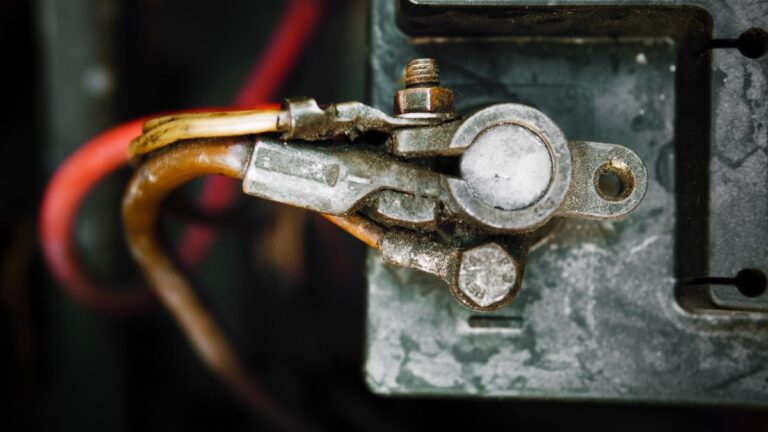
Finally, adhere strictly to International Electrotechnical Commission (IEC) standards for your wiring, breakers, and grounding protocols. Perform bi-annual torque checks on all battery terminals and busbars. Loose connections cause electrical arcing, which is the leading cause of off-grid equipment failure. Proper maintenance guarantees long-term inverter reliability.
The Real Path to Off-Grid Freedom
The appeal of free energy generators is entirely understandable. The idea of buying a single machine that quietly powers your home forever, completely divorced from the laws of nature, is incredibly attractive. However, investing your time, money, and hope into overunity devices is a dangerous mistake that will leave you vulnerable.
Scammers target the off-grid community because they know we value independence above all else. Do not let your desire for self-reliance blind you to verifiable science. Permanent magnets will never power your home. Thermodynamics cannot be cheated by clever geometry or YouTube conspiracy theories.
The genuine path forward relies on physics-compliant engineering. By investing in Tier-1 solar panels, advanced LiFePO4 battery storage, MPPT charge controllers, and robust hybrid redundancy, you can build an off-grid system that provides complete electrical autonomy.
Sustainable energy independence is not a secret hidden by governments; it is a mathematical certainty available to anyone willing to embrace proven technology. Build your system correctly, trust the physics, and you will secure your homestead’s power for generations.
Ready to Build Your Own Off-Grid Power System?
The number one reason DIY magnetic generators fail isn’t the physics—it is a lack of precision tools. Don’t drill a single hole or twist a single wire until your workspace is set up like a professional energy lab. Grab our free 17-page blueprint covering the exact tools, safety gear, and air-gap instruments you need to succeed on your first try. (PDF format, No email needed)