
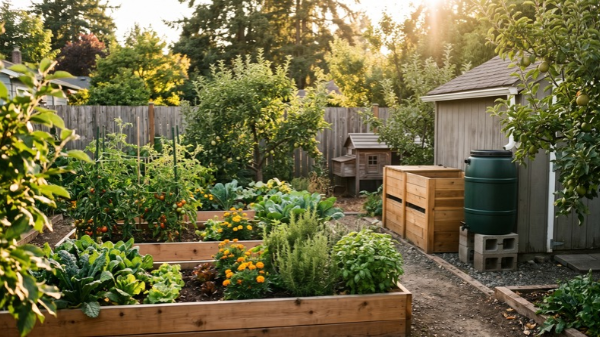
Rising grocery bills and unpredictable utility costs have pushed many homeowners to look at their own yards differently. Yet most beginners burn out trying to overhaul an entire property in one spring. Building a self-sufficient backyard does not require acres of farmland, expensive machinery, or exhausting labor.
With smart planning, even a standard suburban lot or patio can supply meaningful harvests, lower water use, and reduce household waste. This guide walks through the core systems—soil, water, crops, pest control, preservation, and small-scale livestock—before offering an honest review of Ron and Johanna Melchiore’s popular manual, The Self-Sufficient Backyard.
Disclosure: This article contains an affiliate link to The Self-Sufficient Backyard. If you purchase through our link, Green Life Zen may earn a small commission at no extra cost to you.
Key Takeaways
- Start with one system at a time: Most beginners succeed by mastering soil health and a single raised or straw-bale bed in Year 1 before adding rainwater barrels, composting, or chickens.
- Match crops to your climate and space: Using your USDA Plant Hardiness Zone and succession planting multiplies yields far more reliably than expanding garden square footage.
- Respect realistic limits: A suburban yard can meaningfully offset produce and herb costs, though total grocery independence depends heavily on local climate, lot size, and weekly maintenance time.
- Check local ordinances first: City zoning codes, HOA bylaws, rainwater harvesting rules, and livestock limits should always be verified before building structures or buying hens.
- Use structured blueprints wisely: The Self-Sufficient Backyard by Ron and Johanna Melchiore offers a helpful, illustrated starting reference for beginners, though experienced homesteaders will find several chapters introductory.
What a Self-Sufficient Backyard Actually Looks Like
A self-sufficient backyard is a residential outdoor space intentionally organized to produce food, recycle organic waste, conserve water, and—where practical—supplement household energy or preservation needs. Rather than operating as disconnected hobbies, each element supports the next: kitchen scraps feed compost bins, compost enriches raised beds, roof runoff fills rain barrels, and herbs attract pollinators that boost vegetable yields.
Most beginners find that expecting to eliminate grocery trips overnight leads to frustration. Depending on your region, growing season, and available sunlight, a productive backyard typically offsets 15% to 40% of a household’s fresh produce and culinary herb budget during peak months. That steady reduction in bills—paired with fresher, nutrient-dense food—is where real, sustainable value lives.
Step 1: Assess Your Space, Sunlight, and Soil Health
Before buying seeds or lumber, spend one week observing your yard. Most fruiting vegetables—such as tomatoes, peppers, squash, and bush beans—require 6 to 8 hours of direct sunlight daily. Leafy greens like lettuce, spinach, and kale tolerate partial shade of 4 to 6 hours.
Run a Free Mason Jar Soil Test
A common mistake is buying bags of fertilizer or soil amendments without knowing what your native soil lacks. Soil texture is defined by the ratio of three mineral particles: sand (large particles that drain quickly), silt (medium particles that hold moisture), and clay (tiny particles that retain nutrients but compact easily).
You can measure your soil texture in five minutes:
- Dig 4 to 6 inches below the turf and fill a clean quart mason jar halfway with soil, removing rocks and roots.
- Fill the jar nearly to the top with water, add one drop of dish soap to separate particles, seal the lid, and shake for one minute.
- Set the jar on a flat counter. Mark the bottom sand layer after 1 minute, the middle silt layer after 2 hours, and the top clay layer after 24 hours.
The ideal garden soil—called loam—sits near 40% sand, 40% silt, and 20% clay. If your jar shows heavy clay or mostly sand, you do not need to replace all your dirt. Mixing 2 to 4 inches of finished compost into the top layer improves drainage in clay and boosts moisture retention in sandy soil.
Choose Back-Friendly Growing Beds
Traditional in-ground tilling strains the lower back and brings dormant weed seeds to the surface. Two low-strain alternatives work especially well for smaller yards and older gardeners:
- Raised beds (18 to 24 inches tall): Warm up faster in spring, allow complete soil control, and reduce bending.
- Straw bale gardening: Planting directly into conditioned wheat or oat straw bales (never weed-heavy hay) creates a waist-high, fully compostable planter that breaks down into garden mulch by autumn.
Step 2: Plan High-Yield Crops and Succession Planting
Growing food efficiently on a small footprint requires choosing crops that match your local frost dates and produce heavily per square foot. Always start by checking your location on the USDA Plant Hardiness Zone Map to confirm which perennials survive your winters and when to transplant warm-season crops.
High-Return Crops for Small Yards
If space is tight, skip sprawling, low-value crops like sweet corn or giant pumpkins. Focus instead on high-output staples and survival foods you can grow at home:
- Vertical growers: Pole beans, snap peas, vining cucumbers, and indeterminate tomatoes trained up trellises use vertical airspace instead of wide beds.
- Cut-and-come-again greens: Loose-leaf lettuce, Swiss chard, and kale regrow continuously when you harvest outer leaves rather than pulling the whole plant.
- Perennial herbs and compact fruit: Rosemary, thyme, oregano, mint (kept in containers so it does not spread), and dwarf fruit trees in rolling patio pots return year after year with minimal labor.
Use Succession Planting to Extend Harvests
Succession planting means sowing small batches of fast-maturing crops every 2 to 3 weeks—or immediately replacing a harvested spring crop with a summer or fall crop. For example, once spring radishes and spinach finish in late May, you can plant bush beans in the exact same square footage, followed by fall turnips or garlic in early autumn. This simple timing shift can double the output of a modest 4×8-foot raised bed.
Step 3: Build Closed-Loop Composting and Water Conservation
Fertility and water are the two ongoing costs of any garden. Closing both loops keeps your backyard productive without constant trips to the garden center.
Backyard Composting Ratios Made Simple
Healthy aerobic composting relies on balancing carbon-rich “browns” (dried leaves, shredded cardboard, straw) with nitrogen-rich “greens” (vegetable peels, coffee grounds, fresh grass clippings). According to the U.S. EPA Composting at Home Guide, maintaining roughly 2 to 3 parts browns to 1 part greens by volume—an ideal carbon-to-nitrogen ratio near 25:1 to 30:1—prevents foul odors and speeds decomposition. Keep the pile as damp as a wrung-out sponge and turn it every 1 to 2 weeks for finished compost in 3 to 6 months.
Rainwater Catchment and Drip Irrigation
A 1,000-square-foot roof sheds roughly 600 gallons of rainwater during a single 1-inch rainfall. Routing one downspout through a diverter into a food-grade 50-gallon barrel placed on level cinder blocks provides soft, chlorine-free irrigation water at zero utility cost. Always secure a fine mesh screen over the top opening to block mosquitoes and leaf debris.
Pairing rain barrels or an outdoor spigot with a drip irrigation line and simple battery timer cuts water evaporation by up to 50% compared to overhead sprinklers. Because drip emitters deliver water directly to the root zone, foliage stays dry—significantly lowering the risk of powdery mildew and blight. These simple habits pair naturally with broader practical green living habits and methods to minimize your household carbon footprint.
Step 4: Manage Pests Naturally and Preserve Your Harvest
Integrated Pest Management (IPM)
Rather than reaching immediately for broad-spectrum sprays that harm pollinators, follow Integrated Pest Management (IPM)—a tiered strategy recommended by the University of California Statewide IPM Program. Start with physical barriers (floating row covers over squash and brassicas), hand-pick visible beetles or hornworms early in the morning, and plant flowering herbs like dill, yarrow, and sweet alyssum to attract ladybugs and parasitic wasps.
Pay attention to companion planting, too. Avoid placing heavy feeders from the same plant family side by side: cabbage and cauliflower compete for identical nutrients and attract the same cabbage moths, while tomatoes and potatoes belong to the nightshade family and easily spread blight to one another.
Safe Food Preservation Basics
Growing a bumper crop only saves money if you preserve what you cannot eat fresh. Match your preservation method to the food’s acidity:
- Freezing and dehydrating: Lowest barrier to entry for herbs, berries, peppers, and blanched green beans.
- Water-bath canning: Safe exclusively for high-acid foods (pH 4.6 or lower), such as jams, pickles, and properly acidified tomatoes.
- Pressure canning: Mandatory for low-acid vegetables (green beans, carrots, corn) and meats to eliminate the risk of Clostridium botulinum. Always follow tested recipes and altitude adjustments from the USDA National Center for Home Food Preservation.
Step 5: Small-Scale Livestock and Off-Grid Upgrades
Once your garden beds and water systems run smoothly, some homeowners add backyard laying hens or backup power. A small flock of 3 to 4 laying hens typically provides 15 to 24 fresh eggs per week during peak laying seasons, turns kitchen scraps into fertilizer, and requires about 10 to 15 minutes of daily care plus 30 minutes of weekly coop cleaning. However, feed costs, predator-proof housing, and winter light drops mean backyard eggs rarely beat supermarket prices on cost alone—their main advantages are freshness, food security, and nutrient-rich manure.
Similarly, off-grid energy upgrades—such as small solar battery stations for greenhouse fans, water pumps, or freezer backup—work best when sized realistically for critical loads rather than trying to power an entire central HVAC system. If you are already exploring residential solar, review our guide on expanding a home solar power system before purchasing standalone components.
Backyard Self-Sufficiency Planning Table
Use this zone-by-zone planning table to phase projects over your first 12 to 18 months without getting overwhelmed.
| Backyard Zone | Core Projects | Minimum Space Needed | Est. Weekly Maintenance | Best Starting Season |
|---|---|---|---|---|
| Zone 1: Kitchen & Patio | Windowsill culinary herbs, rolling dwarf fruit trees, sprouting | 4–20 sq. ft. (sunny sill or porch) | 20–30 minutes | Year-round |
| Zone 2: Main Food Beds | Raised beds or straw bale gardens, trellised veggies, drip lines | 32–150 sq. ft. | 1.5–3 hours | Early Spring or Early Fall |
| Zone 3: Soil & Water Hub | Two-bin compost station, 50-gallon rainwater barrel with diverter | 25–40 sq. ft. | 20–30 minutes | Spring or Autumn |
| Zone 4: Small Livestock | Predator-proof mini coop + secure run for 3–4 laying hens | 40–60 sq. ft. total | 1.5–2 hours | Spring (chicks) or Fall (pullets) |
| Zone 5: Season Extension | Cold frames, hoop tunnels, or compact backyard greenhouse | 30–100 sq. ft. | 30–45 minutes | Late Summer / Early Fall |
Safety, Zoning, and Legal Compliance Note
Before installing permanent structures or adding animals, confirm four local rules:
- Zoning and HOA covenants: Many homeowner associations restrict front-yard vegetable beds, greenhouses, or visible compost bins.
- Livestock ordinances: Cities frequently cap hen counts (commonly 3 to 6 birds), prohibit roosters, and enforce minimum coop setbacks from property lines.
- Rainwater harvesting laws: While legal in almost all U.S. states, a few Western states (such as Colorado and Utah) regulate total barrel storage volume or require registration.
- Electrical and preservation safety: Any grid-tied or household electrical wiring should follow local building codes and licensed electrician oversight, and home canning must strictly follow tested USDA guidelines.
Honest Review: The Self-Sufficient Backyard by Ron and Johanna Melchiore
If you prefer having diagrams, measurements, and step-by-step project lists organized in one place instead of stitching together dozens of scattered videos, The Self-Sufficient Backyard: For The Independent Homesteader is one of the most widely discussed manuals in this space.
Who Wrote It and What Is Inside
Authors Ron and Johanna Melchiore have lived off the grid since the late 1970s—over 40 years of hands-on homesteading experience in northern Canada. Their 266-page guide (available in digital PDF and printed formats) is structured around maximizing a quarter-acre lot while offering downsized options for smaller yards and apartments.
Core projects covered inside include:
- Small-space food production: Quarter-acre layout sketches, straw bale gardening, companion planting charts (“which plants should never be planted together”), dwarf fruit trees, and a 12-month planting calendar.
- Water and soil independence: The DIY Mason Jar Soil Test, a low-cost rainwater catchment system, automatic irrigation concepts, and off-grid hot water setups.
- Preservation and shelter: Off-the-grid earth refrigeration, root cellaring, and a year-round self-sustaining greenhouse design.
- Livestock and energy: Mini chicken coop secrets, windowsill medicinal herb gardens, and an introduction to backyard hybrid electricity systems.
The current package includes three digital bonus guides (The Aquaponic Gardener, DIY Projects from the 1900s, and Where Free Land Can Still Be Found in the US) and is backed by a 60-day money-back guarantee.
Real Pros and Honest Limitations
What works well:
- Beginner-friendly visual layout: Clear sketches and plain-English steps make intimidating topics—like rain barrels, soil testing, and straw bale beds—approachable in a single weekend.
- Broad all-in-one reference: Having food, water, preservation, and basic power ideas under one cover saves hours of fragmented online searching.
- Low-effort options for smaller lots: Projects like windowsill herbs, container fruit trees, and straw bale beds adapt smoothly for suburban homeowners and adults 55+.
What to watch out for:
- Dramatic sales-page marketing: The official sales page uses aggressive, urgency-heavy headlines that feel much louder than the calm, practical tone of the actual book.
- Broad overview rather than deep engineering: Because it covers 75+ to 100+ projects in one volume, experienced homesteaders or DIY electricians will still need specialized local manuals for complex solar wiring or full-scale construction.
- Regional adjustments required: Techniques developed in Saskatchewan’s cold climate work wonderfully for winter growing, but readers in hot, humid Southern zones will need to adjust planting dates and shade protection.
Bottom line: If you are a veteran homesteader looking for advanced electrical schematics, skip this book. If you are a beginner or suburban gardener who wants a clear, illustrated blueprint to start tackling practical backyard projects one weekend at a time, it is a solid, low-risk reference.
Frequently Asked Questions
How do I start a self-sufficient backyard on a quarter acre?
Start by mapping sunlight patterns and running a simple mason jar soil test before building anything. In your first season, install one or two raised beds or straw bale planters, add a basic compost bin, and grow high-yield vegetables suited to your USDA Hardiness Zone. Expand into rainwater collection and preservation in year two.
Can you build a self-sufficient backyard in an urban neighborhood?
Yes, urban and suburban yards can produce a substantial share of a household’s herbs, salad greens, tomatoes, and berries. Focus on vertical trellises, rolling container fruit trees, windowsill herb gardens, and enclosed tumbler composters that stay tidy and odor-free. Always verify local HOA rules and municipal ordinances before adding rain barrels or chickens.
How much time does backyard homesteading take per week?
A starter setup with two raised beds, a compost bin, and simple drip irrigation typically requires 2 to 4 hours per week during the main growing season. Adding a small flock of laying hens or a greenhouse increases weekly upkeep by another 1.5 to 2.5 hours. Automating watering is the fastest way to keep maintenance manageable.
What is the best carbon-to-nitrogen ratio for backyard compost?
The ideal carbon-to-nitrogen ratio for fast, odor-free backyard composting is roughly 25:1 to 30:1. In practical terms, aim for two to three buckets of carbon-rich “browns” (dry leaves, straw, or shredded cardboard) for every one bucket of nitrogen-rich “greens” (kitchen scraps or fresh grass clippings), keeping the pile evenly moist and turning it regularly.
Is rainwater harvesting legal for backyard gardens?
Rainwater harvesting for garden irrigation is legal across the vast majority of the United States and actively encouraged by many municipalities through barrel rebates. However, a small number of Western states—including Colorado and Utah—enforce limits on total storage capacity or require simple registration, so always check your state and city water department rules first.
Is The Self-Sufficient Backyard book worth it for beginners?
For beginners who want an organized, illustrated blueprint covering soil tests, straw bale beds, rainwater collection, food preservation, and small-yard layouts in one place, The Self-Sufficient Backyard offers strong practical value backed by a 60-day refund policy. Experienced homesteaders seeking advanced electrical or construction blueprints will likely find several chapters too introductory.
Conclusion: Take One Practical Step This Weekend
Creating a self-sufficient backyard is not about perfection or unplugging from modern life overnight. It is about building quiet, practical resilience—one soil test, one raised bed, and one rain barrel at a time. Start with the single project that fits your space and energy this weekend, and let each small harvest fund and inspire the next upgrade.
If you want Ron and Johanna Melchiore’s full illustrated blueprint, quarter-acre layouts, and step-by-step project checklists in one organized manual, you can review the current package details and bonuses directly here: Explore The Self-Sufficient Backyard Guide.