Imagine waking up on a brisk morning, flipping the switch for your coffee maker, and being greeted by nothing but a dead silence. Your solar panels produced plenty of electricity yesterday, but without a reliable way to store it, that energy vanished with the sunset. This is the harsh reality of off-grid living when your energy storage falls short. Choosing the right battery bank for solar isn’t just about buying the most expensive gear; it’s about ensuring true energy independence, avoiding dark, cold nights, and protecting your long-term investment.
After years of designing and maintaining off-grid solar systems—navigating everything from relentless tropical heat to multi-day winter storms—I’ve learned that your battery bank is the true heart of your system. In this comprehensive guide, we will break down exactly how an off-grid solar battery bank works, which battery chemistry suits your needs, how to perfectly size a solar energy storage system, and how to maintain it for the long haul.
What Is a Solar Battery Bank and How Does It Work
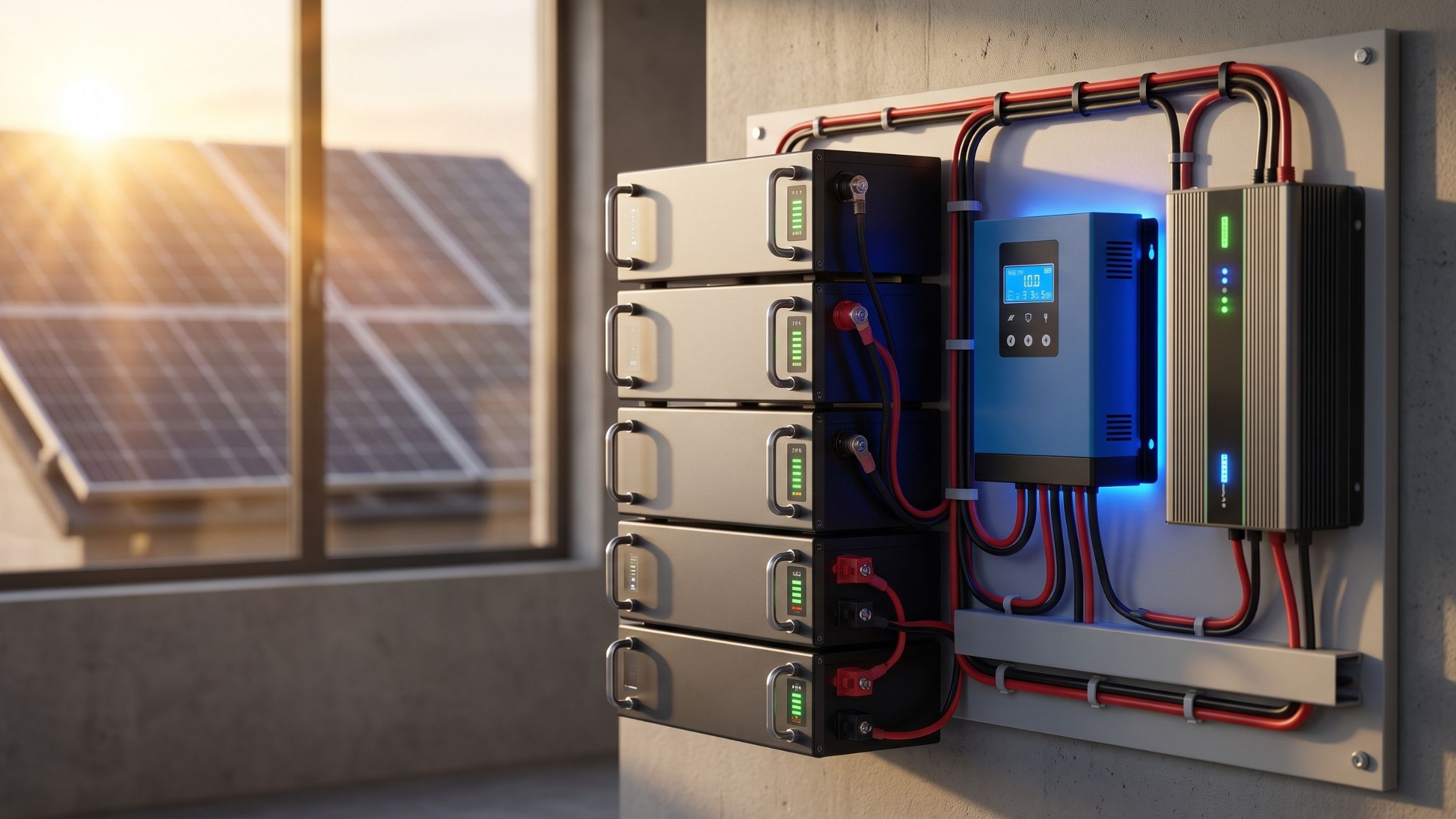
At its core, a solar battery bank is a collection of interconnected batteries designed to capture and store the direct current (DC) electricity generated by your solar panels. Because the sun isn’t always shining, solar panels alone cannot provide a consistent power supply. Your battery bank acts as an energy reservoir, storing the excess power generated during peak sunlight hours so you can draw from it at night or during cloudy days.
Here is the simple, real-world flow of a solar energy storage system:
- Generation: Your solar panels absorb sunlight and convert it into DC electricity.
- Regulation: The electricity flows into a charge controller, which regulates the voltage and current to safely charge the batteries without overcharging them.
- Storage: The regulated DC electricity is stored in your solar battery bank.
- Inversion: When you turn on an AC appliance (like a refrigerator or TV), an inverter pulls the DC power from the battery bank, converts it into alternating current (AC) power, and delivers it to your home.
Without a well-designed battery bank, an off-grid solar setup simply cannot function. The key to a successful system lies in selecting the right battery chemistry, configuring it correctly, and sizing it to match your household’s daily energy consumption.
Types of Batteries for Solar Storage
When searching for the best batteries for solar panels, you will quickly encounter a barrage of acronyms and chemical names. Not all batteries are created equal. Let’s explore the primary options available today, comparing their pros, cons, costs, lifespans, and maintenance requirements so you can make an educated choice.
1. Lead-Acid Batteries
Lead-acid chemistry has been the backbone of off-grid solar for decades. They are heavy, bulky, but incredibly reliable if maintained properly. They are generally categorized into Flooded Lead-Acid (FLA) and Sealed Lead-Acid (VRLA), which includes AGM and Gel.
Flooded Lead-Acid (FLA)
FLA batteries contain a liquid electrolyte solution of sulfuric acid and water.
- Pros: They are the most cost-effective upfront option. When well-maintained, they can withstand severe deep cycling.
- Cons: They require strict monthly maintenance, including checking water levels and adding distilled water. They also off-gas hydrogen while charging, meaning they must be housed in a highly ventilated enclosure.
- Depth of Discharge (DoD): Should not be discharged below 50% to maintain lifespan.
- Lifespan: 3 to 7 years (approx. 500-1,000 charge cycles).
Absorbent Glass Mat (AGM)
AGM batteries suspend the electrolyte in a fiberglass mat, making them spill-proof.
- Pros: Maintenance-free (no watering required). They handle cold temperatures better than FLA and charge faster.
- Cons: More expensive than FLA. They are highly sensitive to overcharging, which can permanently ruin them.
- DoD: Recommended 50% max.
- Lifespan: 4 to 8 years.
Gel Batteries
Gel batteries use silica to turn the electrolyte into a thick paste.
- Pros: Completely maintenance-free, excel in extreme heat, and discharge at a very slow rate.
- Cons: They have very specific, narrow charging profiles. Using the wrong charge controller setting will destroy them.
- DoD: Recommended 50% max.
- Lifespan: 5 to 10 years.
2. Lithium-Ion (Specifically LiFePO4)
For modern off-grid solar systems, Lithium Iron Phosphate (LiFePO4) has become the gold standard. In my own off-grid cabin, switching from a massive bank of flooded lead-acid batteries to a compact LiFePO4 system was a game-changer.
- Pros: Exceptional energy density (they weigh a fraction of lead-acid). They offer a massive usable capacity because their Depth of Discharge (DoD) can safely reach 80% to 100% without damaging the battery. They are completely maintenance-free, don’t off-gas, and have a built-in Battery Management System (BMS) to protect against overcharging or short-circuiting.
- Cons: The initial upfront cost is significantly higher than lead-acid. They also cannot be charged in sub-freezing temperatures unless they feature built-in heating elements.
- DoD: 80% to 100%.
- Lifespan: 10 to 15+ years (often exceeding 3,000 to 6,000 charge cycles).
3. Emerging Technologies: Solid-State and Sodium-Ion
While LiFePO4 is the current king, sodium-ion and solid-state batteries are making waves. Sodium-ion batteries promise to be cheaper than lithium and safer (lower fire risk), though their energy density is currently lower. These are worth watching for future system upgrades, though they aren’t quite ready to dominate the residential off-grid market just yet.
Related Article: Discover 3 Best Batteries For An Off-Grid Energy System
How to Size Your Solar Battery Bank
Learning how to size a solar battery bank is the most critical step in your off-grid journey. If you undersize it, you’ll lose power at night. If you oversize it, your solar panels might not generate enough power to fully charge the bank, leading to chronic undercharging and premature battery death (especially with lead-acid).
Follow this step-by-step sizing process:
Step 1: Calculate Your Daily Energy Consumption
You need to know exactly how much power you use in a 24-hour period. List every electrical device you plan to run. Multiply the wattage of each appliance by the hours it will run daily.
- Example: A 60W laptop run for 4 hours = 240 Watt-hours (Wh). A 100W TV run for 3 hours = 300 Wh.
- Let’s say your total daily consumption comes out to 3,000 Wh (or 3 kWh).
Step 2: Account for Days of Autonomy
“Days of autonomy” refers to how many days your battery bank can power your home without any solar input (e.g., during consecutive cloudy days). For most residential off-grid systems, 2 to 3 days is standard.
- Calculation: 3,000 Wh x 2 days = 6,000 Wh total required storage.
Step 3: Factor in Depth of Discharge (DoD)
Because you cannot safely drain a battery to 0% (especially lead-acid), you must oversize the bank to account for the DoD limit.
- If you are using Lead-Acid (50% DoD): You must double your capacity. (6,000 Wh / 0.5 = 12,000 Wh).
- If you are using LiFePO4 (80% DoD): You only slightly increase it. (6,000 Wh / 0.8 = 7,500 Wh).
Step 4: Convert to Amp-Hours (Ah)
Batteries are usually rated in Amp-hours (Ah) rather than Watt-hours. To find the required Ah, divide your total Watt-hours by your system’s battery voltage (typically 12V, 24V, or 48V).
- Assuming a 24V LiFePO4 system: 7,500 Wh / 24V = 312.5 Ah.
You would need a 24V battery bank with roughly 315 Ah of capacity.
(Pro Tip: For a deeper dive into optimizing the other side of this equation, check out our guide on solar panel sizing to ensure your array can adequately charge your new bank).
Series vs. Parallel Battery Configurations
Once you have purchased your batteries, you need to wire them together. Understanding the difference between series and parallel configurations is vital for building a safe and effective solar energy storage system.
Wiring in Series
Wiring batteries in series increases the total voltage of the battery bank while keeping the Amp-hour (Ah) capacity the same. You connect the positive terminal of the first battery to the negative terminal of the second battery.
- Example: Connecting two 12V 100Ah batteries in series creates a 24V 100Ah battery bank.
- When to use it: Series configurations are highly recommended for medium to large off-grid systems. Higher voltage systems (24V or 48V) allow you to use thinner, less expensive wiring and reduce energy loss over long cable runs. It also makes your charge controllers operate much more efficiently.
Wiring in Parallel
Wiring in parallel increases the total Amp-hour (Ah) capacity of the bank while keeping the voltage the same. You connect the positive terminal of battery one to the positive of battery two, and the negative to the negative.
- Example: Connecting two 12V 100Ah batteries in parallel creates a 12V 200Ah battery bank.
- When to use it: Parallel wiring is common in small 12V systems, like RVs or camper vans, where you are using 12V DC appliances directly. However, stringing too many batteries in parallel can cause unequal charging/discharging across the bank, leading to premature battery degradation.
(Note: Many large off-grid systems use a combination—wiring strings of batteries in series to achieve 48V, and then wiring those strings in parallel to boost the Ah capacity).
Related Article: Builders Boost Profit With Solar – Choose The Right System Size Using Calculators
Top Solar Charger and Battery Products to Consider
Disclosure: We are participant in the Amazon Services LLC Associates Program, an affiliate advertising program designed to provide a means for sites to earn advertising fees by advertising and linking to Amazon.com.
While massive, stationary battery banks are crucial for off-grid cabins, true energy independence often requires mobility. Portable solar battery banks (power stations) paired with efficient folding solar panels are essential for keeping communication gear, laptops, and emergency equipment running.
Based on hands-on testing, here are three standout portable solar charging solutions that can act as supplementary mini off-grid setups:
1. Goal Zero Nomad 100

If you need a robust, large-capacity solar charger to keep a portable lithium power station topped up, the Nomad 100 is an industry heavyweight.
- Specs: 100 Watts, monocrystalline cells, foldable, weighs 10.2 lbs.
- Pros: Extremely durable weather-resistant build; features built-in MC4 or 8mm connections allowing you to chain multiple panels together; highly efficient even in partial shade.
- Cons: At over 10 pounds, it’s quite heavy for backpacking; premium price tag.
- Ideal Use Case: Pairing with a mid-sized portable battery bank (like a Yeti 500X) at a semi-permanent off-grid basecamp or in an RV.
2. Ryno-Tuff 21W

For the ultra-mobile off-gridder who needs a lightweight trickle charger to keep small battery banks alive in the backcountry, the Ryno-Tuff 21W is an incredibly rugged option.
- Specs: 21 Watts, dual USB ports, weighs 1.1 lbs, PVC canvas construction.
- Pros: Practically indestructible design; incredibly lightweight and folds down to the size of a magazine; includes a lifetime warranty.
- Cons: 21W is strictly for small electronics (phones, headlamps, 10,000mAh USB power banks); lacks DC output for larger battery stations.
- Ideal Use Case: Backpackers, hikers, or as an emergency bug-out bag component to ensure you can always charge small USB battery banks.
3. Anker 625 Solar Panel
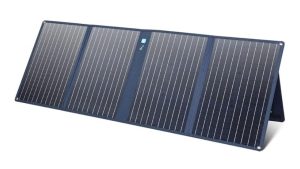
Anker has long dominated the portable battery market, and the Anker 625 is designed specifically to interface with their heavy-duty portable solar energy storage systems (like the Anker PowerHouse series).
- Specs: 100 Watts, high-efficiency cells (up to 23%), XT60 and USB-C outputs, weighs 11 lbs.
- Pros: Features a brilliant built-in sun-alignment tool (a small dot that casts a shadow on a target) to ensure you are getting the optimal angle to the sun; excellent conversion efficiency.
- Cons: Slightly bulky form factor when folded; relies on proprietary barrel connectors for some outputs, which can limit compatibility if you aren’t using an Anker battery bank.
- Ideal Use Case: Emergency home backup, car camping, and pairing with premium portable lithium power stations.
Maintenance Best Practices
A battery bank for solar is a massive financial investment. If you treat it right, it will serve you for over a decade. If you neglect it, you could be buying a new one in two years. Here is a practical maintenance routine based on real off-grid system management:
Quarterly Maintenance Checklist:
- Visual Inspection: Check all battery casings for bulging, cracking, or leaks. Inspect battery terminals for corrosion (a white, powdery buildup).
- Clean Terminals: If you spot corrosion, disconnect the batteries and clean the terminals using a mixture of baking soda and distilled water. Use a wire brush, wipe clean, and dry thoroughly.
- Torque Check: Battery cables can loosen over time due to temperature fluctuations. Use a torque wrench to ensure all terminal nuts are tightened to the manufacturer’s specifications. A loose connection causes resistance, which generates heat and can lead to a fire.
- Water Levels (FLA only): Check the electrolyte levels in flooded lead-acid batteries. If the plates are exposed, add only distilled water (never tap water) until the plates are submerged.
- Check State of Charge (SoC): Review your system monitor to ensure the batteries are regularly reaching a 100% full charge. Chronic undercharging (deficit cycling) leads to sulfation in lead-acid batteries.
Lifespan Extension Tips:
- Keep your batteries in a temperature-controlled environment. Extreme heat accelerates chemical degradation, while extreme cold drastically reduces capacity. Ideally, keep them between 50°F and 75°F (10°C to 24°C).
- Invest in a high-quality battery monitor (like a Victron BMV-712) equipped with a shunt. This acts as a “fuel gauge” for your battery bank, allowing you to accurately track your depth of discharge and avoid draining them too far.
Frequently Asked Questions
What is the lifespan of a solar battery bank?
The lifespan heavily depends on the battery chemistry and how well it is maintained. Lead-acid batteries typically last 3 to 7 years, assuming they are not frequently discharged below 50%. High-quality Lithium Iron Phosphate (LiFePO4) batteries can easily last 10 to 15 years, offering over 4,000 deep discharge cycles.
Can I use a solar battery bank for grid-tied systems?
Yes. While this article focuses on off-grid living, you can install a battery bank on a grid-tied system (often called a hybrid solar system). In this setup, the batteries provide backup power during grid outages and allow you to use your stored solar power during expensive peak utility hours to save money.
Is it possible to expand the capacity of a battery bank in the future?
With lithium batteries (LiFePO4), you generally have a wider window to add parallel batteries to expand capacity later on. However, with lead-acid batteries, it is highly discouraged to mix old batteries with new ones. The older batteries will drag the performance of the new batteries down to their degraded level. If expanding a lead-acid bank, it should be done within the first 6 months of the original purchase.
How often should I perform maintenance on my solar battery bank?
For maintenance-free batteries (AGM, Gel, Lithium), a visual and torque inspection every 3 to 6 months is sufficient. For flooded lead-acid (FLA) batteries, you must check water levels and perform equalization charges at least once a month.
Can I use different types of batteries in the same battery bank?
Absolutely not. You must never mix different battery chemistries (e.g., AGM with Lithium), different capacities (e.g., 100Ah with 200Ah), or even different brands/ages within the same battery bank. Doing so will result in severe charging imbalances, dramatically reduced lifespans, and poses a significant safety hazard.
Conclusion
Building the ideal battery bank for solar is one of the most rewarding steps toward total energy independence. By understanding the fundamentals of energy storage, choosing the right battery chemistry for your budget, carefully sizing your system for your daily needs, and implementing a strict maintenance routine, you can create a reliable power hub that will run your off-grid life seamlessly for years to come.
Whether you are designing a massive 48V LiFePO4 system for a remote cabin or pairing a Goal Zero Nomad 100 with a portable lithium station for a mobile adventure, proper planning is the ultimate key to success. Don’t rush the math, and never cut corners on your battery bank.