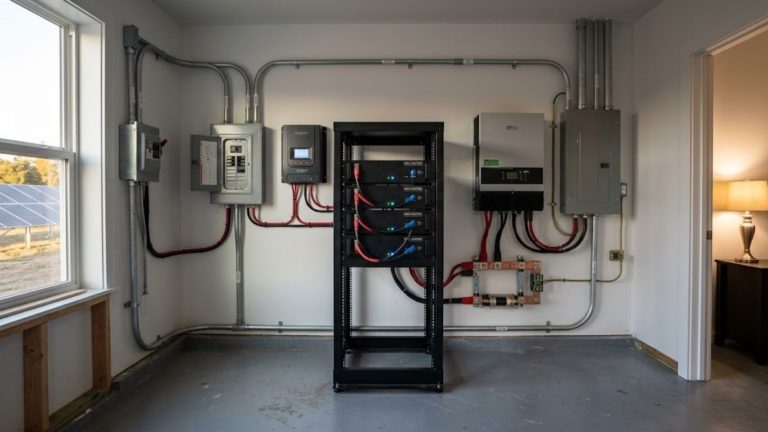

Navigating the sheer volume of power storage options available online can be a daunting task. If you are building an off-grid solar system, upgrading a recreational vehicle, or outfitting a marine vessel, finding a reliable LiFePO4 battery offers is a critical step toward true energy independence. In recent years, Amazon has become the primary marketplace for energy storage, presenting consumers with a vast array of choices ranging from premium, industry-leading brands to cheap, unverified knock-offs.
But what exactly are LiFePO4 batteries, and why do they matter so much in modern power engineering?
In my years of auditing off-grid systems and evaluating lithium battery arrays, I have seen firsthand the consequences of purchasing the wrong battery pack. In this comprehensive guide, you will learn the underlying chemistry of lithium iron phosphate, how it outperforms legacy technologies, and what critical specifications to scrutinize. Whether you are searching for a robust 12V LiFePO4 battery for a van build or a high-capacity 48V bank for home solar, this guide will equip you with the technical expertise to separate authentic engineering from clever marketing.
Understanding LiFePO4 Chemistry: Why It Reigns Supreme
Before clicking “Add to Cart” on any LiFePO4 battery listing, it is vital to understand the physics of what you are buying. LiFePO4 stands for Lithium Iron Phosphate, a specific and highly stable subset of lithium battery technology.
When DIYers search for power storage, one of the most common queries is LiFePO4 vs lithium ion. While LiFePO4 is technically a type of lithium-ion battery, its internal chemistry differs vastly from the standard lithium-cobalt-oxide (LiCoO2) or Nickel-Manganese-Cobalt (NMC) batteries found in smartphones, laptops, and most electric vehicles.
Here are the technical advantages that make LiFePO4 the gold standard for off-grid and deep-cycle applications:
1. Exceptional Thermal Stability and Safety
The most significant difference between LiFePO4 and NMC chemistries is the strength of the covalent bond between the phosphorus and oxygen atoms (the P-O bond) in the cathode. In NMC batteries, excessive heat or internal short circuits can cause the cathode to break down and release pure oxygen, fueling an uncontrollable thermal runaway fire.
LiFePO4 chemistry is vastly more stable. The P-O bond will not break down and release oxygen until temperatures exceed 500°F (270°C). This makes the lithium iron phosphate battery virtually immune to catastrophic thermal runaway under normal fault conditions, making it incredibly safe for indoor residential and RV installations. (For deeper insights on this, review the IEEE publications on lithium iron phosphate thermal runaway).
2. Massive Cycle Life
Lead-acid batteries typically degrade after 300 to 500 charge cycles, especially if discharged below 50% of their total capacity. In stark contrast, a high-quality deep cycle LiFePO4 battery will routinely deliver 2,000 to 5,000+ charge cycles at an 80% to 100% Depth of Discharge (DoD) before its total capacity degrades to 80% of its original rating. In real-world terms, if you cycle the battery once a day, it will last 10 to 15 years.
3. Consistent Voltage and Energy Density
Lead-acid batteries suffer from severe voltage sag under heavy load (a phenomenon known as Peukert’s Law). LiFePO4 batteries maintain a flat voltage curve, delivering consistent, high-voltage power until the battery is nearly 100% depleted. While their energy density (typically 90–160 Wh/kg) is slightly lower than NMC batteries, it is more than double that of lead-acid, resulting in a battery that weighs roughly half as much as a comparable AGM pack.
4. Low Self-Discharge
When placed in storage, a LiFePO4 battery loses charge at an incredibly slow rate—averaging just 1% to 3% per month. This makes them ideal for seasonal vehicles like RVs and boats that sit dormant for half the year.
How to Choose the Best LiFePO4 Battery on Amazon
When evaluating a LiFePO4 battery page, the marketing bullet points can be overwhelming. To find the best LiFePO4 battery for your specific application, you must evaluate the following critical specifications.
Capacity (Ah) and Voltage Requirements
Your first step is sizing your battery bank properly. Capacity is measured in Amp-hours (Ah). A standard 12V LiFePO4 battery rated at 100Ah contains roughly 1,280 Watt-hours (Wh) of energy (12.8V x 100Ah = 1280Wh).
- 12V Systems: Best for small RVs, camper vans, and trolling motors where space is tight and loads are small.
- 24V Systems: Ideal for medium-sized solar setups and larger travel trailers.
- 48V Systems: Mandatory for off-grid homes and heavy industrial applications. Higher voltage drastically reduces the necessary wire thickness (amperage) and increases the efficiency of solar charge controllers and inverters.
The Role of the LiFePO4 Battery BMS
The brain of any lithium battery is the Battery Management System (BMS). A LiFePO4 battery BMS is an internal circuit board that constantly monitors the individual cells. Do not buy any LiFePO4 battery that lacks a comprehensive BMS.
A high-quality BMS must provide:
- Over-Voltage and Under-Voltage Protection: Prevents cells from charging above 3.65V or discharging below 2.5V, which causes permanent damage.
- Over-Current Protection: Automatically shuts down the battery if a short circuit or massive appliance surge draws too much current.
- Cell Balancing: Ensures all internal cells charge at the exact same rate, preventing premature wear.
- Low-Temperature Cutoff (Crucial Safety Note): Charging a LiFePO4 battery below freezing (32°F / 0°C) causes a phenomenon called lithium plating, which permanently destroys the battery and can cause internal short circuits. Your BMS must have a verified low-temperature charging cutoff sensor to block incoming current when it is freezing outside.
Industry Certifications
Look for rigorous, third-party testing certifications. A battery listing that proudly displays compliance with UL 1973 standards for energy storage indicates that the cells and the BMS have undergone severe stress testing for puncture, crush, and overcharge safety. Additional valid certifications include CE, RoHS, and UN38.3 (a mandatory standard for safe transport). See NREL (National Renewable Energy Laboratory) lithium battery safety guidelines for further reading on these standards.
Amazon Seller Credibility
Before purchasing a LiFePO4 battery Amazon recommends, check the seller’s storefront.
- Are they a dedicated energy storage manufacturer, or a shell company selling everything from spatulas to electronics?
- Check the battery weight in the specifications. A true 12V 100Ah LiFePO4 battery should weigh between 22 and 26 pounds. If the listing claims it weighs 12 pounds, they are lying about the capacity.
- Look for US-based customer service and warranty fulfillment; shipping a defective 50-pound battery back to an overseas factory will likely cost more than the battery itself.
Related Post: Best 12V MPPT Solar Charge Controller: Buyer’s Guide
Top LiFePO4 Battery Categories on Amazon
The sheer variety of batteries available means you need to buy a unit engineered for your exact use case.
1. Deep Cycle Batteries for Solar
A solar LiFePO4 battery is engineered for daily heavy cycling. These are typically large format (100Ah to 400Ah) and designed to be wired in large series/parallel strings to create massive 48V home battery banks. Look for brands that explicitly state their BMS supports connecting 4-to-16 batteries together.
2. RV and Camper Van Batteries
The ultimate deep cycle LiFePO4 for mobile living. These often feature built-in Bluetooth modules so you can check your battery’s state of charge (SoC) via a smartphone app. Many top-tier RV batteries now include internal heating pads that draw off incoming solar power to warm the cells above freezing before accepting a charge, allowing winter camping.
3. Marine and Trolling Motor Batteries
Marine environments require distinct engineering. The best LiFePO4 battery for a trolling motor must be IP65 (or IP67) water and dust resistant. Furthermore, the BMS must have a high continuous discharge rating to handle the sustained thrust required by heavy outboard electric motors without tripping the over-current protection.
4. Portable Power Station Batteries
Often sold as “drop-in replacements,” these are smaller (20Ah to 50Ah) LiFePO4 batteries designed to replace the heavy sealed lead-acid (SLA) batteries inside mobility scooters, fish finders, and portable emergency power boxes.
Comparison of Popular LiFePO4 Battery Types
| Battery Category | Typical Voltage | Typical Capacity | Best Real-World Use Case | Average Price Range on Amazon |
|---|---|---|---|---|
| Budget Solar / DIY | 12V | 100Ah | Entry-level camper vans, small shed lighting | $180 – $250 |
| Premium RV / Heated | 12V | 100Ah – 200Ah | Four-season RVs, off-grid mobile living | $300 – $700 |
| Marine Trolling | 24V or 36V | 50Ah – 100Ah | Bass boats, prolonged water excursions | $400 – $900 |
| Off-Grid Home Server Rack | 48V | 100Ah (5.1kWh) | Residential solar, severe weather backup | $1,000 – $1,500 |
Red Flags and Mistakes to Avoid When Shopping on Amazon
While Amazon offers incredible deals, the marketplace is also littered with deceptive listings. Avoid these common pitfalls to ensure your system remains reliable and safe.
1. Purchasing “Grade B” or Recycled Cells
Premium manufacturers use brand new “Grade A” lithium cells with matched internal resistance. Some ultra-cheap LiFePO4 battery listings utilize Grade B cells (which failed factory tolerance tests) or recycled cells salvaged from dead electric vehicles. These batteries will suffer from rapid cell imbalance and severely reduced lifespans. If the price seems impossibly low compared to the rest of the market, it is likely built with Grade B cells.
2. Ignoring the BMS Continuous Discharge Rating
A battery might hold 100Ah of energy, but its BMS dictates how fast you can extract it. If you buy a 100Ah battery with a weak 50A BMS, the maximum continuous power you can draw is 600 watts (12V x 50A = 600W). If you try to run a 1,200-watt microwave, the BMS will instantly shut the battery off. Always ensure the BMS continuous discharge rating matches your inverter’s maximum output.
3. Missing Low-Temp Cutoff
As mentioned in the safety section, charging frozen lithium is destructive. Do not trust generic listings that say “Cold Weather Safe” without explicitly stating the BMS has an automatic sub-freezing charge disconnect.
4. Violating Series and Parallel Limits
Many budget batteries use lower-tier Mosfets in their BMS that cannot handle high-voltage series connections. If you plan to wire four 12V batteries together to make a 48V system, you must read the fine print. Connecting batteries in series when the manufacturer explicitly forbids it will permanently fry the internal circuit board and void your warranty.
Related Post: Top 5 Solar Inverters — Which One Suits Your Home
5 Best LiFePO4 Batteries on Amazon
LiFePO4 batteries have become a top choice for off-grid enthusiasts, RV owners, and solar energy users. With countless options flooding the market, finding the right one can feel overwhelming. Amazon offers several standout models, each with distinct advantages worth examining closely. The five batteries highlighted here represent some of the most compelling choices available today, and what sets them apart may surprise even seasoned buyers.
1. 12V 300Ah (314Ah) Lithium LiFePO4 Battery With 200A BMS Dumfume
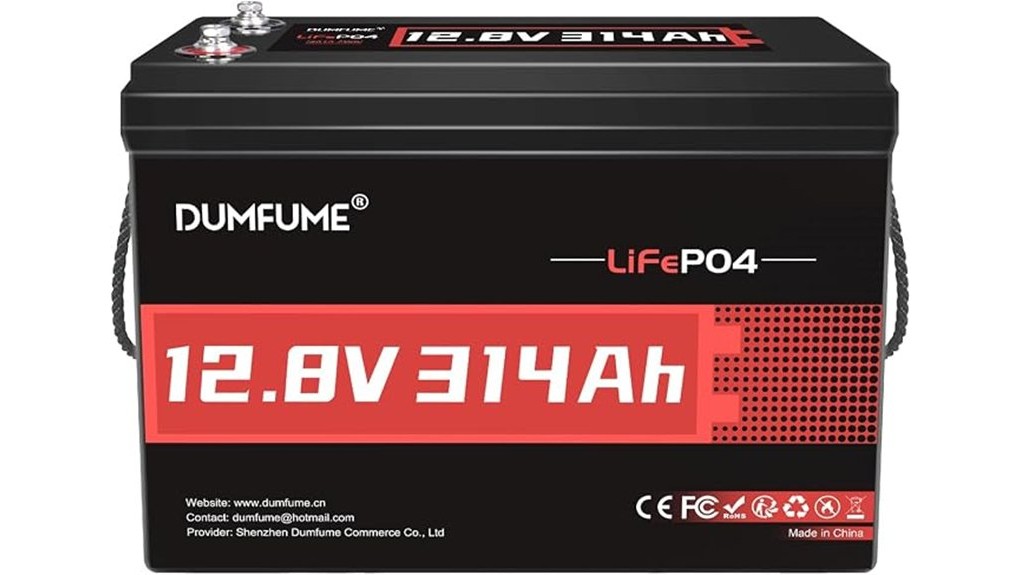
Those seeking a lightweight, high-capacity power solution for RVs, solar energy storage, or off-grid systems will find the Dumfume 12V 314Ah LiFePO4 battery a compelling option. Weighing just 57 lbs, it delivers up to 4,019.2Wh of energy at one-third the weight of comparable lead-acid batteries. Its built-in 200A BMS protects against overcharge, overdischarge, overcurrent, overheating, and short circuits. Users can expect up to 4,000 cycles at 100% DOD or 15,000 cycles at 60% DOD. The impact-resistant ABS casing supports harsh-environment use, and parallel or series configurations accommodate diverse power requirements.
Best For: The Dumfume 12V 314Ah LiFePO4 battery is best for RV enthusiasts, off-grid dwellers, and solar energy users seeking a lightweight, long-lasting, and high-capacity power solution.
Pros:
- Exceptional cycle life of up to 4,000 cycles at 100% DOD and 15,000 cycles at 60% DOD, offering significant long-term value over traditional lead-acid batteries
- Lightweight design at just 57 lbs delivers up to 4,019.2Wh of energy, making it easy to transport and install in space-limited applications
- Built-in 200A BMS provides comprehensive protection against overcharge, overdischarge, overcurrent, overheating, and short circuits for reliable safe operation
Cons:
- Performance is limited at temperatures below 5°C, making it potentially unsuitable for cold-weather or winter applications without additional precautions
- Higher upfront cost compared to traditional lead-acid batteries may present a barrier despite long-term cost-effectiveness
- Requires charging or discharging every 6 months during periods of disuse, adding a maintenance obligation that may be inconvenient for seasonal users
2. 12V 100Ah LiFePO4 Lithium Battery Group 31 with Built-in 100A BMS Rvpozwer
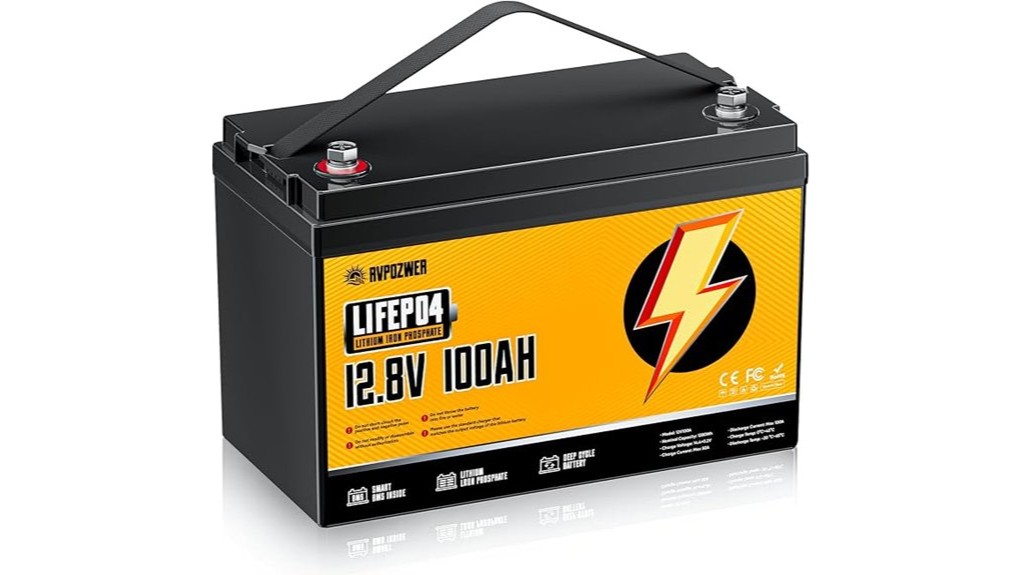
Outdoor enthusiasts and off-grid energy seekers will find the 12V 100Ah LiFePO4 Lithium Battery by Rvpozwer a reliable power solution. Built to Group 31 standards, it delivers 4,000 cycles at 100% DOD and up to 15,000 cycles at 60% DOD, with a 15-year lifespan. The integrated 100A Smart BMS protects against overcharge, over-discharge, over-current, over-voltage, and short circuits. Operating between -20°C and 65°C, it suits RVs, boats, solar systems, and off-grid setups. Users can configure up to four units in series for 51.2V or parallel for 400Ah, with warranty and technical support included.
Best For: Outdoor enthusiasts, off-grid energy seekers, RV owners, boaters, and solar system users who need a durable, scalable, and long-lasting lithium battery solution.
Pros:
- Exceptional lifespan of up to 15 years and 15,000 cycles at 60% DOD, offering significant long-term value compared to traditional lead-acid batteries
- Built-in 100A Smart BMS provides comprehensive protection against overcharge, over-discharge, over-current, over-voltage, and short circuits for safe, worry-free operation
- Highly scalable and versatile, supporting series or parallel configurations for up to 51.2V or 400Ah, making it adaptable for a wide range of applications
Cons:
- Higher upfront cost compared to traditional lead-acid batteries may be a barrier for budget-conscious buyers
- Scalability is limited to four units, which may not meet the demands of larger or more complex energy storage systems
- Operating temperature range, while broad, includes a lower charging threshold that may require additional cold-weather management in extreme climates
3. 12V 100Ah LiFePO4 Lithium Battery with Bluetooth BUKNUWO
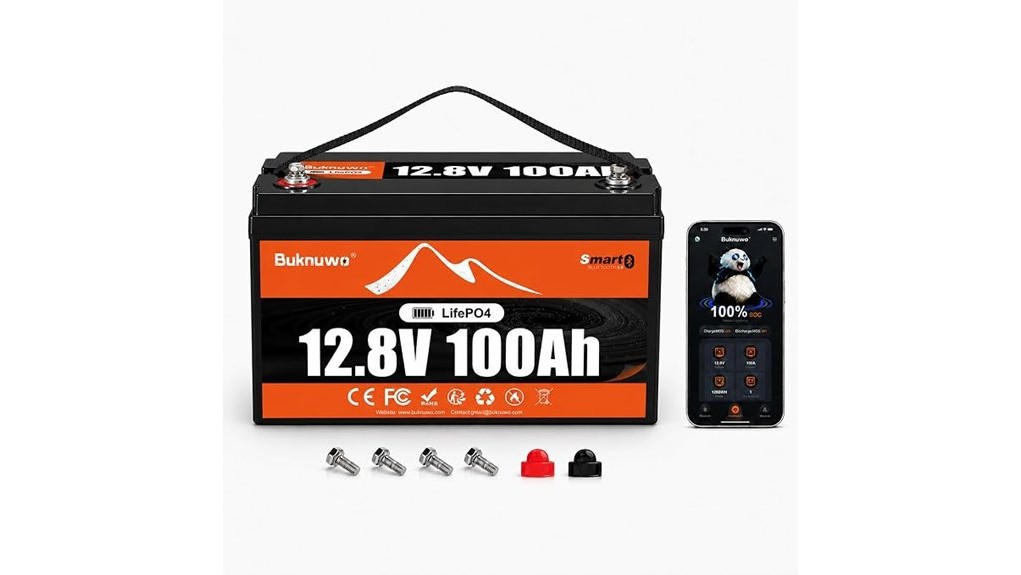
Boaters, RV enthusiasts, and off-grid solar users will find the BUKNUWO 12.8V 100Ah LiFePO4 battery a compelling power solution. Weighing 22 pounds, it delivers 1.28kWh with 95% capacity utilization, far surpassing lead-acid alternatives. Built-in Bluetooth 5.0 enables real-time monitoring of voltage, current, temperature, and SOC via a dedicated app. The integrated 100A BMS guards against overcharging, short circuits, and overheating, while an automatic temperature cut-off guarantees safe operation. Supporting up to 4S4P configurations, it scales for larger systems. ABS casing provides weather resistance, self-discharge stays under 5% monthly, and a 5-year warranty backs long-term reliability.
Best For: Boaters, RV enthusiasts, and off-grid solar users seeking a lightweight, long-lasting, and remotely monitorable power solution to replace traditional lead-acid batteries.
Pros:
- At just 22 pounds with 95% capacity utilization, it delivers significantly more usable energy than lead-acid batteries while being far lighter and more compact.
- Built-in Bluetooth 5.0 allows real-time monitoring of critical battery metrics—including SOC, voltage, temperature, and current—directly from a smartphone app.
- The integrated 100A BMS combined with automatic temperature cut-off and a 5-year warranty ensures safe, reliable, and long-term maintenance-free operation.
Cons:
- The 12.8V nominal voltage may require a compatible LiFePO4-specific charger, as standard lead-acid chargers could be incompatible or reduce battery lifespan.
- Charging is restricted to temperatures between 0°C and 45°C, limiting usability in extremely cold environments without additional thermal management.
- While the 4S4P scalability is a strong feature, building larger battery banks significantly increases upfront cost compared to traditional lead-acid alternatives.
4. 12V 100Ah-4 Packs LiFePO4 Lithium Battery ASTURNU
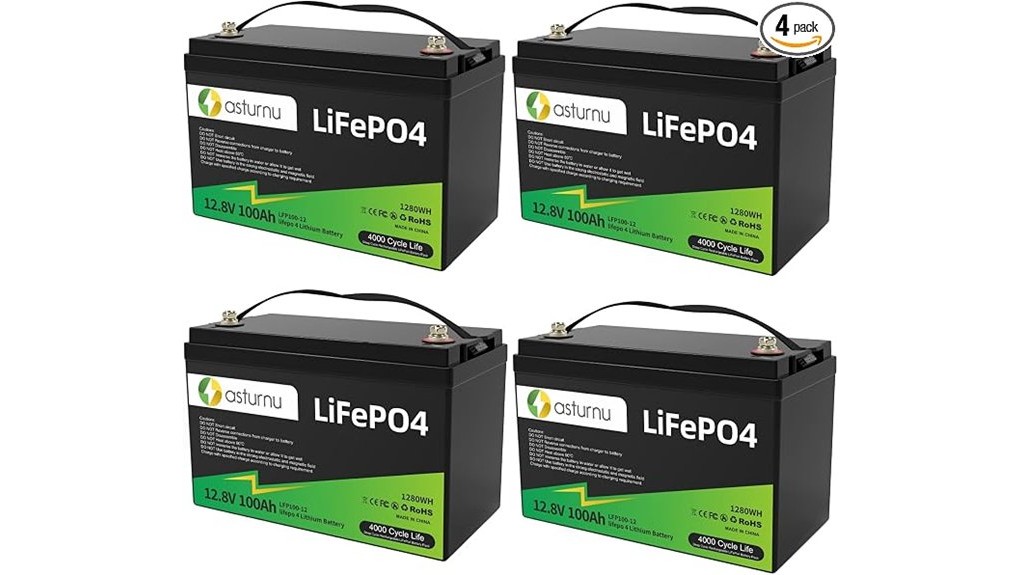
Anyone needing scalable energy storage will find the ASTURNU 12.8V 100Ah LiFePO4 battery a compelling option. Configurations expand from 1.28kWh up to 20.48kWh using 16 batteries in a 4P4S arrangement. The built-in 100A BMS protects against overcharge, over-discharge, overcurrent, short circuits, and temperature extremes. Rated for up to 15,000 cycles and a 10-year lifespan, this Group 31 battery weighs 23 pounds and delivers 1,280Wh. Applications include solar systems, marine, RV, and UPS backup. IP65 waterproofing, UL testing, FCC and CE certifications, and a 3-year manufacturer warranty reinforce its credibility.
Best For: Those seeking a scalable, long-lasting energy storage solution for solar, marine, RV, or backup power applications who need a reliable battery that can expand to meet growing energy demands.
Pros:
- Highly scalable energy storage, expandable from 1.28kWh up to 20.48kWh using 16 batteries in a 4P4S configuration
- Exceptional longevity with up to 15,000 cycles and a 10-year lifespan, backed by a built-in 100A BMS for comprehensive protection
- IP65 waterproof rating combined with UL, FCC, and CE certifications ensures durability and safety across demanding environments
Cons:
- At 23 pounds per unit, scaling to a full 16-battery configuration creates a significantly heavy and potentially difficult-to-manage system
- The 3-year manufacturer warranty falls short relative to the claimed 10-year lifespan, leaving a considerable gap in covered protection
- The 4P4S configuration required for maximum capacity demands careful setup knowledge, which may present challenges for less experienced users
5. 12V 300Ah LiFePO4 Lithium Battery with APP Monitoring MEYULMOL
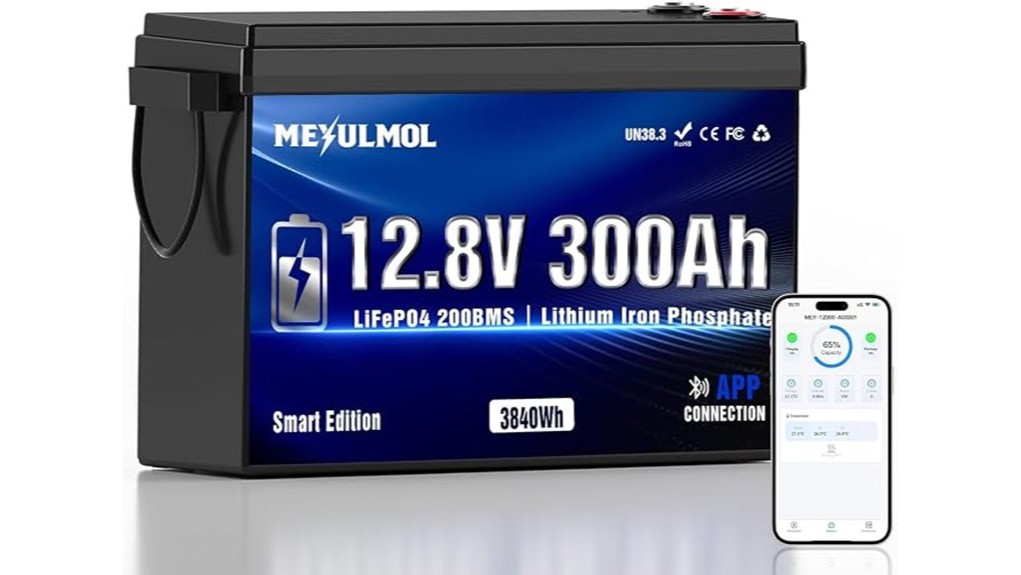
Those seeking a scalable, long-term energy solution will find the MEYULMOL 12V 300Ah LiFePO4 battery a compelling option. Delivering 3,840Wh with over 5,000 deep cycles and a 10-year lifespan, it substantially outperforms lead-acid alternatives. Its 4S4P configuration supports expansion up to a 48V/1,200Ah system, suitable for RVs, solar farms, and off-grid cabins. The built-in 200A BMS handles overcharge, over-discharge, overcurrent, and short-circuit protection, while low-temperature safeguards prevent lithium plating. Real-time APP monitoring tracks voltage, current, capacity, and temperature across Android and iOS. A self-discharge rate under 3% monthly guarantees reliability during storage.
Best For: Those who need a scalable, long-term energy storage solution for RVs, solar farms, marine use, or off-grid cabins and want smart monitoring capabilities with minimal maintenance.
Pros:
- Exceptional lifespan of over 10 years and 5,000+ deep cycles significantly outlasts lead-acid batteries, offering strong long-term value
- Expandable 4S4P configuration allows gradual scaling up to a 48V/1,200Ah system, providing flexibility as energy needs grow
- Built-in APP monitoring and 200A BMS deliver comprehensive real-time data and multi-layered protection without requiring additional hardware
Cons:
- Higher upfront cost compared to traditional lead-acid batteries may present a barrier for budget-conscious buyers
- Discharge automatically suspends below -4°F, limiting usability in extremely cold climates without additional thermal management
- The 300Ah capacity and expansion requirements may be more than necessary for users with modest or simple energy needs, adding unnecessary complexity and cost
Frequently Asked Questions
LiFePO4 vs lithium ion: What is the main difference?
The main difference is the chemical composition of the cathode and the resulting safety profile. Standard lithium-ion (NMC/LiCoO2) batteries offer a slightly higher energy density, making them great for cell phones and EVs, but they carry a risk of thermal runaway fires. LiFePO4 (lithium iron phosphate) trades a bit of energy density for massive cycle life, perfectly flat voltage discharge, and complete thermal stability, making them the safest choice for residential and mobile energy storage.
Can I charge a 12V LiFePO4 battery with a standard lead-acid charger?
It is highly discouraged. While a standard automotive alternator or lead-acid charger might push some energy into a LiFePO4 battery, their voltage profiles are entirely different. Lead-acid chargers often utilize a “desulfation” or equalization phase that spikes the voltage above 15V. This will trigger the LiFePO4 battery BMS to shut down to protect the cells, leaving your battery uncharged. You must use a charger with a dedicated lithium profile (typically bulk charging at 14.4V to 14.6V).
How does the LiFePO4 battery BMS protect my system?
The BMS (Battery Management System) is the computer guarding the cells. It acts as an automatic circuit breaker. If it detects temperatures that are too high or too low, a short circuit, or if the voltage drops below 10V (on a 12V system), it physically severs the connection to the battery terminals. This prevents the cells from suffering irreversible chemical damage.
Are cheap Amazon LiFePO4 batteries worth it?
It depends entirely on your use case. If you are building a small, non-critical solar setup for a tool shed, a $200 budget LiFePO4 battery sells might be perfectly adequate. However, if you are relying on this battery to power medical equipment, a full-time RV refrigerator, or an off-grid cabin in the winter, the lack of low-temp protection, potential use of Grade B cells, and non-existent customer support make cheap batteries a massive liability.
Do LiFePO4 batteries need to be vented?
No. Unlike flooded lead-acid or AGM batteries that off-gas explosive hydrogen during the charging process, LiFePO4 batteries are entirely sealed and do not emit dangerous gasses. They are perfectly safe to install inside the living space of a home, van, or boat without external ventilation.
Can I wire different brands of lithium iron phosphate batteries together?
Absolutely not. You should never mix different brands, different capacities (Ah), or even old and new batteries of the same brand. Differing internal resistances and varying BMS algorithms will cause unequal charging and discharging. One battery will end up doing all the heavy lifting, leading to premature failure of the entire battery bank. Always build your battery bank with identical units purchased at the same time.
Conclusion: Power Your Next Adventure
Making the jump from heavy, short-lived lead-acid batteries to modern lithium technology is the single most impactful upgrade you can make to any power system. While searching for the perfect LiFePO4 battery listing can feel like navigating a minefield of technical jargon, adhering to the fundamentals of battery physics will guide you to a safe and robust purchase.
Prioritize verified cell grades, demand a high-quality BMS with low-temperature protection, and carefully match your capacity and continuous discharge ratings to your actual power loads. By investing intelligently in proven lithium iron phosphate battery technology, you are not just buying a box of cells; you are securing decades of reliable, maintenance-free energy independence.
Ready to design the rest of your system? Dive into our comprehensive guides on sizing solar arrays and matching your new LiFePO4 battery bank to the perfect MPPT charge controller.
Watch this review to learn more about budget LiFePO4 testing. This video is highly relevant because it demonstrates real-world capacity testing and tear-downs of budget LiFePO4 batteries available on Amazon.