The optimal fixed tilt angle for solar panels is roughly equal to your location’s latitude. While a fixed, flush roof mount is the most cost-effective and reliable solution for residential homes, utilizing seasonally adjustable solar panel mounts or automated solar trackers on a ground mount can boost your annual energy production by 5% to 40%. Ultimately, the decision to adjust your solar panel angle depends heavily on your local climate, structural wind loads, structural engineering constraints, and your utility’s specific net metering rules.
Key takeaways:
- Latitude dictates the baseline: Setting your fixed panel tilt equal to your geographical latitude captures the highest baseline annual solar radiation.
- Trackers yield the highest gains: Single-axis and dual-axis solar trackers can increase electricity output by 25% to 40% compared to static fixed-tilt systems.
- More panels often beat tilt frames: Due to the plunging wholesale costs of photovoltaic (PV) modules, adding extra panels is frequently cheaper than upgrading to heavy adjustable mounts or tracking hardware.
- Time-of-Use (TOU) dictates orientation: Adjusting your panel orientation to the west can be more profitable than south-facing optimization if your utility charges premium rates during late afternoon peak hours.
What Is the Best Tilt Angle for Solar Panels?
Solar panels achieve their absolute peak efficiency when sunlight hits the photovoltaic cells at a perfectly perpendicular 90-degree angle, known as the optimal solar incidence angle. Because the Earth is tilted on its axis by 23.5 degrees, the sun’s trajectory across the sky shifts continuously throughout the year. It sits high in the sky during the summer solstice and drops low on the horizon during the winter solstice.
Because of this constant movement, maintaining a perfect 90-degree incidence angle year-round is mathematically impossible without dual-axis mechanical tracking. For fixed-tilt systems—which account for the vast majority of residential roof-mounted and commercial rooftop solar arrays—engineers rely on a well-established baseline: the optimal solar panel angle by latitude.
Setting your panels at a tilt angle equal to your geographical latitude maximizes your baseline annual solar radiation capture. For example, if your property is located in Denver, Colorado (latitude 39.7 degrees), a fixed tilt of approximately 40 degrees will yield the highest total annual electricity generation.
However, homeowners do not need to obsess over hitting the exact degree. Field data published by the National Renewable Energy Laboratory (NREL) demonstrates a broad forgiveness zone. If your roof’s natural pitch falls anywhere within 15 degrees of your exact latitude, your total annual energy loss will generally be less than 2% to 4% compared to a perfectly optimized tilt.
Optimal Solar Panel Tilt by Latitude and Season
| Geographical Latitude | Annual Fixed Tilt (Year-Round) | Summer Tilt (Optimize for High Sun) | Winter Tilt (Optimize for Low Sun) |
|---|---|---|---|
| 0° to 15° (Near Equator) | 15° (Minimum for rain runoff) | 15° | 15° |
| 15° to 25° | Equal to Latitude | Latitude – 15° | Latitude + 15° |
| 25° to 40° | Equal to Latitude | Latitude – 15° | Latitude + 15° |
| 40° to 50°+ | Equal to Latitude | Latitude – 15° | Latitude + 15° |
Is It Worth Adjusting Solar Panels Seasonally?
For property owners with adjustable ground mounts or specialized ground-level racking, seasonal solar panel adjustment is a viable engineering method to capture extra kilowatt-hours (kWh). The strategy involves manually changing the array’s pitch to mirror the sun’s seasonal elevation—lowering the tilt in the summer and raising it steeply in the winter.
The physical act of tilting solar panels in the winter is vital for off-grid homes relying on battery storage. During the winter months, sunlight must penetrate a thicker slice of the Earth’s atmosphere, and daylight hours are significantly shorter. By tilting the panels closer to a vertical orientation (Latitude + 15 degrees), off-grid systems can squeeze maximum amperage out of limited winter sunlight, ensuring deep-cycle battery banks remain adequately charged to prevent degradation.
Conversely, grid-tied homes operating under 1:1 net metering policies face a completely different calculus. Under true net metering, the utility grid acts as an infinite, 100% efficient battery. A grid-tied system can intentionally overproduce during the long, sunny days of summer, rack up utility kWh credits, and automatically draw against those credits during the winter deficit. In this scenario, maximizing your total annual production with a fixed latitude tilt is financially superior to prioritizing seasonal winter production.
Furthermore, manual seasonal adjustment should only be performed on ground-mounted arrays. Scaling a roof multiple times a year with hand tools to unbolt and pivot heavy solar modules introduces severe slip-and-fall hazards. It also drastically increases the likelihood of tearing the roofing membrane, compromising weatherproof penetrations, or inducing micro-cracks in the silicon solar cells by applying uneven physical pressure to the module frames.
Fixed Tilt, Adjustable Mounts, or Solar Trackers?
When designing a solar PV system, you must choose how the racking framework will interface with the sun. The commercial and residential solar industries utilize three primary mounting methodologies.
Fixed Tilt Systems
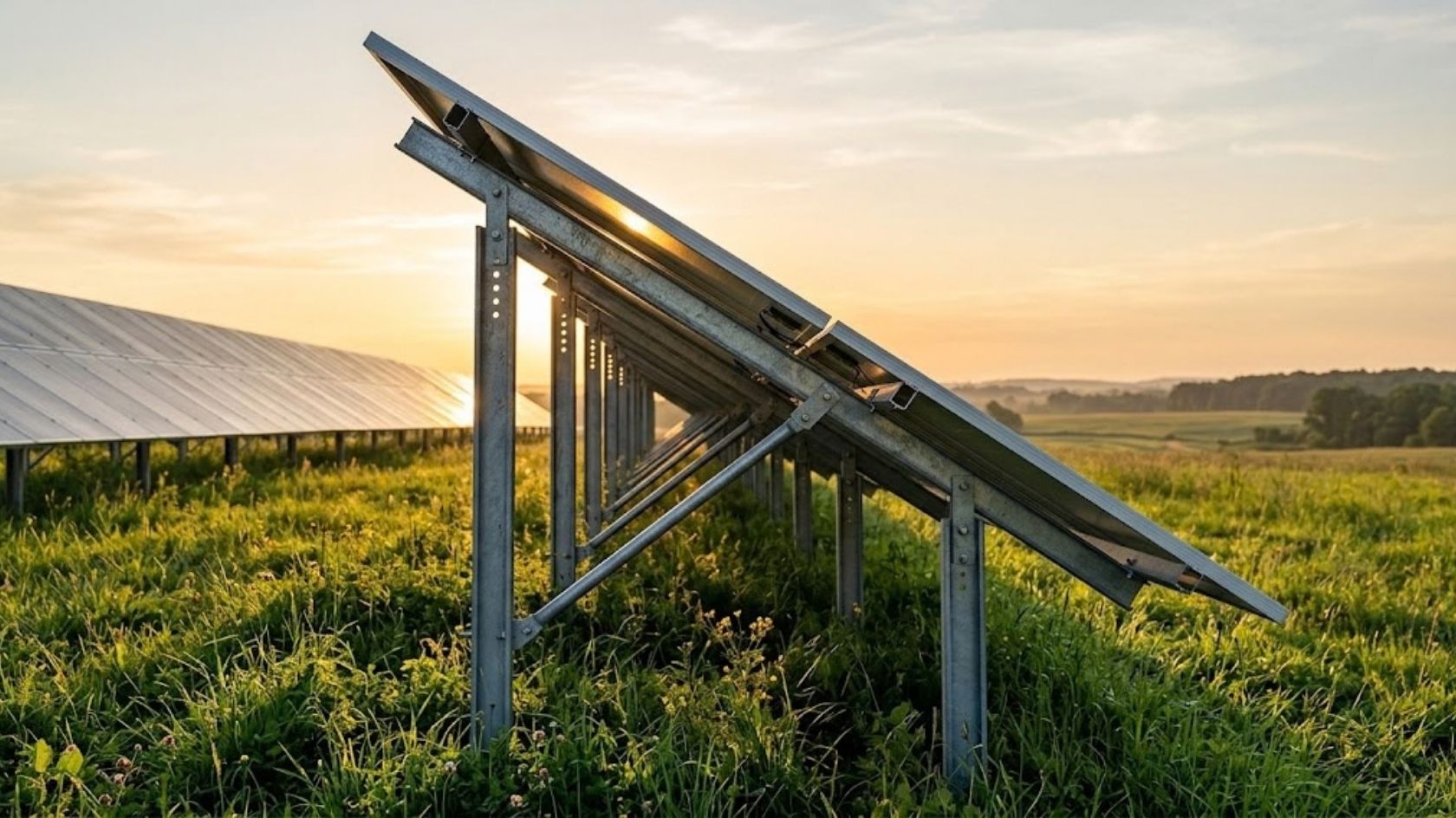
Fixed systems are locked into a single position for their entire 25-to-30-year lifespan. They feature no moving parts, require zero maintenance beyond occasional rain cleaning, and represent the cheapest upfront capital cost. For flush-mounted residential rooftops, fixed racking is the undisputed standard.
Adjustable Solar Panel Mounts
Adjustable mounts feature telescoping legs or multi-position brackets, allowing the system owner to manually change the array’s pitch. These are highly popular for off-grid ground mounts, recreational vehicles (RVs), and remote cabins where winter energy survival is critical. The drawback is the ongoing manual labor required to adjust the heavy arrays.
Automated Solar Trackers
Solar trackers utilize localized GPS data, light sensors, and motorized actuators to follow the sun continuously without human intervention. Single-axis trackers pivot on one axis, following the sun from east to west throughout the day. Dual-axis trackers pivot on two axes, tracking east to west while simultaneously adjusting up and down for seasonal elevation.
Solar Mounting Systems Compared
| System Type | Annual Energy Gain | Initial Cost & Complexity | Maintenance Level | Best Use Case |
|---|---|---|---|---|
| Fixed Tilt | Baseline (0%) | Low | Zero | Standard residential rooftops, flat commercial roofs. |
| Adjustable Mount | 5% to 10% | Moderate | Low (Manual Labor) | Off-grid ground mounts, RVs, remote cabins. |
| Single-Axis Tracker | 25% to 35% | High | Moderate | Utility-scale solar farms, large residential ground mounts. |
| Dual-Axis Tracker | 35% to 40% | Very High | High | Specialized commercial sites with extreme space constraints. |
Solar Panel Orientation and Utility Rate Structures
While tilt refers to the vertical angle of the panels, solar panel orientation (or azimuth) refers to the compass direction the array faces. In the Northern Hemisphere, True South is the optimal orientation for generating the maximum volume of annual electricity. In the Southern Hemisphere, True North is optimal.
However, optimal solar design is no longer dictated exclusively by the path of the sun. It is heavily influenced by modern utility rate structures, specifically Time-of-Use (TOU) pricing.
Under TOU rates, utility companies charge significantly more for electricity during peak demand hours, which typically occur between 4:00 PM and 9:00 PM when the electrical grid is heavily stressed. If your utility utilizes aggressive TOU pricing and does not offer 1:1 net metering, a south-facing roof will generate the most total energy, but a west-facing roof will generate the most financially valuable energy.
West-facing panels capture the late afternoon sun, generating peak power precisely when the utility is charging peak rates. By offsetting your most expensive consumption hours, a sub-optimal orientation (west) can often yield a faster financial payback period than the mathematically optimal orientation (south).
Practical Factors: Snow Shedding, Wind Loading, and Shading
Altering the angle of your solar panels introduces a host of mechanical and environmental variables that must be accounted for by an installer. Consult with a licensed structural professional before executing any roof-mounted changes.
Snow Shedding and Self-Cleaning
Tilt plays a massive role in system resilience in cold climates where snowfall exceeds 40 inches (100 cm) annually. A shallow tilt (under 20 degrees) allows snow to accumulate and sit on the glass, effectively reducing the panel’s output to zero until it melts. Steeper angles (35 degrees or higher) promote rapid snow shedding. The slick tempered glass, combined with the mild heat generated by the operating silicon cells, allows snow to slide off quickly. Steeper angles also assist in self-cleaning, allowing rain to effectively wash away dust, pollen, and bird droppings.
Wind Loading and Structural Integrity
From an aerodynamic perspective, a tilted solar panel acts as a sail. The steeper the tilt angle, the higher the wind uplift forces exerted on the array. If you utilize adjustable tilt legs on a roof, the racking must be engineered to withstand localized hurricane or straight-line wind speeds exceeding 100 mph (160 km/h). This requires heavy ballast blocks on flat roofs or deep lag-bolt penetrations into structural rafters on pitched roofs. Permitting offices strictly regulate how far off the roof deck a panel can be tilted without a custom sign-off from a structural engineer.
Shading and Ground Mount Row Spacing
For ground-mounted systems featuring multiple rows, tilt directly affects the system’s physical footprint. A steeper panel casts a longer shadow behind it, especially in the winter when the sun is low. To prevent the first row of panels from casting a shadow on the bottom edge of the second row (inter-row shading), the physical distance between the rows must be increased. This requires significantly more trenching, longer wire runs, and a larger parcel of land.
Bifacial Solar Panels
Bifacial solar modules produce electricity from both the front and rear sides by capturing albedo (reflected light bouncing off the ground). Tilting bifacial panels on a ground mount, particularly over a highly reflective surface like crushed white stone or winter snow, allows maximum light to reach the rear cells. This can yield an additional 5% to 15% energy gain, heavily reinforcing the financial case for a tilted ground rack.
The Cost-Benefit Framework: Should You Invest in Tilting Mounts?
Before purchasing automated tracking hardware or paying a premium for manually adjustable racks, evaluate the investment through a strict cost-benefit framework. You can model your property’s solar potential using the U.S. Department of Energy’s NREL PVWatts Calculator, which utilizes decades of localized meteorological data.
The framework requires four steps:
- Model your baseline annual production (in kWh) using a standard fixed flush-mount configuration.
- Model the theoretical production (in kWh) using a single-axis tracker or an optimized seasonal tilt.
- Calculate the difference to find your annual energy gain (e.g., an extra 1,500 kWh per year).
- Multiply that extra energy by your utility’s per-kWh electricity rate to find your annual financial savings.
If a residential single-axis tracker costs an additional $4,500 to purchase and install, but only yields $300 in extra electricity per year, the simple payback period for the tracking hardware is 15 years. Because mechanical trackers feature moving parts—such as motorized linear actuators, slewing drives, and anemometers—they require routine maintenance and parts replacement. It is highly likely the tracker will require servicing before it reaches its break-even point.
Because the wholesale cost of high-efficiency PV modules has dropped so dramatically, the most reliable and cost-effective way to supercharge your energy generation is almost always to purchase a few extra solar panels and mount them in a static, fixed position to make up the energy difference.
Common Mistakes to Avoid When Tilting Solar Panels
- Forcing a Tilt on a Pitched Roof: Adding bulky tilt legs to a standard 25-degree residential roof to achieve a few extra degrees of optimization is a poor design choice. It degrades the home’s curb appeal, creates debris traps under the array, vastly increases wind uplift risks, and often voids roofing warranties—all for a negligible boost in power.
- Ignoring Module-Level Monitoring: If you utilize an adjustable ground mount, you must verify your results. Using string inverters without module-level optimization makes it difficult to measure the impact of your adjustments. Utilizing microinverters or DC optimizers provides granular data, allowing you to see exactly how your seasonal tilt changes affect real-time wattage.
- Neglecting Local Wind Codes: DIY solar enthusiasts frequently purchase off-the-shelf adjustable brackets without checking local wind load requirements. Installing a steep array in a high-wind zone without proper structural calculations can lead to catastrophic system failure during severe weather.
Frequently Asked Questions (FAQ)
What is the best angle for solar panels in the winter?
To maximize winter production when the sun is low on the horizon, tilt your solar panels to your latitude plus 15 degrees. This steeper, nearly vertical angle captures direct sunlight more efficiently and helps shed heavy snow accumulations rapidly, ensuring the panels continue producing power during short winter days.
Does a 10-degree tilt make a difference?
Yes, a minimum 10-degree tilt is highly recommended for all flat-roof solar installations. While a perfectly flat (0-degree) panel will generate electricity, it suffers a 10% to 15% efficiency penalty because rain cannot wash away dirt, dust, and pollen. A 10-degree tilt ensures proper water runoff and self-cleaning.
Are solar trackers worth it for residential homes?
For most residential properties, solar trackers are not worth the investment. The high upfront cost, complex installation, and ongoing maintenance of motorized parts outweigh the financial benefits of the extra electricity generated. Because standard solar panels are highly affordable today, installing a larger fixed-tilt array is almost always more cost-effective.
Can I manually adjust roof-mounted solar panels?
Manually adjusting roof-mounted solar panels is strongly discouraged by solar professionals. Scaling a roof multiple times a year introduces severe slip-and-fall hazards, risks damaging your roofing membrane, and can cause micro-cracks in the solar cells if you lean heavily on the module frames.
How does solar panel tilt affect net metering?
If you have 1:1 net metering, your utility credits you equally for every kilowatt-hour you export. In this case, adjusting for seasonal dips is unnecessary; you should use a fixed tilt optimized for maximum annual production. You can overproduce in the summer and use those accumulated credits to cover your winter energy deficit.
Conclusion
Finding the right tilt for your solar panels is a balance between physics, economics, and practical structural engineering. While automated trackers and adjustable ground mounts can certainly squeeze more electricity out of the sun, the reliability, safety, and low cost of a fixed, latitude-matched array make it the industry standard. To determine the most profitable setup for your home, run a free simulation on the NREL PVWatts Calculator to model your property’s specific solar potential, and consult a licensed solar installer for a comprehensive site assessment.
Sources and Further Reading
- National Renewable Energy Laboratory (NREL): PVWatts Calculator
- U.S. Department of Energy: Solar Radiation Basics
- Sandia National Laboratories: Photovoltaic Performance Modeling Collaborative
- International Energy Agency (IEA): Photovoltaic Power Systems Programme