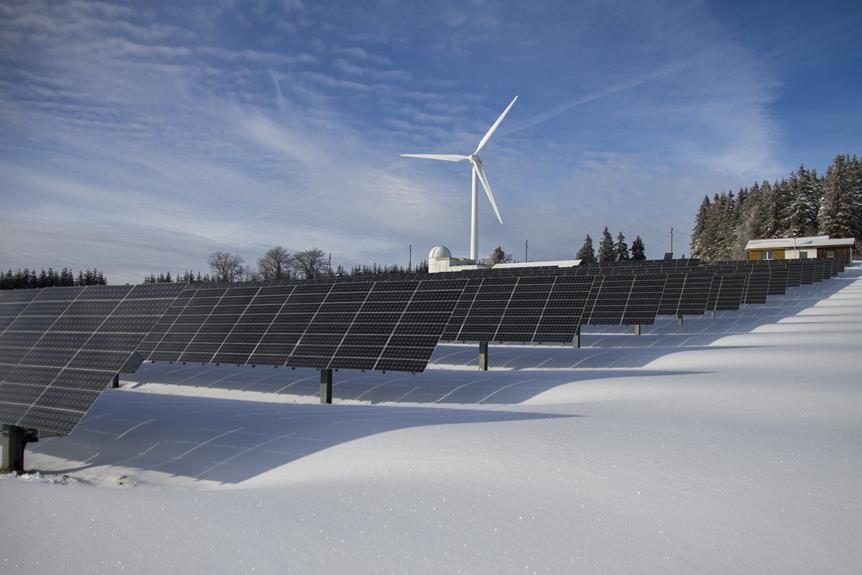
If you are building an off-grid cabin, designing a micro-hydro system, or assembling a backyard wind turbine, you have likely encountered the term magnet-powered generator—more formally known in the renewable energy industry as a Permanent Magnet Generator (PMG) or Permanent Magnet Alternator (PMA).
Unlike standard induction motors or traditional alternators that require an external power source to create a magnetic field (excitation), PMGs generate electricity using the inherent magnetic fields of rare-earth neodymium magnets. This makes them incredibly efficient, highly durable, and uniquely suited for alternative energy systems where every watt matters.
However, the internet is rife with misinformation regarding “magnet motors” and pseudoscientific claims of free energy. This comprehensive guide cuts through the noise. We will explain the actual physics behind PMGs, debunk the myths, and review the 10 best magnet-powered generators currently available for your off-grid power and alternative energy projects.
How Permanent Magnet Generators Actually Work
To understand why PMGs are the gold standard for small-scale renewable energy, we need to look at the electromagnetic physics that govern them.
Faraday’s Law of Induction
The foundational principle of any generator is Faraday’s Law of Electromagnetic Induction, which states that a change in magnetic flux through a circuit induces an electromotive force (EMF)—or voltage—in that circuit. In simpler terms: if you move a magnet past a coil of copper wire, you force the electrons in that wire to move, creating an electrical current.
The Rotor and Stator Mechanics
In a permanent magnet generator, this process is stripped down to its most efficient mechanical form:
- The Rotor: This is the spinning portion of the generator. Instead of using electromagnets (which require electricity to run), the rotor is lined with incredibly powerful permanent magnets—usually Neodymium Iron Boron (NdFeB) magnets.
- The Stator: This is the stationary outer shell containing tightly wound coils of copper wire.
- The Interaction: As the prime mover (wind turning a blade, or water turning a hydro-pelton wheel) spins the rotor, the alternating north and south poles of the neodymium magnets sweep past the copper coils in the stator. This rapidly fluctuating magnetic field induces a strong three-phase alternating current (AC).
Why PMGs Dominate Alternative Energy
Traditional car alternators use “slip rings” and “brushes” to supply power to electromagnets to create a magnetic field. This causes mechanical friction and requires a high RPM (Revolutions Per Minute) to start generating usable power.
Permanent magnet generators are brushless and gearless. Because the magnetic field is “always on” thanks to the neodymium magnets, a PMG has virtually zero mechanical friction (aside from the main bearing). This allows them to produce usable voltage at incredibly low RPMs, making them perfect for low-wind wind turbine generators or slow-moving micro-hydro setups.
Ready to Build Your Own Off-Grid Power System?
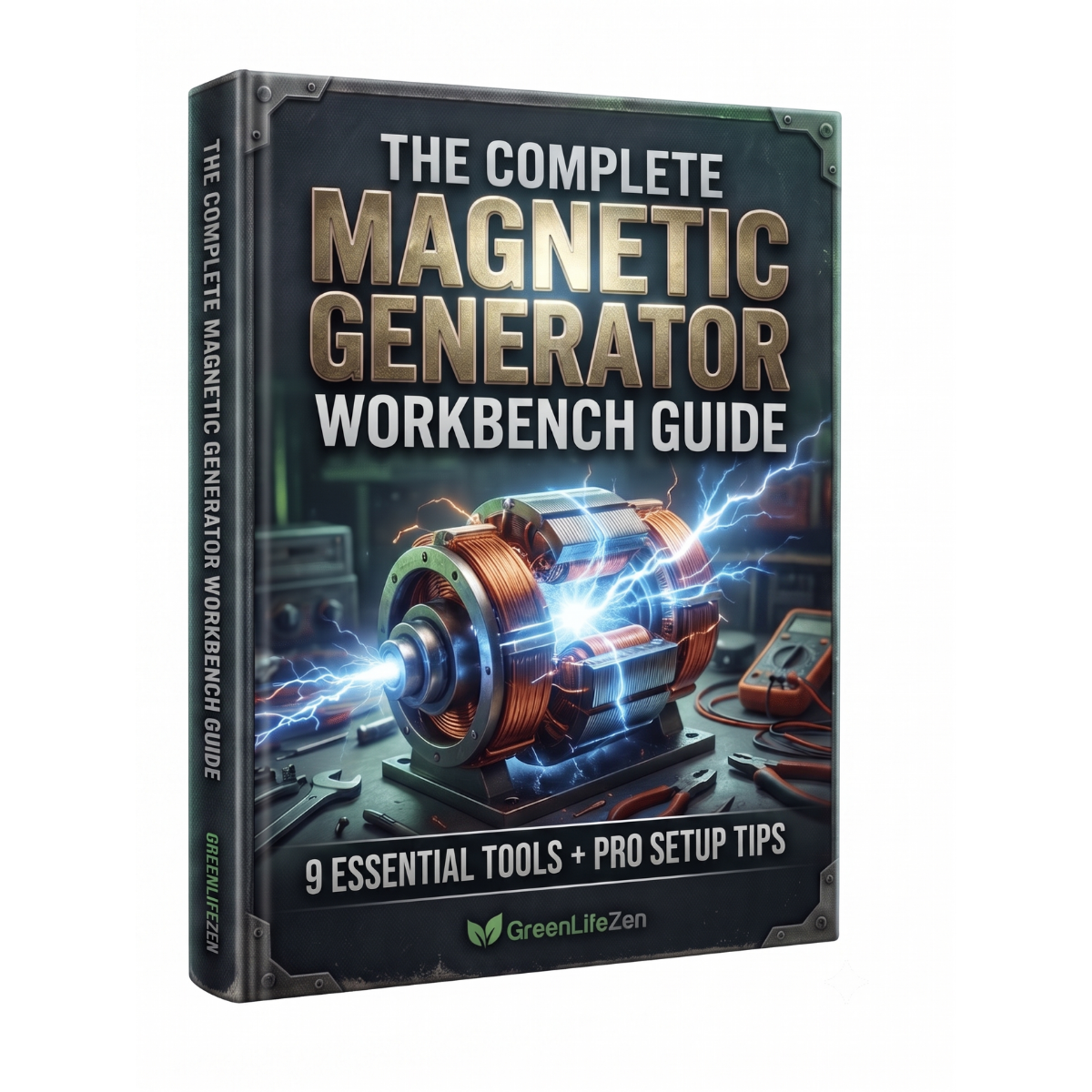
The number one reason DIY magnetic generators fail isn’t the physics—it is a lack of precision tools. Don’t drill a single hole or twist a single wire until your workspace is set up like a professional energy lab. Grab our free 17-page blueprint covering the exact tools, safety gear, and air-gap instruments you need to succeed on your first try. (PDF format, No email needed)
The “Free Energy” Myth: Separating Science from Scam
Before diving into the top products, we must address the most common misconception surrounding magnet-powered generators.
If you search for “magnet generator” on YouTube, you will inevitably find videos of machines claiming to run endlessly by using magnets pushing against one another, supposedly creating “free energy” (overunity) with no external fuel or input.
This is scientifically impossible.
According to the First Law of Thermodynamics, energy cannot be created or destroyed; it can only be transferred. Magnets are not a source of energy; they are a mechanism for converting mechanical energy into electrical energy.
A permanent magnet generator will not spin itself. It requires a “prime mover”—an external physical force—to turn the rotor. In alternative energy, this prime mover is:
- The kinetic energy of wind pushing turbine blades.
- The gravitational force of falling water turning a hydro wheel.
- The mechanical force of a stationary bicycle pedaled by a human.
The generators on this list are legitimate, physics-based PMGs designed to be paired with these prime movers, meeting IEEE (Institute of Electrical and Electronics Engineers) standards for reliable power conversion.
Evaluation Methodology: How We Chose the Best PMGs
Each generator on this list was evaluated against a strict set of criteria crucial for off-grid and alternative energy applications:
- Efficiency and Power Output: We analyzed the power curve, focusing on the wattage produced at specific RPMs. Generators that deliver high output at lower speeds scored higher.
- Build Quality and Durability: We assessed the casing materials (cast aluminum vs. plastic), the grade of the neodymium magnets, and the quality of the weather-sealing (crucial for outdoor wind/hydro use).
- Starting Torque (Cogging): “Cogging” is the physical resistance felt when magnets align with the steel stators. Lower cogging torque means the generator can start spinning in lighter winds or lower water flow.
- Cost-Effectiveness: We balanced the price against the rated wattage to determine overall value.
- Ease of Installation: We prioritized generators that offer straightforward mounting configurations and clear wiring schematics for DIY builders.
10 Best Magnet-Powered Generators Comparison Table
| Product Name | Rated Power | Voltage Options | Best Use Case | Approx. Price |
|---|---|---|---|---|
| 1. Missouri Wind Freedom PMG | ~1000W | 12V / 24V / 48V | DIY Wind / Hydro | $300 – $350 |
| 2. Tumo-Int 1000W PMG | 1000W | 48V | Micro-Hydro / Wind | $350 – $400 |
| 3. Pikasola 400W Turbine | 400W | 12V / 24V | Entry-level Wind | $180 – $220 |
| 4. Marsrock 600W PMG | 600W | 12V / 24V / 48V | Custom DIY Builds | $200 – $250 |
| 5. YaeMarine 500W Alternator | 500W | 12V / 24V | Budget DIY Projects | $130 – $160 |
| 6. IstaBreeze i-2000 | 2000W | 48V | Heavy-Duty Wind | $800 – $900 |
| 7. Ginlong GL-PMG-1800 | 1800W | 48V / 96V | Commercial/Pro Hydro | $2,999 |
| 8. Automaxx Windmill 1500W | 1500W | 24V / 48V | All-in-one Wind System | $800 – $950 |
| 9. Sun-gold 1000W PMA | 1000W | 24V / 48V | Water Wheel / Hydro | $320 – $380 |
| 10. Windmax HY400 | 400W | 12V | Marine / RV Wind | $250 – $300 |
(Note: Prices fluctuate based on suppliers and global shipping rates. Check manufacturers for exact current pricing).
1. Missouri Wind and Solar Freedom PMG
The Gold Standard for DIY Wind and Hydro Enthusiasts
If you are building your own alternative energy system, the Missouri Wind and Solar Freedom PMG is likely the most famous standalone permanent magnet generator on the market. Manufactured in the USA, this dual-stator PMG is heavily favored by off-grid homesteaders for its ruggedness and incredibly low cut-in speeds.
- Key Specs:
- Wattage: Up to 1000W (depending on RPM)
- Voltage: Available in 12V, 24V, or 48V configurations
- Magnets: N52 Neodymium rare-earth magnets
- Housing: Heavy-duty aluminum
- Pros:
- Incredibly low cogging torque (starts spinning effortlessly).
- Dual stator design allows for high power output at low RPM.
- Exceptional customer support and vast DIY community documentation.
- Cons:
- Aesthetics are utilitarian; it is built for work, not to look pretty.
- Requires a separate rectifier to convert the 3-phase AC to DC for battery charging.
- Best Use Case: Custom-built wind turbines or small-scale water wheels where maximum low-RPM efficiency is required.
- Approximate Price: $300 – $350
2. Tumo-Int 1000W 3-Phase Gearless PMG
Best Mid-Range Generator for Micro-Hydro Projects
The Tumo-Int 1000W PMG is a heavy-duty, gearless permanent magnet alternator designed to endure continuous rotational stress. Because it is highly weather-sealed and built with a thick cast-aluminum shell, it is heavily favored for micro-hydroelectric systems where water runs continuously 24/7.
- Key Specs:
- Wattage: 1000W
- Voltage: 48V
- Efficiency: >85% at rated RPM
- Weight: 15.4 lbs (7 kg)
- Pros:
- Gearless, direct-drive design eliminates mechanical wear points.
- High-grade SKF bearings ensure a long lifespan under continuous load.
- Excellent heat dissipation due to the ribbed aluminum casing.
- Cons:
- Rated RPM is slightly higher (around 500-600 RPM to hit 1000W), making it less ideal for very slow wind setups.
- Best Use Case: Micro-hydro installations with a reliable, medium-pressure water source driving a Pelton wheel.
- Approximate Price: $350 – $400
3. Pikasola 400W Wind Turbine Generator
Best All-in-One Entry Level System
Not everyone wants to machine their own rotors and mount standalone PMGs. For those looking for an out-of-the-box alternative energy generator, the Pikasola 400W integrates a highly efficient PMG directly into a sleek, consumer-friendly wind turbine chassis.
- Key Specs:
- Wattage: 400W
- Voltage: 12V or 24V auto-sensing
- Start-up Wind Speed: 2.5 m/s (5.5 mph)
- Includes: MPPT (Maximum Power Point Tracking) Controller
- Pros:
- Complete kit; includes the blades, generator, and charge controller.
- Teflon wire wrapping inside the stator prevents high-temperature shorting.
- Extremely lightweight and easy to mount on standard piping.
- Cons:
- Real-world output rarely hits 400W unless in sustained gale-force winds.
- Not suitable for heavy off-grid home power; better for trickle charging.
- Best Use Case: RVs, boats, or powering off-grid sheds and remote lighting systems.
- Approximate Price: $180 – $220
4. Marsrock 600W PMG
Best Budget PMG for Custom Projects
Marsrock produces a line of highly accessible PMGs specifically aimed at the DIY maker market. Their 600W unit is highly versatile, featuring a standard shaft and mounting bracket that makes it easy to attach to a bicycle chain, a water turbine, or custom PVC wind blades.
- Key Specs:
- Wattage: 600W
- Voltage: 12V, 24V, or 48V
- Operating Temp: -40°C to 80°C
- Pros:
- Excellent price-to-wattage ratio.
- Very low starting torque.
- Compact footprint fits easily into tight custom enclosures.
- Cons:
- The bearings are standard, not high-grade, which may require replacement after a few years of harsh weather exposure.
- Best Use Case: Educational projects, pedal-powered generators, and entry-level DIY wind turbines.
- Approximate Price: $200 – $250
5. YaeMarine 500W Permanent Magnet Alternator
Best Ultra-Budget Alternator
If you are just dipping your toes into the world of alternative energy and want to test a proof-of-concept without breaking the bank, the YaeMarine 500W PMG is a solid starting point. It utilizes a three-phase AC output and standard rare-earth magnets to provide reliable, albeit modest, power.
- Key Specs:
- Wattage: 500W (Rated at roughly 600 RPM)
- Voltage: 12V or 24V
- Phase: 3-Phase AC
- Pros:
- Highly affordable.
- Simple, two-bolt mounting system.
- Surprisingly robust aluminum alloy casing for the price.
- Cons:
- High cogging torque compared to premium models; it requires a strong breeze or fast water to break the magnetic lock and start spinning.
- Best Use Case: Tinkering, small water-stream generators, or high-wind environments where startup torque isn’t an issue.
- Approximate Price: $130 – $160
6. IstaBreeze i-2000
Best High-Capacity PMG for Serious Wind Power
IstaBreeze is a highly respected European manufacturer known for producing robust, high-yield wind systems. The IstaBreeze i-2000 utilizes a massive, custom-engineered permanent magnet generator designed to harvest serious wattage for off-grid homes relying heavily on wind turbine generators.
- Key Specs:
- Wattage: 2000W
- Voltage: 48V
- Generator Type: 3-Phase AC with NdFeB magnets
- Weight: ~45 lbs
- Pros:
- Produces massive amounts of power capable of running household appliances.
- Integrated cooling fins prevent the stator from overheating during continuous high-wind events.
- Exceptional European build quality.
- Cons:
- Heavy and requires substantial mounting infrastructure.
- High upfront cost.
- Best Use Case: True off-grid living, rural homesteads, and agricultural power supplementation.
- Approximate Price: $800 – $900
7. Ginlong (Solis) GL-PMG-1800
Best Industrial-Grade Permanent Magnet Generator
Ginlong Technologies is a massive player in the commercial inverter and wind sector. Their standalone PMGs are essentially industrial-grade units made available to the public. The GL-PMG-1800 boasts incredibly high efficiency (often exceeding 90%) and uses high-grade electrical steel laminations in the stator to minimize eddy current losses.
- Key Specs:
- Wattage: 1800W
- Voltage: 48V / 96V
- Efficiency: >90%
- Pros:
- Commercial-grade durability; designed for 20+ year lifespans.
- Extremely efficient magnetic flux utilization.
- Heavy-duty marine-grade anti-corrosion coating.
- Cons:
- Very expensive.
- Difficult to source outside of specialized renewable energy distributors.
- Best Use Case: Large-scale micro-hydro systems or high-end residential wind arrays where reliability cannot be compromised.
- Approximate Price: $2,999
8. Automaxx Windmill 1500W
Best High-Yield All-In-One System
Automaxx produces some of the most reliable integrated wind systems on the market. The 1500W Windmill utilizes a proprietary PMG that is perfectly matched to its fiberglass-reinforced turbine blades. This exact matching of the “prime mover” (the blades) to the PMG ensures that the generator hits its optimal RPM sweet spot rapidly.
- Key Specs:
- Wattage: 1500W
- Voltage: 24V or 48V
- Protection: Integrated automatic braking system (dump load)
- Pros:
- No guesswork; the PMG is perfectly matched to the aerodynamics of the blades.
- Includes a sophisticated MPPT charge controller that handles over-speed braking.
- Highly durable in extreme weather.
- Cons:
- Cannot be bought as a standalone PMG; you must buy the whole turbine system.
- Best Use Case: Users who want high wind power output without the hassle of a DIY build.
- Approximate Price: $800 – $950
9. Sun-gold 1000W Permanent Magnet Alternator
Best Balance of Price and Power for Hydro
Sun-gold offers a highly efficient 1000W PMG that strikes a perfect balance between the ultra-budget models and the industrial Ginlong units. It features an IP54 waterproof rating, making it highly resistant to splashes and rain, which is why it has become a favorite in the DIY micro-hydro community.
- Key Specs:
- Wattage: 1000W
- Voltage: 24V / 48V
- Housing: Die-cast aluminum alloy
- Pros:
- Great IP54 weather sealing.
- Low start-up torque allows it to generate power in low-flow water environments.
- Smooth, vibration-free operation at high RPMs.
- Cons:
- The mounting flange is a bit narrow, requiring careful drilling for custom brackets.
- Best Use Case: Backyard creeks, gravity-fed water pipes, and custom Pelton wheel generators.
- Approximate Price: $320 – $380
10. Windmax HY400
Best PMG for Marine and RV Environments
Windmax has long been a staple in the small-scale wind market. The HY400 utilizes a highly specialized permanent magnet generator with a unique electromagnetic design that completely eliminates cogging torque. This means the turbine will start spinning—and charging your batteries—in winds as low as 4 mph.
- Key Specs:
- Wattage: 400W
- Voltage: 12V
- Start-up Wind Speed: 4 mph (1.8 m/s)
- Pros:
- Zero cogging torque; the smoothest startup in its class.
- Blades are made of injected nylon fiberglass, minimizing aerodynamic noise.
- Highly resistant to salt-water corrosion.
- Cons:
- Max output is limited to 400W, making it purely a supplementary power source.
- Best Use Case: Sailboats, coastal off-grid cabins, and RV battery bank maintenance.
- Approximate Price: $250 – $300
The Ultimate Buying Guide: How to Choose the Right PMG
Selecting a magnet-powered generator is not just about buying the unit with the highest wattage. A successful alternative energy project requires matching the PMG perfectly to your environment and battery system.
1. Match the Voltage to Your Battery Bank
If you have a 12V battery bank (common in RVs and small solar setups), you need a 12V PMG. If you are running a whole-house off-grid system, you likely have a 48V battery bank and require a 48V PMG. Attempting to push 48V directly into a 12V battery without a highly specialized step-down charge controller can destroy your batteries and cause a fire hazard.
2. Understand RPM and the “Prime Mover”
Generators do not produce their maximum rated power immediately; they produce power on a curve based on RPM (Revolutions Per Minute).
- For Wind: If you live in an area with low wind speeds (average 8-10 mph), you need a PMG with low cogging torque and a low rated RPM. A massive 2000W generator that requires 800 RPM to generate power will just sit completely still in a light breeze, producing zero watts.
- For Hydro: Water provides continuous, heavy torque. You can afford a PMG with slightly higher cogging torque because the weight of the water will easily overcome the magnetic resistance.
3. Don’t Forget the Rectifier
Almost all legitimate permanent magnet generators produce 3-Phase AC (Alternating Current). Batteries cannot store AC power; they require DC (Direct Current). Therefore, if you buy a standalone PMG (like the Missouri Wind Freedom or Marsrock), you must purchase a 3-Phase Bridge Rectifier. This small electronic component converts the chaotic AC power generated by the magnets into smooth DC power for your battery bank.
4. Cooling and Over-Speed Protection
Magnets lose their magnetism if they get too hot (approaching their Curie temperature). If a PMG spins too fast during a storm, the electrical resistance causes massive heat buildup. Ensure your system utilizes a Charge Controller with a Dump Load. When the batteries are full, or the wind is too fast, the controller dumps the excess electrical energy into a large resistor heater, physically slowing the generator down through electromagnetic braking and preventing it from melting.
Frequently Asked Questions (FAQ)
A standard car alternator uses part of the electricity it generates to power electromagnets (the excitation field) via brushes. This causes mechanical friction and requires high RPMs to work. A permanent magnet generator uses rare-earth neodymium magnets to maintain a constant magnetic field, requiring zero excitation power, no brushes, and generating electricity at much lower RPMs.
A magnet generator cannot power a house on its own. However, when paired with a strong prime mover (like a large wind turbine or a micro-hydro system), a high-capacity PMG (2000W+) can generate 10 to 20 kWh of energy per day. This energy is stored in a large battery bank, which is then inverted to AC power to run your household appliances.
No. Videos showing permanent magnets arranged in a circle, continuously spinning a rotor forever without wind or water, are hoaxes. According to the laws of physics, a permanent magnet generator must have an external physical force (wind, water, or manual labor) to spin the rotor through the magnetic field to create electricity.
Neodymium magnets lose a minuscule fraction of their magnetism over time (roughly 1% every 10 years). For all practical purposes in an alternative energy system, the magnets will outlast the physical bearings and weather-sealing of the generator by decades.
Most PMGs produce 3-phase alternating current (AC). Each wire represents one phase of the electrical sine wave. This is a highly efficient way to transmit power down a tower or across a yard with minimal voltage drop. These three wires are then connected to a rectifier near your battery bank, which converts the 3-phase AC into 2-wire (positive and negative) DC power.
Ready to start generating your own power? Evaluate your natural resources—be it wind or water—select the PMG that matches your RPM capabilities, and take your first major step toward energy independence.
Ready to Build Your Own Off-Grid Power System?
The number one reason DIY magnetic generators fail isn’t the physics—it is a lack of precision tools. Don’t drill a single hole or twist a single wire until your workspace is set up like a professional energy lab. Grab our free 17-page blueprint covering the exact tools, safety gear, and air-gap instruments you need to succeed on your first try. (PDF format, No email needed)