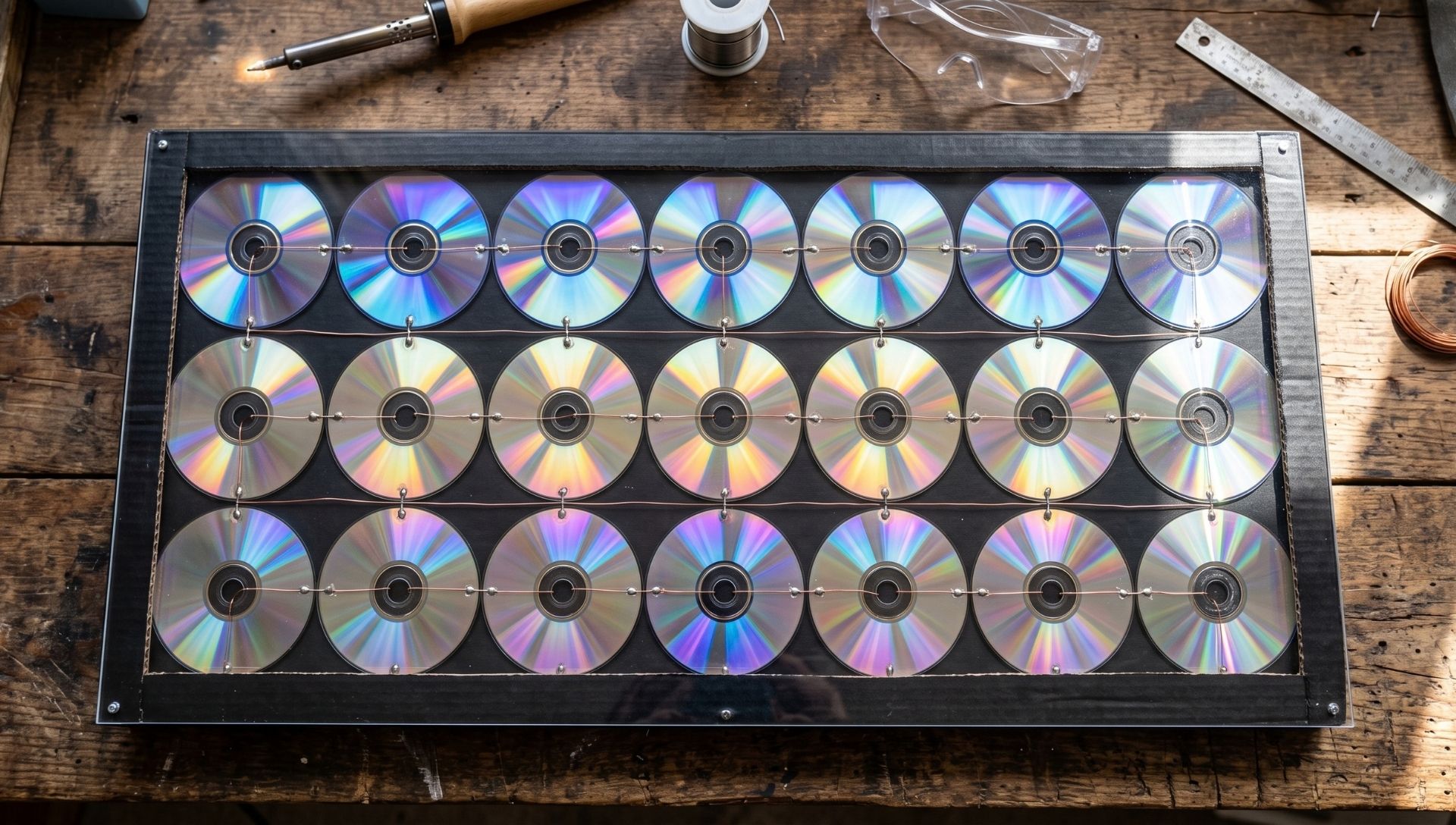
I still remember staring at a dusty spindle of old 1990s mixtapes and outdated software discs, wondering if there was a better destiny for them than the local landfill. As someone who has spent years tinkering with off-grid setups, I constantly look for ways to turn scrap into functional science. If you have ever wondered how to make a solar panel with CD materials, you are in the right place.
Before we start cutting cardboard and melting solder, let’s set the record straight. Repurposing CDs for solar energy is a fantastic, hands-on educational experiment. It will not power your refrigerator, nor will it replace a commercial rooftop solar array. However, building a homemade solar panel using old discs is one of the most effective ways to learn the fundamentals of solar heat capture, light diffraction, and basic circuitry.
In this guide, I will walk you through exactly how I build these panels. We will cover everything from prepping the base to wiring the circuit. If you happen to have old Blu-ray discs lying around, grab those—their microscopic track patterns are even finer than standard CDs or DVDs, which yields slightly better light diffraction for our purposes. Whether you are a hobbyist, a STEM educator, or a beginner diving into renewable energy DIY, this project provides a brilliant weekend challenge.
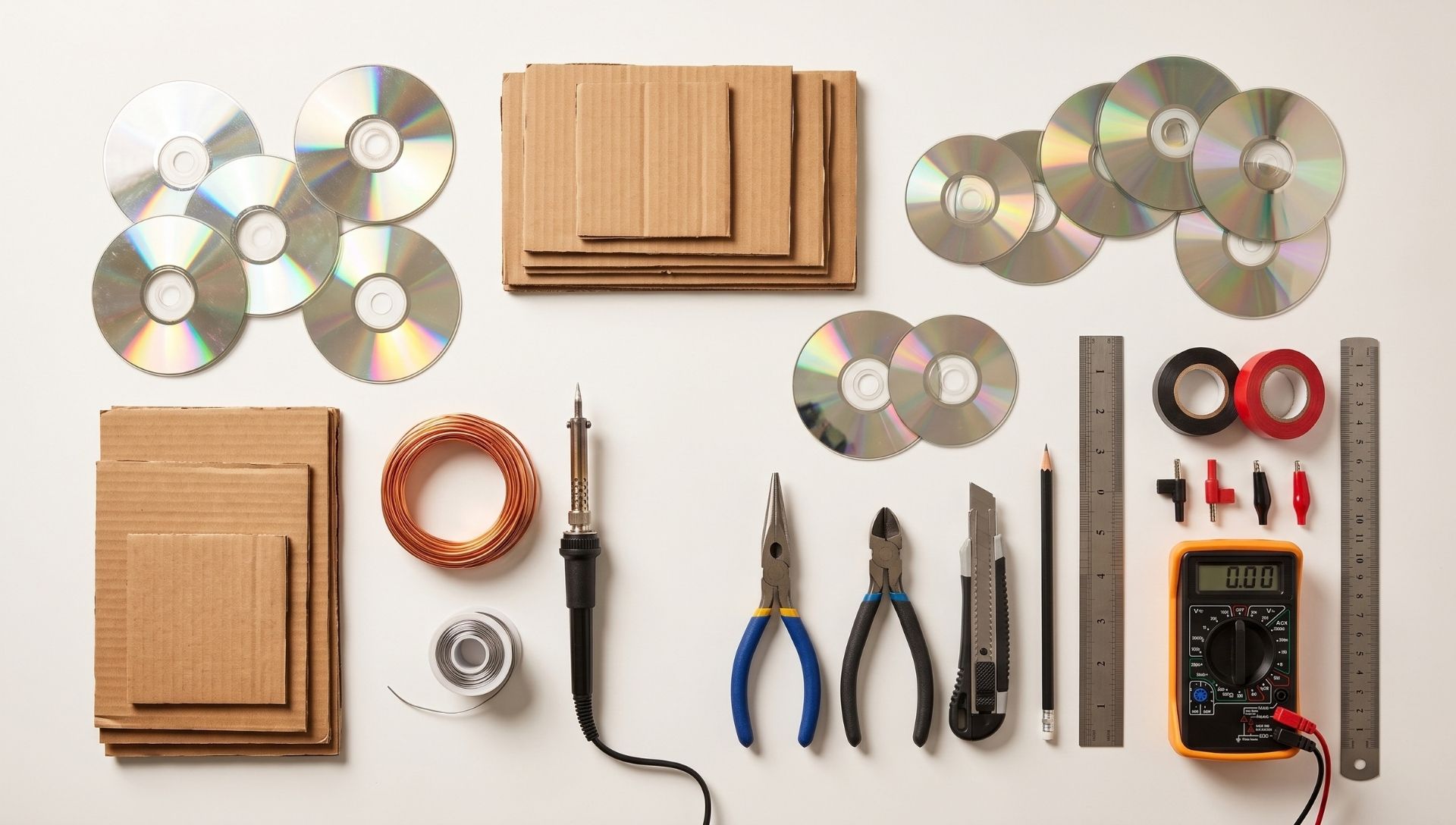
What You Need: Materials and Tools
The beauty of a CD solar energy project lies in its accessibility. You can find almost everything you need in your garage, at a local hardware store, or by scouring thrift shops and online community marketplaces for cheap, discarded media.
Essential Materials
- Cardboard base: This acts as the structural foundation for your panel, keeping the lightweight components rigid and portable.
- Aluminum foil: Used to create a highly reflective back layer that bounces sunlight back up through the CDs, maximizing light capture.
- Old CDs, DVDs, or Blu-rays: The star of the project; their metallic data layers and microscopic grooves help capture and trap solar radiation.
- Strong adhesive: A robust construction adhesive or high-grade epoxy is necessary to bond the CDs permanently to the foil and cardboard.
- Copper wire: You will need thin, uninsulated copper wire (or stripped wire) to link the discs together, simulating the electrical pathways of a real solar array.
- Silicone sealant: Used to waterproof the edges of the panel and seal the protective top layer, preventing moisture from ruining the cardboard.
- Transparent acrylic or plexiglass sheet: This covers the finished panel, protecting the delicate internal components while creating a miniature greenhouse effect to trap solar heat.
Required Tools
- Utility knife: For making precise, clean cuts through the heavy cardboard and trimming excess foil.
- Ruler or straight edge: Essential for measuring your base accurately and ensuring your rows of CDs are perfectly aligned.
- Sandpaper (medium grit): Used to smooth the rough cut edges of the cardboard, preventing fraying and ensuring the silicone sealant adheres properly later.
- Paintbrush: For applying primer and paint to the exposed areas of your cardboard base.
- Primer: Seals the porous cardboard surface so the acrylic paint does not soak in and warp the material.
- Acrylic paint: Provides a durable, weather-resistant finish to the outside of your cardboard housing.
- Soldering iron and rosin-core solder: Necessary for securely attaching the copper wire to the metallic surface of the CDs to create our circuit.
Step-by-Step Instructions
Building a homemade solar panel requires patience and a bit of precision. I highly recommend reading through all these steps before you make your first cut.
Step 1 – Measure and Cut the Cardboard Base
Your first task is creating the housing. Lay your CDs out on your uncut cardboard to determine the footprint of your panel. I usually aim for a 3×3 or 4×4 grid of discs. Leave at least a two-inch border around the perimeter of the CDs so you have room to attach the acrylic cover later.
Once you have your dimensions, use your ruler and utility knife to score the cardboard. Make several shallow passes with the knife rather than trying to hack through it all at once; this prevents the cardboard from crushing or tearing. After you cut out the rectangular base, take your medium-grit sandpaper and gently sand down the edges. This knocks off any frayed paper fibers and leaves a clean, professional-looking finish.
Step 2 – Prime and Paint the Cardboard
Cardboard acts like a sponge, which is the enemy of any project meant to sit in the sun and weather. To protect it, apply a thin, even coat of primer to the top, bottom, and sanded edges.
Let the primer dry completely. Once dry, apply your acrylic paint. I personally prefer flat black paint for the exterior because black absorbs ambient heat, which conceptually aligns with our solar project, but any color will do. Allow the paint to cure for at least a few hours. Rushing this step will result in a sticky surface that makes attaching the foil a nightmare.
Step 3 – Attach Aluminum Foil to the Cardboard
The aluminum foil acts as a reflector, bouncing escaping light rays back up toward the underside of the CDs. Measure a piece of aluminum foil that perfectly matches the interior dimensions of your painted base (leaving the borders bare for the sealant later).
Apply a thin, even layer of spray adhesive or spread liquid glue very thinly over the cardboard. Carefully lay the foil down, shiny side up.
Builder’s Tip: The first time I attempted this, I slapped the foil down carelessly and ended up with massive, sharp wrinkles that ruined the flat surface. To avoid this, lay one edge of the foil down first, and use the edge of a credit card to slowly smooth the foil outward, pushing air bubbles out as you go.
Step 4 – Position and Glue the CDs
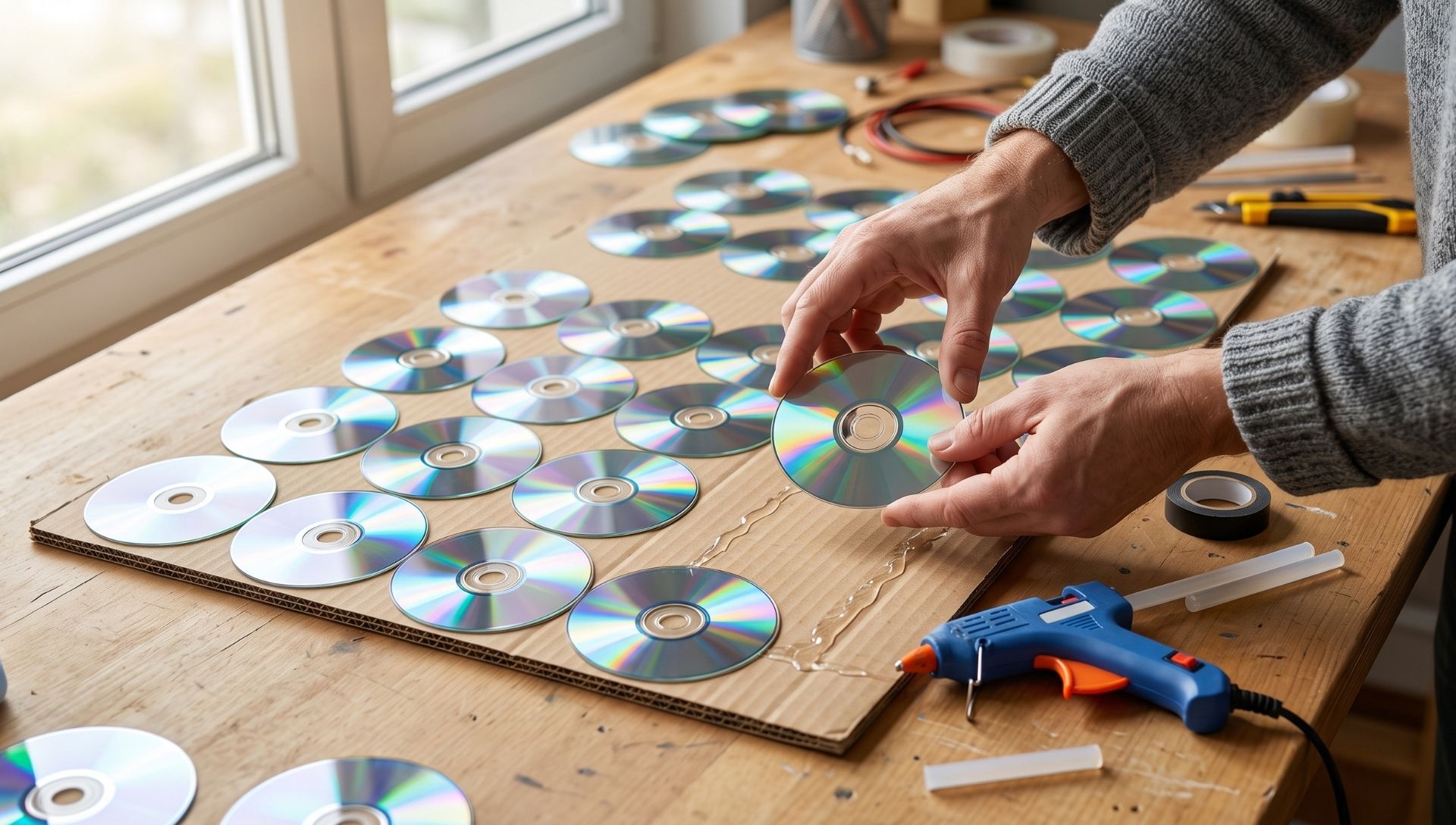
Now we arrange the discs. Lay your CDs onto the foil-covered board in evenly spaced rows and columns. Ensure they are all facing the exact same direction (usually with the shiny, reflective data side facing up toward the sun).
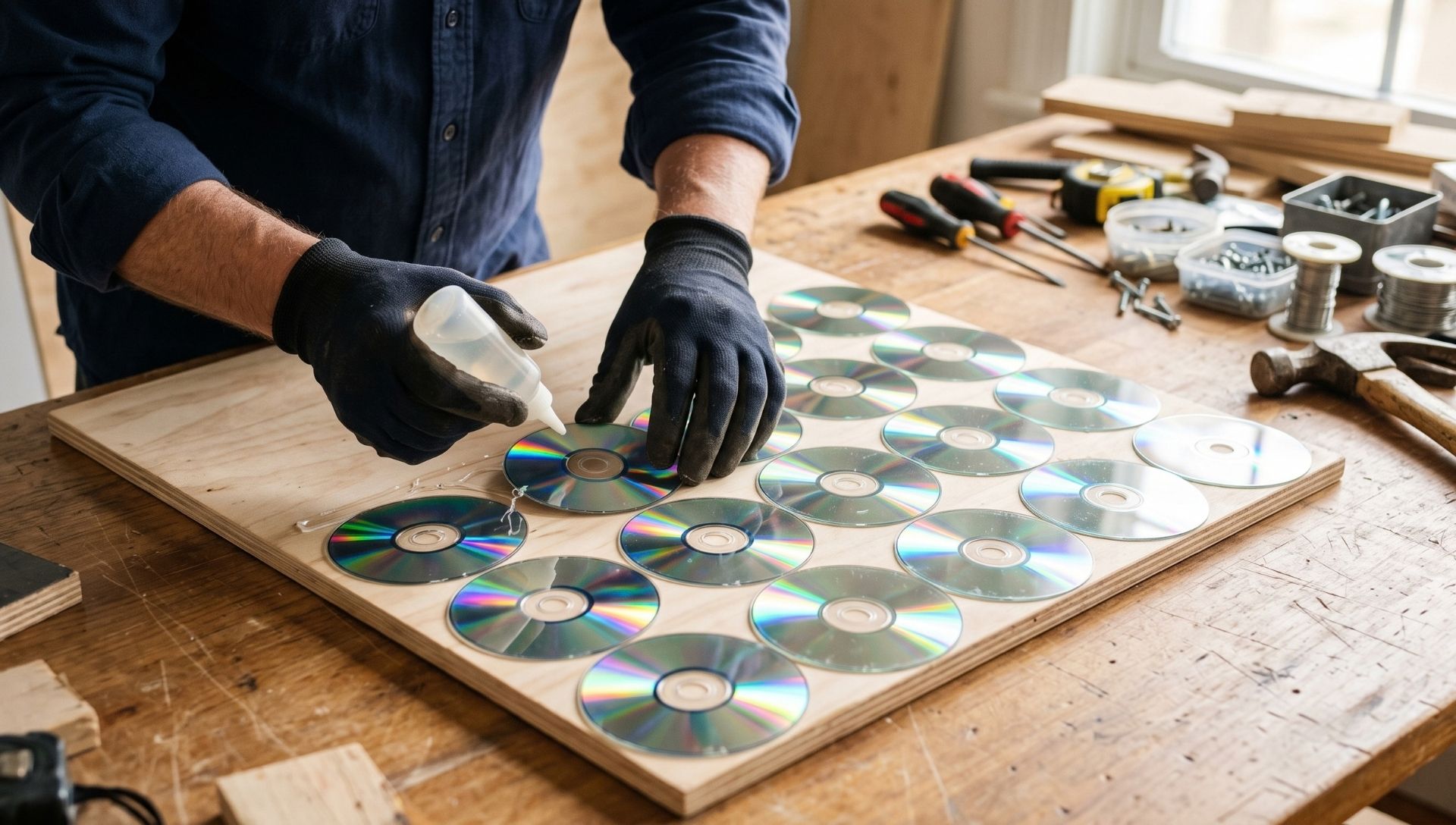
Use your ruler to align the edges of the discs. Once you are happy with the layout, pick up one CD at a time, apply a small ring of strong adhesive to the bottom, and press it firmly back into its spot. Double-check your alignment immediately before the adhesive sets. Crooked CDs will make the wiring step incredibly frustrating.
Step 5 – Wire the CDs in a Series Circuit
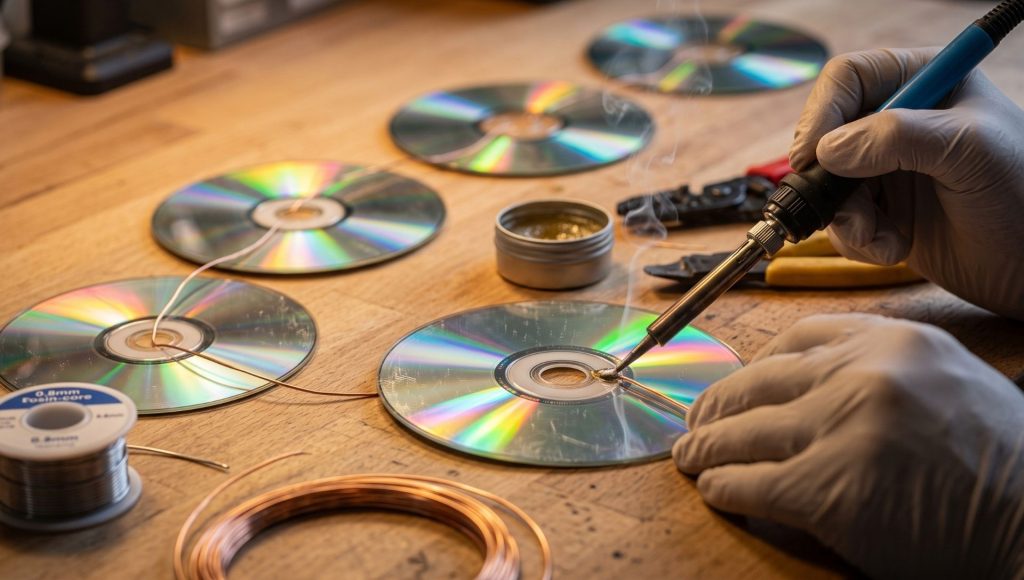
This is where the project bridges the gap between arts and crafts and a true STEM experiment. You are going to connect the CDs using copper wire in a series circuit. In a series circuit, components are connected end-to-end, forming a single path for electrical current to flow. In commercial solar panels, wiring cells in series increases the total voltage of the panel. By doing this here, you are physically modeling how actual photovoltaic arrays are constructed.
Cut short lengths of copper wire to bridge the gap between the center hole of one CD and the outer edge of the next. Heat up your soldering iron. Apply a tiny drop of solder to the metallic surface of the CD, and attach the wire. Repeat this process, linking the first CD to the second, the second to the third, and so on, until the entire grid is connected in one continuous zigzag path.
Builder’s Tip: Soldering plastic-backed discs requires a very light touch. Early on in my renewable energy DIY journey, I held the soldering iron against a CD for about three seconds too long. It melted a massive hole straight through the plastic and ruined the disc. Touch the iron to the disc only long enough to melt the solder—usually less than a second. If you are unfamiliar with soldering, practice on a spare, unglued CD first.
Step 6 – Seal and Protect the Panel
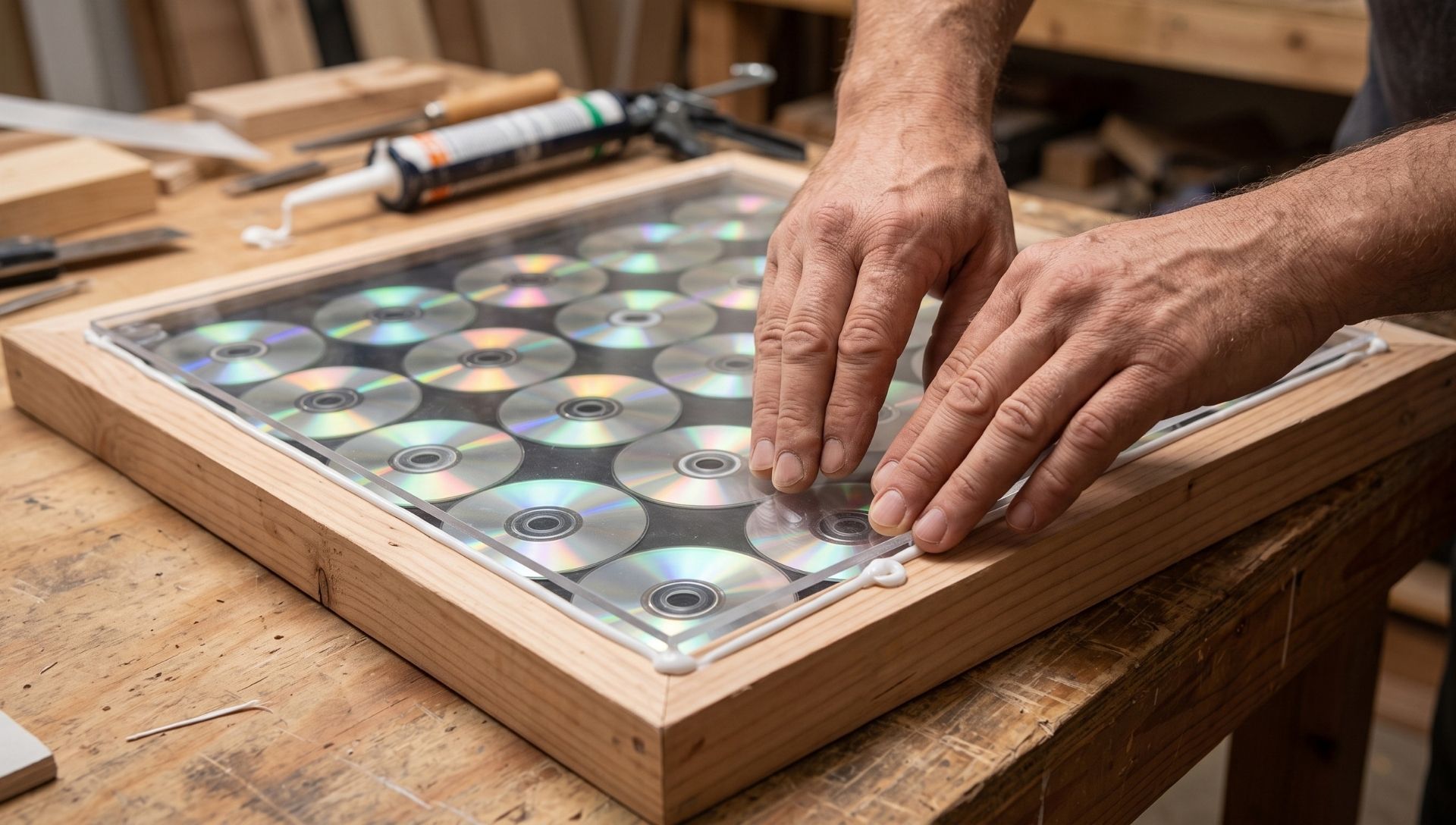
With the interior components finished, it is time to enclose the panel. Run a continuous, thick bead of silicone sealant along the outer painted border of your cardboard base.
Carefully lower your transparent acrylic or plexiglass sheet onto the silicone bead. Press down gently along the edges to ensure the silicone flattens out and creates a watertight, airtight seal. This acrylic layer does two things: it protects your fragile soldered wires from wind and debris, and it traps the solar radiation inside the box, significantly increasing the heat retained by the CDs. Wipe away any excess silicone that squeezes out the sides, and let the entire assembly cure overnight.
How It Works: The Science Behind CD Solar Panels
To appreciate this project, we have to look at the science of what is actually happening under that plexiglass. When sunlight hits your finished panel, it passes through the clear acrylic and strikes the CDs.
CDs, DVDs, and Blu-ray discs are manufactured with a thin layer of aluminum or gold to reflect laser light in a media player. They also feature microscopic, spiral grooves (or pits). When sunlight hits these metallic grooves, the light is scattered and diffracted. The aluminum foil backing catches any light that passes through the holes or gaps and bounces it right back into the discs.
It is vital to understand the difference between solar heat energy capture and photovoltaic electricity generation. Real commercial solar panels are made of silicon semiconductors that exhibit the photovoltaic effect—meaning they literally knock electrons loose from atoms when hit by photons of light, creating an electrical current.
Your CD panel does not contain these semiconductor materials. While the copper wire teaches the concept of an electrical circuit, the actual energy generated by this CD panel is primarily thermal (heat), alongside an incredibly minute, almost unmeasurable voltage caused by the metallic reaction to intense heat. You are building a highly efficient solar heat trap, not a power plant.
Ready to Build a Panel That Actually Powers Your Appliances?
Building a CD solar panel is a fantastic educational experiment, but it will not run your refrigerator or slash your utility bills. If you are ready to graduate from tabletop science projects to genuine energy independence, you need functional, high-output solutions. The DIY Home Energy system teaches you exactly how to build professional-grade solar panels and wind turbines from scratch using easily accessible materials—for a fraction of the cost of retail commercial systems.
Watch the DIY Home Energy Video to Start Building Real Off-Grid Power
Limitations and Honest Expectations
I believe in being completely straightforward about DIY projects. If you build this expecting to charge your smartphone or run a fan, you will be disappointed. A CD solar panel is an experimental, low-output device.
This build shines as an educational tool. It provides a tactile, visual way to understand how surface area, reflectivity, circuitry, and the greenhouse effect work together in renewable energy systems. It is perfect for middle school science fairs, scouting badges, or a weekend hobby project to teach children about sustainability.
If your goal is real energy independence, off-grid living, or lowering your monthly utility bills, this project will not get you there. For those goals, I highly recommend consulting a certified solar installer or purchasing a small, commercially manufactured 100-watt monocrystalline solar panel to begin your off-grid journey.
If your ultimate goal is real energy independence, off-grid living, or lowering your monthly utility bills, this CD project will not get you there. For those serious goals, I highly recommend following the DIY Home Energy step-by-step blueprints to build high-output, functional solar panels that actually power your household appliances. Consult a certified solar installer or purchasing a small, commercially manufactured 100-watt monocrystalline solar panel to begin your off-grid journey.
Safety Precautions
Working with sharp tools, adhesives, and molten metal requires respect for safety protocols. Do not skip these precautions.
- Wear safety glasses: Always protect your eyes. Solder can pop and spit unexpectedly, and snapping utility knife blades are a real hazard when cutting thick cardboard.
- Use a dust mask: Cardboard dust from sanding is fine and easily inhaled. Wear a basic dust mask to protect your lungs.
- Wear closed-toe shoes: If you drop a hot soldering iron or a sharp utility knife, you want your feet protected.
- Handle CDs with care: Old, brittle CDs can snap easily. The resulting plastic shards are razor-sharp. Apply gentle pressure when gluing them down.
- Ensure proper ventilation: Soldering rosin, spray adhesives, and silicone sealants all emit fumes. Only work in a well-ventilated garage with the door open, or outdoors.
- Practice electrical safety: Even though this specific panel will not generate dangerous voltages, you are still working with a hot soldering iron capable of causing severe burns (upwards of 600°F). Always return the iron to its designated stand immediately after use.
Frequently Asked Questions
Can a CD solar panel actually generate electricity?
A CD panel generates almost zero usable electricity because it lacks the silicon semiconductors required for the photovoltaic effect. It primarily acts as a solar thermal collector, capturing and trapping heat from the sun. The wiring in this project serves mainly to teach the concept of circuitry.
How many CDs do I need to make a solar panel?
The number of CDs depends entirely on the size of the panel you want to build. A standard experimental panel usually uses between 9 and 16 discs, arranged in a 3×3 or 4×4 grid. You can scale the project up or down based on how much cardboard and acrylic you have available.
Are Blu-ray discs better than regular CDs for this project?
Yes, Blu-ray discs are slightly better than standard CDs or DVDs for this specific experiment. Blu-rays have much finer, more densely packed data tracks, which allows them to diffract and capture sunlight a bit more efficiently than older media formats.
How long does it take to build a CD solar panel?
Active hands-on building time is roughly two to three hours. However, you must account for drying times. Allowing the primer, paint, adhesives, and the final silicone sealant to cure properly means this project is best spread over a two-day weekend.
Is a CD solar panel safe to make at home?
Yes, it is very safe to make at home provided you follow basic DIY safety guidelines. The main risks come from the tools used—specifically the sharp utility knife and the hot soldering iron—rather than the materials or the final product itself.
Wrapping Up
Building a homemade solar panel out of old media discs is a highly rewarding way to spend a weekend. By following this guide, you have not only kept plastic waste out of the trash, but you have also built a functional model that demonstrates the core principles of solar geometry, thermal trapping, and series circuitry.
Remember that while this panel will not power your home, the concepts you just practiced are the exact same principles powering massive solar farms around the world. Every expert starts by tinkering with the basics.
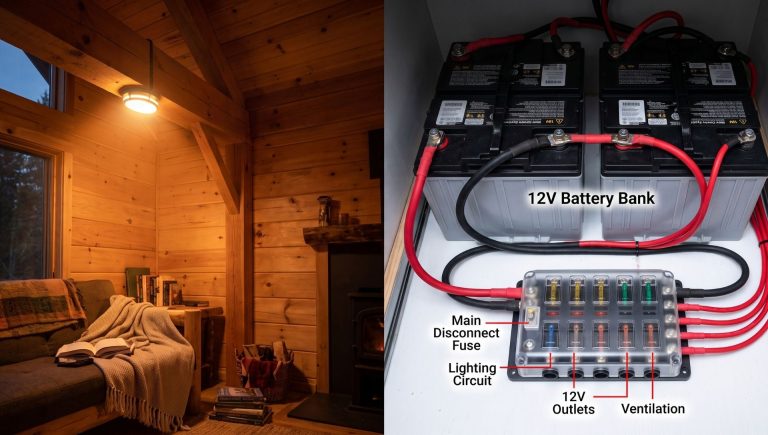
If this project sparked your interest in building practical off-grid solutions, do not stop here. Explore our other guides on sizing real battery banks, wiring 12-volt commercial panels, and designing sustainable energy systems. Knowing how to make a solar panel with CD materials is just the first step on a much larger journey toward understanding renewable energy.
Take the Next Step: Power Your Entire Home Off-Grid
You have mastered the fundamental science of solar capture and circuitry. Now it is time to apply those principles to real-world electricity generation. The DIY Home Energy system provides complete, step-by-step blueprints designed for average homeowners to achieve total energy independence. Stop relying on an unstable grid and learn how to construct a robust, affordable off-grid power system right in your garage.