The internet is awash with claims of revolutionary technologies, with zero-point energy generators often touted as the ultimate solution to our global power needs. Promising limitless, clean, and free electricity, these theoretical devices capture the imagination of renewable energy enthusiasts and science fiction fans alike. But what is the actual science behind these claims?
To understand the reality of this technology, we must navigate the complex boundary between legitimate quantum mechanics and speculative pseudoscience. While zero-point energy is a very real, experimentally verified phenomenon in physics, the concept of building a macroscopic generator to harvest it is fundamentally flawed.
In this comprehensive guide, we will explore the actual mechanics of quantum vacuum fluctuations. We will break down why legitimate phenomena like the Casimir effect exist, and explain why harnessing this energy for daily power consumption remains firmly outside the laws of physics.
Ready to Build Your Own Off-Grid Power System?
The number one reason DIY magnetic generators fail isn’t the physics—it is a lack of precision tools. Don’t drill a single hole or twist a single wire until you’ve set up your workspace like a professional energy lab. Grab our free 17-page blueprint covering the exact tools, safety gear, and air-gap instruments you need to succeed on your first try.
Fundamentals of Zero-Point Energy
What Is Zero-Point Energy?
In classical physics, a complete vacuum is entirely empty, possessing zero energy and no movement. However, quantum mechanics paints a vastly different picture. Zero-point energy (ZPE) is the lowest possible energy that a quantum mechanical physical system may have. It is the energy that remains in a system even at absolute zero (0 Kelvin or -273.15°C).
At absolute zero, classical thermodynamics dictates that all atomic and molecular movement should stop. Yet, quantum systems cannot be completely stripped of energy. Even in the deepest, coldest vacuum of space, microscopic electromagnetic waves continue to ripple. This baseline energy is what physicists refer to as vacuum energy.
Empty Space Is Never Truly Empty
To understand ZPE, we must redefine our concept of “empty space.” The universe is permeated by quantum fields. Even when these fields are in their most stable, lowest-energy state (the “vacuum state”), they are not perfectly still.
Instead of a serene, empty void, the quantum vacuum is a boiling sea of activity. It is filled with transient electromagnetic waves and “virtual particles” that briefly pop into existence before annihilating each other almost instantly. This continuous, unavoidable baseline activity is the true nature of zero-point energy.
Quantum Mechanics Principles Behind ZPE
The Heisenberg Uncertainty Principle
The foundational rule that makes zero-point energy possible is the Heisenberg Uncertainty Principle, formulated by physicist Werner Heisenberg in 1927. This principle states that it is impossible to simultaneously know both the exact position and the exact momentum of a particle.
- The Energy-Time Relationship: A parallel version of this principle applies to energy and time. We cannot know the exact energy of a system at a perfectly precise moment in time.
- The Quantum Jitter: Because a system cannot possess absolute zero energy (which would imply knowing its exact energy state with absolute certainty), there must always be a residual “jitter” or fluctuation.
- Irreducible Energy: This quantum jitter guarantees that a baseline level of energy—the zero-point energy—must always exist, even in a perfect vacuum.
Quantum Vacuum Fluctuations
Because of this inherent uncertainty, the fabric of space undergoes constant quantum vacuum fluctuations. These fluctuations manifest as virtual particle-antiparticle pairs. An electron and a positron might spontaneously appear, exist for a fraction of a millisecond, and then recombine and vanish.
While these particles are termed “virtual” because they cannot be directly captured or observed in the traditional sense, their aggregate effects are very real. They exert measurable forces on physical objects, which serves as the concrete proof that zero-point energy is not just a mathematical quirk, but a fundamental characteristic of our universe.
The Truth About “Zero-Point Energy Generators
Can Zero-Point Energy Be Harnessed?
This brings us to the core controversy: the pursuit of zero-point energy generators. If empty space contains boundless energy, why can’t we simply plug a machine into the vacuum and power our cities? The answer lies in the uncompromising laws of thermodynamics.
To do useful work—like turning a turbine, lighting a bulb, or charging a battery—energy must flow from a region of high energy to a region of low energy. This is a basic tenet of the Second Law of Thermodynamics.
The Thermodynamic Roadblock
The insurmountable problem with quantum energy extraction is the definition of the vacuum state itself.
- Zero-point energy is, by definition, the lowest possible energy state of a system.
- Because there is no lower energy state for the energy to flow into, no useful work can be extracted.
- Attempting to extract energy from the quantum vacuum is like trying to use water at sea level to turn a waterwheel; without a drop in elevation, the water has no kinetic potential to do work.
Debunking Pseudoscientific Claims
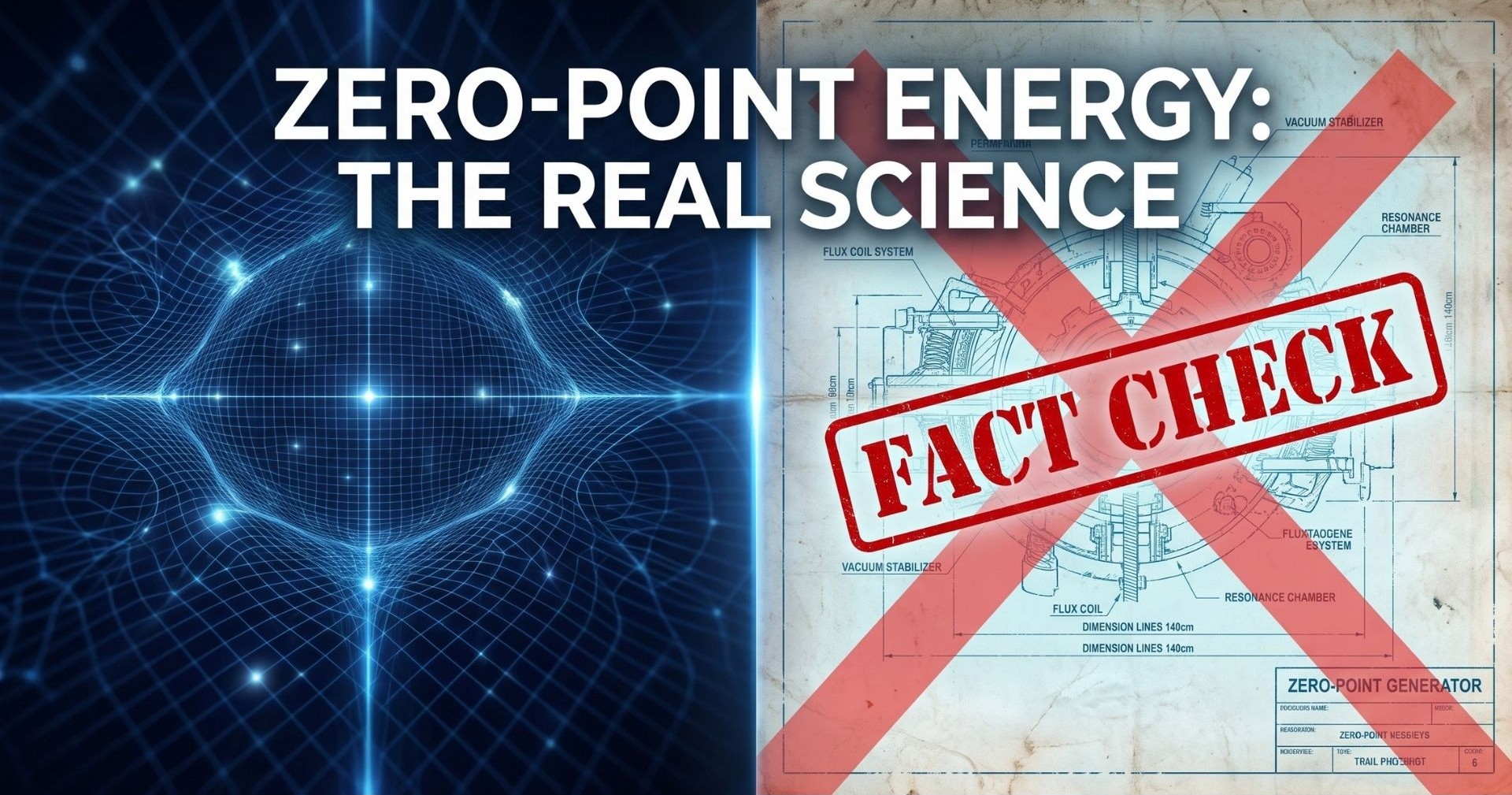
Many online schematics and blueprints claim to have bypassed these laws using so-called zero-point energy generators. These claims often rely on impressive-sounding but scientifically meaningless jargon.
- Resonant Energy Conversion: Often used in fringe circles to describe tuning a machine to the frequency of the vacuum. In reality, you cannot resonate with a ground state to extract net-positive energy.
- Vortex Theory: A pseudoscientific concept suggesting that spinning magnets or specific geometries can create a vortex to suck energy from the quantum realm. No peer-reviewed physics supports this.
- Quantum Tunneling Devices: While quantum tunneling is a real phenomenon used in modern electronics (like flash memory), it does not create free energy. It simply allows particles to pass through barriers, strictly adhering to energy conservation laws.
Legitimate Research and Real-World Applications
The Science Behind the Casimir Effect
If we cannot extract ZPE for power, how do we know it actually exists? The most famous and concrete proof of vacuum energy is the Casimir effect, predicted by Dutch physicist Hendrik Casimir in 1948 and experimentally confirmed in the late 1990s.
The Casimir effect occurs when two uncharged, highly polished metal plates are placed incredibly close together in a perfect vacuum (mere nanometers apart).
- Outside the plates, vacuum fluctuations of all wavelengths can exist.
- Between the extremely narrow gap of the plates, only fluctuations with certain small wavelengths can fit.
- Because there are more fluctuations (and thus more energy pressure) pushing on the outside of the plates than pushing outward from the inside, the plates are forced together.
This measurable attractive force is the direct physical manifestation of zero-point energy. It proves that the quantum vacuum exerts real mechanical pressure.
Applications in Nanotechnology
While the Casimir effect doesn’t provide a power source, understanding it is vital for modern engineering. Researchers at institutions like MIT and various global quantum physics labs are actively studying these forces.
In the realm of Micro-Electromechanical Systems (MEMS) and Nano-Electromechanical Systems (NEMS), the Casimir force becomes a significant factor. When building microscopic machines, the vacuum pressure can cause tiny moving parts to stick together—a phenomenon known as “stiction.” Understanding ZPE is essential to designing the next generation of nanotechnology and quantum computing hardware.
Common Myths and Misconceptions About ZPE Generators
To maintain scientific literacy, it is crucial to separate the rigorous study of quantum mechanics from modern mythology. Several prevalent myths surround zero-point energy generators:
- The “Suppressed Technology” Myth: A common narrative suggests that functional free-energy devices have already been invented but are actively suppressed by the fossil fuel industry or governments. In reality, the lack of these devices is due to the laws of physics, not a global conspiracy.
- Spiritual and Metaphysical Conflation: Many fringe theories attempt to link zero-point energy to human consciousness, vibrational healing, or higher-dimensional spiritual planes. These claims are entirely unscientific. Quantum field theory is a framework of rigorous mathematics and physical measurements; it has no proven intersection with consciousness or spiritual metaphysics.
- The “Over-Unity” Fallacy: Many purported ZPE generators are pitched as “over-unity” devices, meaning they output more energy than they consume. Every rigorously tested over-unity device in history has ultimately been proven to be either a deliberate fraud or the result of flawed measurement errors.
Future Outlook for Quantum Energy Research
While desktop zero-point energy generators powering your home belong to the realm of science fiction, the study of the quantum vacuum is driving actual, legitimate scientific breakthroughs.
Advancements in Quantum Computing
The study of vacuum fluctuations is critical in the development of quantum computers. Qubits (quantum bits) are highly sensitive to their environment, and understanding how vacuum energy interacts with these systems is essential for reducing computational errors and achieving quantum supremacy.
Cosmology and Dark Energy
On a macroscopic scale, zero-point energy has profound implications for our understanding of the universe. Physicists theorize that vacuum energy may be related to “Dark Energy,” the mysterious force causing the accelerated expansion of the universe. While there is currently a massive discrepancy between the predicted value of vacuum energy and the observed density of dark energy (often called the “vacuum catastrophe”), this remains one of the most exciting frontiers in modern astrophysics.
Conclusion
The allure of zero-point energy generators is entirely understandable. The idea of tapping into the invisible fabric of the universe to secure a post-scarcity, clean-energy future is a beautiful dream. However, true scientific literacy requires us to differentiate between what sounds good and what is mathematically and physically possible.
Zero-point energy is a profound and established scientific reality. It proves that the universe is vibrant and active even at its lowest energy states. Phenomena like the Casimir effect demonstrate that quantum vacuum fluctuations are not just math—they are physical forces. Yet, because ZPE represents the absolute floor of energy in the universe, the second law of thermodynamics firmly prohibits us from siphoning it off to power our grids.
By focusing on legitimate quantum research rather than chasing impossible free-energy machines, we pave the way for real advancements in nanotechnology, quantum computing, and a deeper understanding of the cosmos itself.
Frequently Asked Questions (FAQ)
No, macroscopic zero-point energy generators that produce usable electricity are not real. While zero-point energy itself is a proven scientific concept, extracting it to do useful work violates the Second Law of Thermodynamics, as the energy is already in its lowest possible state.
No. “Free energy” or “over-unity” devices (machines that generate more energy than they consume) violate the fundamental law of conservation of energy. Vacuum fluctuations exist, but they cannot be harnessed as a continuous, net-positive energy source.
The Casimir effect is a physical force arising from a quantized field. It is most commonly observed as an attractive force between two uncharged, parallel metal plates placed in a vacuum, caused by the difference in quantum vacuum fluctuations inside and outside the plates. It is the primary experimental proof of zero-point energy.
Because ZPE involves complex, counter-intuitive quantum mechanics (like energy existing in a vacuum), it is easily misinterpreted or deliberately misrepresented by individuals promoting fraudulent “free energy” technologies or unscientific metaphysical concepts.