Over my 15 years of testing and engineering off-grid energy systems, I have seen every kind of alternative energy prototype imaginable. People routinely bring me blueprints for a revolutionary magnetic power generator that promises to power a home forever without fuel. I have built these prototypes, tested the voltage outputs, and analyzed the magnetic arrays. The reality of this technology is fascinating, but it is deeply clouded by internet myths.
If you are looking for a reliable way to generate electricity, you need to understand the difference between proven electromagnetic engineering and internet hype. This guide breaks down the actual science of magnetic power generation. We will look at what works, what violates the laws of physics, and how real magnetic systems are powering the future.
Disclaimer: This article distinguishes between proven, peer-reviewed electromagnetic science and theoretical claims. Devices claiming to produce more energy than they consume (overunity) violate the First and Second Laws of Thermodynamics and have never been scientifically validated.
What is a Magnetic Power Generator?
A magnetic power generator is an electromechanical device that uses the interaction between magnetic fields and conductive wire coils to produce electrical energy. Based on Faraday’s Law of Induction, these devices require a mechanical input force—such as wind, water, or a combustion engine—to spin the magnets or coils, thereby converting kinetic energy into usable electricity.
When people search for a free energy generator, they are usually looking for a device that spins on its own using permanent magnets. However, legitimate magnetic generators always require an external mechanical force to operate. They are the foundational technology behind modern wind turbines, hydroelectric dams, and portable gas generators.
How Does a Magnetic Power Generator Actually Work?
To understand this technology, we must look at the proven physics of electromagnetic induction. James Clerk Maxwell and Michael Faraday established these principles in the 19th century, and they remain the absolute standard in electrical engineering today.
Here is the step-by-step process of how a legitimate magnetic power generator creates electricity:
- Mechanical Input Initiation: An external physical force (like a spinning wind turbine blade or a hand crank) rotates a central shaft.
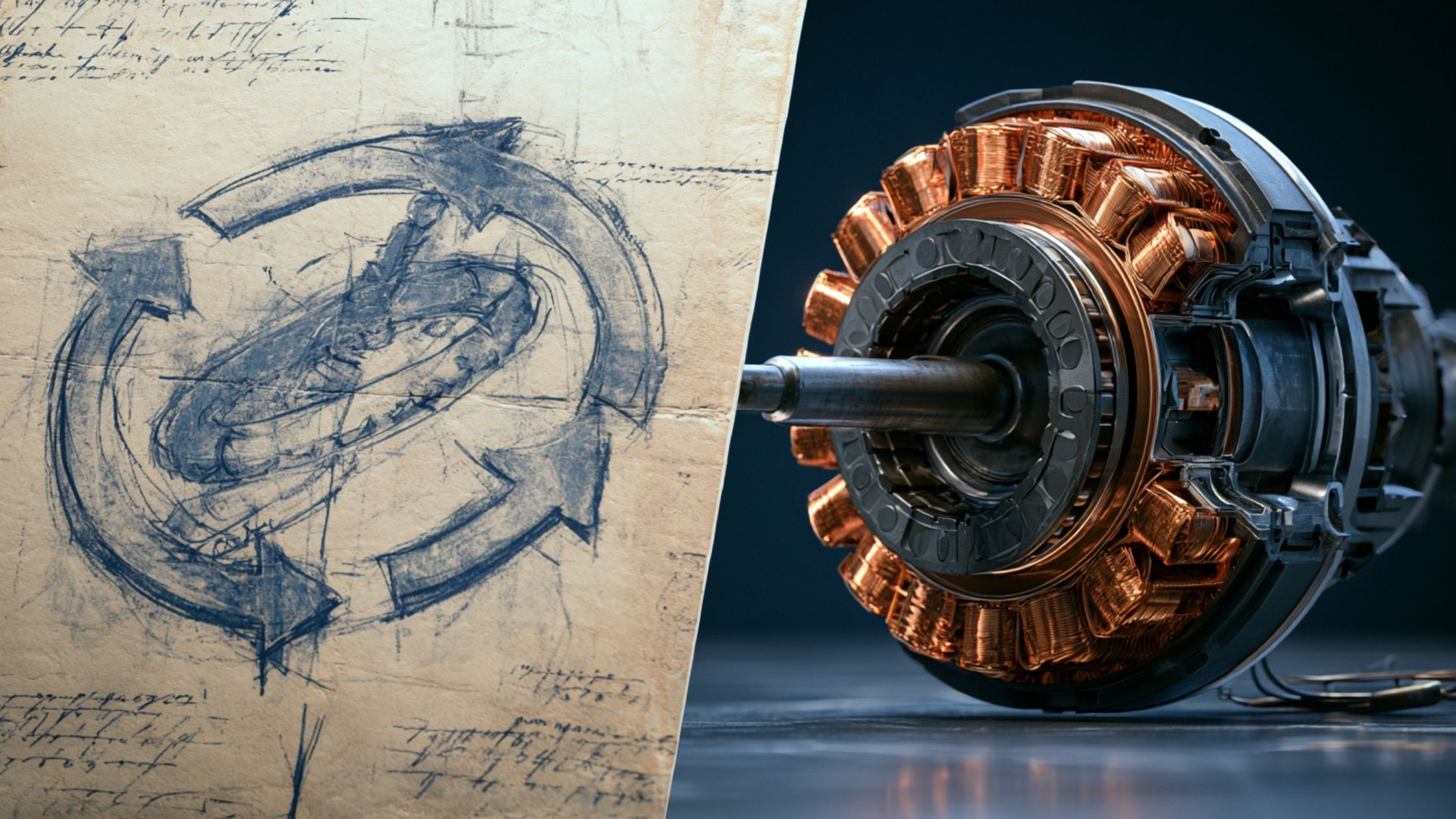
- Magnetic Field Rotation: Attached to this shaft is a rotor equipped with strong neodymium or samarium-cobalt magnets.
- Flux Line Intersection: As the rotor spins, the invisible lines of magnetic flux continuously sweep across a surrounding stationary stator, which is lined with tightly wound copper coils.
- Electron Displacement: The shifting magnetic field pushes and pulls the free electrons within the copper wire, forcing them to flow in a specific direction.
- Current Collection: This flow of electrons produces an alternating current (AC), which is then captured, regulated, and sent to a battery bank or direct load.
Without step one—the mechanical input—the entire process stops. The magnets themselves do not contain a reservoir of extractable electrical energy; they merely act as the mechanism that converts physical motion into electrical current.
The “Free Energy” Myth vs. Reality
One of the most pervasive myths in the alternative energy space is the concept of a perpetual motion machine. Online videos frequently showcase a magnetic power generator spinning endlessly, seemingly powering lightbulbs without any wind, fuel, or solar input.
The Illusion of Infinite Power
These videos claim that by angling permanent magnets in a specific array, the repelling forces will push the rotor in a continuous circle. This is a profound misunderstanding of physics. A permanent magnet exerts a static force, much like a stretched rubber band or gravity. You cannot extract continuous dynamic energy from a static field.
Factual Counterpoints to Common Misconceptions
- Misconception: Magnets lose their charge as they produce electricity.
- Fact: Magnets in a standard generator do not degrade from generating power. They lose their magnetism only through extreme heat, physical damage, or naturally over hundreds of years.
- Misconception: A magnetic power generator can power itself.
- Fact: This is called “overunity.” Due to friction and electrical resistance, a system will always lose a small amount of energy as heat. A generator can never output enough power to continuously drive its own motor.
- Misconception: The government is hiding “free energy” patents.
- Fact: The United States Patent and Trademark Office (USPTO) explicitly requires a working model for any device claiming perpetual motion, because historically, 100% of these claims have failed under independent engineering scrutiny.
Types of Magnetic Energy Devices
While free energy is a myth, highly efficient magnetic systems are very real. The engineering world relies heavily on the permanent magnet motor and specialized alternators. Below is a comparison of how different magnetic energy devices function in the real world.
| Device Type | Power Source | Efficiency Rate | Primary Real-World Application | Scientific Validity |
|---|---|---|---|---|
| Standard Alternator | Gas/Diesel Engine | 50% – 60% | Automotive charging systems | Proven & Standard |
| Permanent Magnet Generator (PMG) | Wind / Hydro | 85% – 95% | Renewable energy turbines | Proven & Highly Efficient |
| Axial Flux Generator | Wind / Human Power | 80% – 90% | DIY wind turbines, compact electronics | Proven & Growing |
| “Overunity” Magnetic Motor | Self-Propelling | N/A (Fails) | Internet videos, scams | Disproven (Violates Physics) |
The Role of the Permanent Magnet Motor
A permanent magnet motor (PMM) operates in the reverse of a generator. Instead of using motion to create electricity, it uses electricity to create motion. When paired together in modern engineering, they create highly efficient systems.
For example, most modern electric vehicles (EVs) utilize permanent magnet synchronous motors. These motors use powerful rare-earth magnets to achieve incredibly high torque and efficiency. Furthermore, they utilize regenerative braking. When the driver takes their foot off the accelerator, the motor briefly turns into a magnetic power generator, capturing the kinetic energy of the moving car and pushing it back into the battery.
This is not a magnetic energy device creating energy out of thin air. It is a highly optimized system recovering energy that would otherwise be lost as brake heat. Organizations like the Institute of Electrical and Electronics Engineers (IEEE) continuously publish studies on optimizing these exact magnetic flux arrays to squeeze out every drop of efficiency.
Legitimate Applications for Off-Grid Power Solutions
For homesteaders and survivalists, the appeal of a magnetic power generator is obvious: energy independence. While you cannot build a perpetual motion machine, you can build highly efficient off-grid power solutions utilizing magnetic induction.
Micro-Hydro Turbines
If you have a flowing stream on your property, a micro-hydro turbine is the closest thing to continuous, passive energy you can get. These systems use a highly efficient permanent magnet generator. The flowing water provides the endless mechanical input, turning the magnetic rotor inside the stator 24 hours a day.
DIY Wind Generators
Many off-grid enthusiasts build axial flux magnetic generators from scratch. By setting neodymium magnets in a resin disc and spinning them past copper coils using homemade wind turbine blades, you can generate hundreds of watts of power. These projects teach the realities of electromagnetic physics firsthand. You quickly learn that to extract 500 watts of electrical power, your wind blades must capture substantially more than 500 watts of kinetic wind energy.
What the Experts Say: Studies and Engineering Consensus
When evaluating a magnetic power generator, it is vital to look at peer-reviewed consensus. Institutions like the Massachusetts Institute of Technology (MIT) and the Department of Energy (DOE) heavily research magnetic materials, specifically focusing on rare-earth magnets like neodymium-iron-boron (NdFeB).
Expert research focuses on reducing the weight of the generator, managing the heat that degrades magnetic fields, and increasing the conversion efficiency. According to the DOE, replacing traditional electromagnet rotors with permanent magnets in utility-scale wind turbines reduces mechanical failure points and increases energy yield by up to 4% over the lifespan of the turbine.
No credible scientific institution is researching self-running magnetic motors, because the mathematical models governing the universe explicitly forbid them. The focus of true expertise is always on conversion efficiency, not energy creation.
Frequently Asked Questions (FAQ)
Can a magnetic power generator run a house?
Yes, but only if it is driven by a continuous external mechanical force, such as a water turbine, a wind turbine, or a gas engine. A magnetic generator cannot power a house by simply spinning on its own using internal magnetic propulsion.
Are free energy magnetic motors real?
No. Videos showing free energy magnetic motors are typically hoaxes. They often hide small batteries inside the device, run hidden wires under the table, or use compressed air off-camera to spin the rotor.
Why do some people claim they have built working perpetual magnetic generators?
Many well-meaning inventors misinterpret their testing data. They might measure voltage spikes without measuring current under a load, or they fail to account for the energy drawn from a startup battery. Others are unfortunately running investment scams, seeking funding for a “revolutionary” magnetic energy device that will never reach the market.
What is the best magnetic generator for off-grid living?
The best legitimate magnetic generators for off-grid living are low-RPM permanent magnet alternators designed for wind or micro-hydro applications. Brands that specialize in renewable energy components offer generators optimized to produce 12V, 24V, or 48V output at very low rotational speeds.
Next Steps for Your Energy Independence
Understanding the true physics behind a magnetic power generator protects you from scams and empowers you to invest in technology that actually works. Magnets are undeniably the backbone of our modern electrical grid and the key to our renewable energy future, but they still play by the rules of physics.
If you are ready to apply real science to your energy independence, check out our comprehensive guide on designing a hybrid solar and wind system. Don’t let your off-grid journey stall on internet myths. Stay tuned with us to get weekly, science-backed tutorials on building reliable, independent power systems right in your backyard.