Affiliate & Editorial Disclosure: This guide and review contains affiliate links. If you purchase through our links, we may earn a commission at no extra cost to you. All performance assertions made by the vendor of The Energy Revolution System are treated as experimental DIY claims; we do not guarantee specific electricity bill reductions. Any downloadable blueprints referenced on this page are digital PDF and video instructions—physical hardware components are purchased separately.
When your utility bill jumps by $50 to $100, most energy blogs suggest expensive fixes. They tell you to finance a $20,000 solar array, replace your HVAC system, or buy new appliances. However, renters, apartment dwellers, and HOA-restricted homeowners rarely have those options. Spending $15,000 to save $100 a month also makes little financial sense.
For renters, apartment dwellers, HOA-restricted homeowners, and families on a practical budget, spending $15,000+ to save $100 a month makes zero financial sense. You want to know how to lower your electric bill without solar panels—and without taking on a 15-year solar loan.
As we demonstrated in our budget off-grid power system under $200 guide, the fastest way to cut your monthly kilowatt-hour (kWh) consumption isn’t mounting silicon panels on your roof. It is systematically eliminating phantom (“vampire”) standby loads, optimizing your water heater and refrigerator thermal cycles, and shifting everyday micro-loads (like phone charging and task lighting) off the utility grid.
In this practical household audit guide, we break down why your electric bill is so high from phantom loads, provide a room-by-room Standby Wattage Waste Table, share 11 no-solar habits you can implement this afternoon, and review how the efficiency manual inside The Energy Revolution System helps DIYers combine load reduction with a workbench 12V micro-power build.
Why Is My Electric Bill So High? The Hidden Math of Phantom Loads
Most homeowners assume an appliance only draws electricity while they are actively using it. In reality, modern homes contain dozens of devices with instant-on circuits, Wi-Fi chips, power bricks, and glowing displays. These devices draw power 24 hours a day, even when switched “off.”
Engineers call this standby draw phantom load. According to Lawrence Berkeley National Laboratory and Department of Energy research, phantom loads make up roughly 5% to 10% of residential electricity use.
Let’s look at how a seemingly tiny 100-Watt continuous phantom load quietly inflates your monthly utility bill:
- Daily Standby Drain: 100 Watts X 24 hours = 2,400 Watt-hours (2.4 kWh) per day.
- Monthly Standby Drain: 2.4 kWh X 30 days = 72 kWh per month of pure wasted electricity.
- Annual Cash Burn: At $0.20 to $0.28 per kWh (the current rate in many US regions), that single 100W trickle costs you $172 to $241 per year for electronics doing nothing while you sleep.
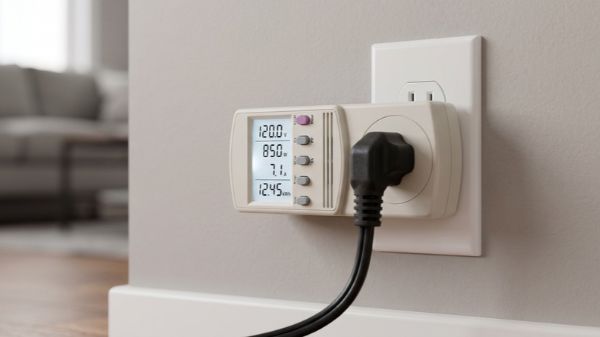
As shown above, a simple $15 plug-in digital watt meter (like a Kill A Watt monitor) plugs between your wall outlet and any appliance, displaying the exact real-time Watts and monthly kWh your devices consume while sitting idle.
Household Phantom Load Audit Table: The Top 8 Standby Offenders
Before you touch your thermostat, check these eight everyday household setups. Together, they easily account for 65 to 125 Watts of continuous 24/7 drain:
| Household Device / Zone | Standby Draw (When “Off” / Idle) | Monthly Waste (24/7) | Est. Annual Cost (@ $0.22/kWh) | Simple Fix |
|---|---|---|---|---|
| Cable / Satellite DVR Set-Top Box | 18W – 35W | 13.0 – 25.2 kWh | $34 – $66 / yr | Replace with streaming stick (2W) or smart strip |
| Gaming Console (PS5 / Xbox in Rest Mode) | 10W – 22W | 7.2 – 15.8 kWh | $19 – $42 / yr | Set power menu to “Full Energy Saver / Shutdown” |
| 65″ Smart TV (“Quick Start” Enabled) | 8W – 18W | 5.8 – 13.0 kWh | $15 – $34 / yr | Disable “Quick Start+” in TV settings or use switch strip |
| Desktop PC + Dual Monitors (Sleep Mode) | 12W – 25W | 8.6 – 18.0 kWh | $23 – $47 / yr | Enable Hibernation or flip master surge protector off |
| Subwoofer / Home Audio Receiver | 7W – 15W | 5.0 – 10.8 kWh | $13 – $28 / yr | Plug into a master-controlled TV power strip |
| Garage Cordless Tool Battery Chargers (2–3) | 4W – 10W | 2.9 – 7.2 kWh | $8 – $19 / yr | Unplug chargers once battery LED turns solid green |
| Kitchen Countertop (Microwave, Coffee, Air Fryer) | 6W – 12W | 4.3 – 8.6 kWh | $11 – $23 / yr | Use a single switched outlet wall tap for counter gadgets |
| Older Unswitched AC Wall Adapters & Bricks | 3W – 8W | 2.2 – 5.8 kWh | $6 – $15 / yr | Consolidate onto a single switched USB/12V charging station |
| Combined Household Phantom Total | 68W – 145W | 49 – 104 kWh/mo | $129 – $274 / yr | Master-switched strips + standby menu tweaks |
Download The Energy Revolution System Efficiency Guide & 12V Blueprints Here
11 Practical Ways to Lower Your Electric Bill Without Solar Panels
You don’t need to live in the dark or sit in a sweltering living room to trim 15% to 25% off your electric bill. Group your weekend adjustments into these three high-impact categories:
Slashing Standby & Electronic Waste (Habits 1–4)
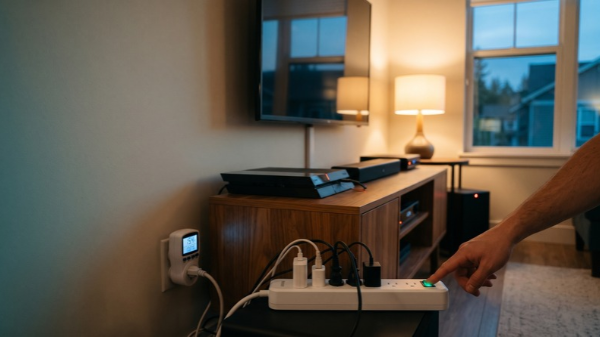
- Put Your Entertainment Center on a Master-Controlled Smart Power Strip: Your soundbar, subwoofer, and consoles do not need power at 3:00 AM. A $20 master-sensing strip cuts power to them when you turn off the TV.
- Turn Off “Instant-On” and “Quick-Start” TV & Console Modes: TVs and consoles often ship with these modes enabled so they wake a few seconds faster. In exchange, they can burn 10 to 30 watts all night. Switch to full shutdown in the settings menu, which takes about a minute.
- Unplug Garage Battery Maintainers and Tool Chargers: Chargers left plugged in waste power. Constant charging can also shorten battery life. Alternatively, put the chargers on a countdown timer outlet that shuts off after three hours.
- Consolidate Daily USB & Small-Device Charging Onto a 12V Micro-Circuit: Instead of having six separate AC wall warts plugged into bedrooms and kitchens across the house, shift your family’s daily smartphone, tablet, flashlight, and power-bank charging onto a dedicated 12V DC workbench setup—like the one taught in The Energy Revolution System.
Taming Hidden Thermal Hogs (Habits 5–8)
- Drop Your Electric Water Heater Thermostat from 140°F to 120°F: Factory electric water heaters are frequently set to 140°F, forcing the 4,500-Watt heating elements to cycle on repeatedly all day and night to fight standby tank heat loss. Lowering the dial to 120°F prevents scalding and trims 6% to 10% off your water heating electricity immediately.
- Add a $35 Mechanical Timer to Your Electric Water Heater: If your house is empty from 8:00 AM to 5:00 PM and everyone sleeps from 11:00 PM to 6:00 AM, why pay to keep 50 gallons of water piping hot for 16 unused hours a day? A heavy-duty 240V water heater timer Box heats water only before morning showers and evening dishes—saving 30 to 50 kWh every month.
- Vacuum Your Refrigerator Condenser Coils & Check Door Dollar-Bill Seals: When pet hair and dust coat the black condenser coils underneath or behind your refrigerator, the compressor has to run 20% to 30% longer to dump heat out of the cabinet. Spend 10 minutes vacuuming the coils twice a year, and close the fridge door on a dollar bill—if the bill slides out with zero resistance, a $25 replacement magnetic door gasket will stop cold air from pouring onto your kitchen floor.
- Wash Laundry on Cold Water & Clean the Dryer Vent Duct: Roughly 85% to 90% of the electricity used by a washing machine goes solely toward heating the water, not spinning the drum. Switching two-thirds of your loads to cold water with modern enzymatic detergent—and clearing lint buildup from your exterior dryer vent hood so clothes dry in 35 minutes instead of 70—saves $8 to $15 every single month.
Smart Lighting & Peak-Rate Shifting (Habits 9–11)
- Swap the Last 5 Halogen or Incandescent Bulbs in High-Use Rooms: Most homeowners think they have already switched to LEDs, yet still have forgotten 60W halogen floods in recessed kitchen cans, bathroom vanities, or porch fixtures. Replacing five 60W bulbs that run 5 hours a day with 8W LEDs saves 39 kWh per month ($100+ per year).
- Stop Running Dishwashers and Dryers During 4:00 PM–9:00 PM “Time-of-Use” Peak Windows: Over half of US electric utilities now use Time-of-Use (TOU) smart meter billing, charging 2 to 3 times more per kWh between 4:00 PM and 9:00 PM. Hitting the “4-Hour Delay Start” button on your dishwasher so it runs at 10:00 PM cuts the cost of that exact same wash cycle in half.
- Use Localized 12V DC Fans Instead of Dropping Central AC by 3 Degrees: Every single degree you raise your central air conditioner thermostat in summer saves 3% to 5% on cooling costs. Running a quiet 12V DC fan pointed directly at your desk or bed creates a 4°F wind-chill cooling effect on your skin while drawing just 12 Watts—compared to 3,500 Watts for a central AC compressor!
How The Energy Revolution System Bridges Efficiency and DIY Backup
When readers ask us why The Energy Revolution System ranks #1 in our Best DIY Home Energy Guides for Beginners roundup, we always point out a detail that casual reviewers miss: it is a two-part system.
As we emphasized in our realistic DIY energy system wattage breakdown, we never repeat the vendor’s exaggerated sales video claims about a small coil eliminating 80% of a household’s power bill on its own. A benchtop electromagnetic coil built for under $150 in hardware store parts produces around 12W to 18W of continuous DC trickle power—which is ideal for banking emergency power into a 12V buffer battery to run LED lights, phone chargers, Wi-Fi routers, and 12V fans during blackouts.
However, when you combine that hands-on Nikola Tesla bifilar pancake coil build (US Patent 512,340) with the manual’s Household Load-Reduction & Efficiency Protocol, two things happen simultaneously:
- Immediate Monthly Utility Savings ($20–$35/Month): By auditing your phantom loads, optimizing appliance cycles, and moving daily micro-charging onto your 12V workbench circuit, you cut 80 to 140 kWh of monthly waste from your utility meter without touching your roof.
- Indoor-Safe Blackout Independence: Unlike a $400 100W DIY solar kit or a bulky Backyard Revolution wooden solar rack that requires a sunny yard and produces zero watts during a nighttime winter storm, your compact Energy Revolution System enclosure sits quietly indoors on a shelf or workbench.
Final Verdict: Start With Free Habits, Then Build Your 12V Buffer
Start tonight. Walk through your house with a notepad. Next, unplug idle garage chargers and switch off “Quick Start” on your TV and console. Then lower your water heater to 120°F. These steps cost nothing, and they begin saving kilowatt-hours right away.
And if you are ready to take the next step this weekend—learning practical 12V electronics, building a Tesla-inspired bifilar coil micro-power station for under $160 all-in, and following a structured home energy efficiency blueprint—The Energy Revolution System is the most affordable place to start.
Because your $39 digital download is backed by ClickBank’s 60-day money-back guarantee, you can read the complete 47-page manual, watch the 2-hour video tutorial series, and apply the household efficiency strategies risk-free for two full months—or request a 100% refund with zero hassle.
Click Here to Download The Energy Revolution System Blueprints & Efficiency Guide (60-Day Guarantee)