Affiliate & Editorial Disclosure: This guide and review contains affiliate links. If you purchase through our links, we may earn a commission at no extra cost to you. All performance assertions made by third-party blueprint vendors are treated as experimental DIY claims; we do not guarantee specific electricity bill reductions. Any downloadable blueprints referenced on this page are digital PDF and video instructions—physical hardware components are purchased separately.
Ask a commercial solar salesperson what it costs to set up emergency backup power for your home, and you will likely be handed a quote between $15,000 and $28,000. Even stepping down to a name-brand portable lithium power station with a couple of folding solar panels routinely sets you back $800 to $1,500+.
For millions of homeowners, renters, and retirees living on a sensible budget, spending thousands of dollars just to keep the lights on, phones charged, and air moving during a grid blackout is completely out of reach.
Here is the good news that commercial solar installers rarely mention: you do not need a $15,000 rooftop array to survive a 48-hour blackout comfortably or trim wasted kilowatt-hours off your monthly electric bill. By focusing on 12-Volt DC micro-loads instead of trying to run an entire house on 120V AC, you can build a dependable budget off-grid power system under $200 in a single weekend.
In this comprehensive off-grid pillar guide, we explain why micro-load backup is the smartest starting point for beginners, compare 4 proven DIY and entry-level power setups under $200, and show you how to combine a benchtop project with household phantom-load audits for immediate utility bill relief.
Why Whole-Home Solar Pricing Locks Out Most Homeowners
Why do commercial solar and whole-house generator quotes skyrocket into the tens of thousands of dollars? Because whole-home systems are sized to run resistive heating elements and heavy inductive compressors—central air conditioners, electric ovens, clothes dryers, and electric water heaters—that gulp 3,000 to 6,000 Watts at a time.
However, when a winter ice storm or summer grid failure knocks out neighborhood power lines, 90% of your immediate emergency needs require less than 40 Watts of continuous power:
- Keeping two rooms brightly lit at night (10 Watts total using 12V LED strips).
- Keeping family smartphones, tablets, and portable power banks charged (12 to 18 Watts).
- Running an emergency NOAA weather radio and keeping your home Wi-Fi router online (15 Watts).
- Running a quiet 12V DC fan for bedroom air circulation (12 to 15 Watts).
As we proved with our interactive runtime calculator in What Can a Small DIY Energy System Actually Power?, sizing your first project specifically for these 12V micro-loads slashes your hardware cost by more than 90%—putting true emergency resilience well under the $200 mark.
Quick Comparison: 4 Budget Off-Grid Power Systems Under $200
Before you buy a single spool of wire or battery terminal, compare the four realistic ways to build or assemble an off-grid backup system for under $200 in 2026:
| System Option | Total All-In Cost | Continuous / Stored Output | Works Indoors / In Storms? | Best For |
|---|---|---|---|---|
| 1. The Energy Revolution System (DIY Coil + Audit) | $111 – $186 ($39 PDF + ~$72–$147 parts) | ~12W–18W DC trickle + 12V buffer battery + phantom load cuts | Yes (100% Indoor Safe) | Best Overall: Apartment renters, beginners & hobbyists wanting a 24/7 indoor build + lower electric bills |
| 2. DIY 12V Waterproof Battery Ammo-Can / Box | $135 – $195 (Parts only) | 240Wh – 380Wh stored reserve (0W generation) | Yes (Storage Only) | Short 12–24 hr blackouts where you recharge from wall power beforehand |
| 3. Ultra-Budget 50W Balkonkraftwerk / Mini Solar | $165 – $198 (Panel + PWM + small SLA battery) | ~30W–40W peak in direct midday sun (~160Wh/day) | No (Requires sunny yard or south balcony) | Sunny sheds, RVs, or daytime battery topping in clear climates |
| 4. Salvaged Car Alternator / Bike PMG Rig | $140 – $195 (Salvaged parts + belt frame) | 35W–60W bursts (while actively pedaling) | Yes (Requires physical pedaling effort) | Mechanical tinkerers who want manual human-powered charging |
Option 1: The Energy Revolution System (Indoor Bifilar Coil + Efficiency Blueprint)
- Total Budget: $111 to $186 all-in ($39 digital blueprint + ~$72 to $147 in hardware store parts).
- Workspace Required: Kitchen table or small garage workbench (zero outdoor yard space needed).
- Skill Level: Beginner (47-page illustrated PDF manual + 2 hours of step-by-step video walkthroughs).
If you live in an apartment, an HOA-restricted subdivision, or a cloudy climate where mounting solar panels outdoors is either forbidden or ineffective during winter storms, The Energy Revolution System is our #1-recommended DIY home energy guide for beginners under $200.
Instead of relying on weather-dependent photovoltaic panels, this downloadable blueprint teaches you how to wind a flat spiral bifilar pancake coil based on Nikola Tesla’s 1894 US Patent 512,340. By winding two parallel strands of enameled copper magnet wire side-by-side and connecting them in series, the coil creates a high turn-to-turn voltage differential that neutralizes internal inductive reactance (drag).
Why This Setup Beats Standard $200 Hardware Kits:
- Fits Comfortably Under the $200 Ceiling: As we documented item-by-item in our Energy Revolution System materials list and cost review, even after paying $39 for the digital schematics and video tutorials, you can buy both spools of enameled magnet wire, the non-conductive acrylic backing, neodymium rotor magnets, bridge rectifier diodes, smoothing capacitors, and a small 12V buffer battery for $72 to $147.
- Operates Quietly Indoors 24/7: Whether an ice storm hits at midnight or heavy clouds hang over your neighborhood for a week, your enclosed benchtop circuit continues trickling 12V DC charge into your buffer battery without fumes, fuel, or sunlight.
- Includes a Complete Household Load-Reduction Protocol: No $200 micro-generator will run a central air conditioner—and we always warn readers to ignore exaggerated sales video hype claiming 80% bill cuts from a small coil alone. Instead, the real monthly financial win comes from pairing your 12V workbench charger with the manual’s Household Efficiency & Phantom Load Guide, which helps you eliminate 60W to 100W of 24/7 “vampire” standby drain across your home.
Click Here to Download The Energy Revolution System Blueprints (Backed by 60-Day Guarantee)
Option 2: The DIY 12V Waterproof Battery Box (“Ammo Can Power Station”)
- Total Budget: $135 to $195 (12V 20Ah LiFePO4 battery, waterproof plastic case, inline 20A fuse, 12V cigarette socket, dual QC3.0 USB ports, and AC wall maintainer).
- Workspace Required: Indoor benchtop (60 minutes of basic crimping).
If you don’t want to wind copper coils or mount solar panels—and you only need a grab-and-go battery bank for overnight storms or weekend camping trips—building a DIY 12V waterproof battery box beats buying an overpriced $250 retail power bank every time.
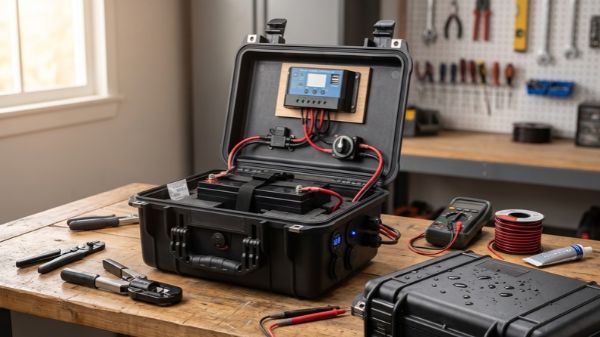
As seen in the open waterproof utility case build above, you simply drop a 12V 20Ah LiFePO4 battery ($65–$75) inside a rugged plastic dry box ($20), drill holes for a pre-wired 12V USB/voltmeter panel (~$18), and connect the positive lead through an inline blade fuse holder.
- The Advantage: Gives you ~204 Watt-hours of usable, silent 12V DC power that can charge a smartphone 15+ times or run a 6W LED light strip for 34 hours straight.
- The Limitation: It is pure storage, not a generator. Once you use up the 204 Watt-hours during an extended blackout, the box cannot recharge itself without grid power—which is why many DIYers build this exact battery box FIRST and then wire it as the buffer battery for The Energy Revolution System coil build!
Option 3: Ultra-Budget 50W Mini Solar Setup (Under $200 Limit)
- Total Budget: $165 to $198 (50W monocrystalline panel ~$55, PWM charge controller ~$18, 12V 18Ah SLA or LiFePO4 battery ~$55, MC4 extension leads & fuses ~$35).
- Workspace Required: Unshaded south-facing yard, balcony rail, or shed roof.
In our detailed Energy Revolution System vs. DIY Solar Kit comparison and our Backyard Revolution wooden solar tower review, we showed that a full 100-Watt solar starter kit with a deep-cycle battery and pure sine wave inverter costs $290 to $519 all-in—blowing right past a strict $200 budget.
However, if you downsize to a single 50-Watt solar panel and skip the AC inverter (running strictly 12V DC USB cords and 12V LED bulbs straight off the PWM charge controller), you can squeeze a mini photovoltaic setup just under $200.
- The Advantage: On a clear, sunny afternoon, a 50W panel banks roughly 140 to 175 Watt-hours of free solar energy into your 12V battery.
- The Limitation: Output drops by 75% to 90% on overcast winter days, drops to zero at night, and does not work through tinted double-pane apartment windows.
Option 4: Salvaged 12V Permanent Magnet DC Motor / Pedal Rig
- Total Budget: $140 to $195 (Salvaged 24V–36V scooter/treadmill permanent magnet DC motor ~$55, bicycle trainer stand ~$45, belt drive, blocking diode, and 12V SLA battery ~$65).
- Workspace Required: Garage or basement floor space.
For mechanical tinkerers who enjoy salvaging parts, a permanent magnet DC treadmill or electric scooter motor acts as a generator when spun backward by a bicycle rear wheel on a stationary exercise stand.
- The Advantage: Works indoors day or night and turns a 30-minute workout into 25 to 35 Watt-hours of 12V battery charge.
- The Limitation: Producing electricity with human legs is exhausting, noisy, and impractical for older adults or anyone dealing with mobility limitations during an emergency.
How to Stretch a $200 Backup System by Cutting “Vampire” Loads
Here is the most overlooked secret in off-grid living: every Watt you eliminate through efficiency is 3 times cheaper than a Watt you have to generate or store.
Before a blackout ever hits, auditing your home’s standby electricity drain accomplishes two massive goals:
- It Cuts Your Monthly Utility Bill Immediately: The average home leaks 60W to 110W of continuous phantom power 24/7 through smart TVs, cable boxes, microwave displays, wall warts, and standby appliances. Putting entertainment centers and home offices on switched power strips—a core module inside the Energy Revolution System manual—saves 43 to 79 kWh per month ($15 to $25+ every billing cycle) without spending a dime on rooftop panels.
- It Doubles Your Emergency Battery Runtime: Switching from plugging a phone cord into a 120V AC inverter (which wastes 15% of your battery capacity just running the inverter’s internal cooling fan and transformer) to plugging directly into a 12V DC buck converter USB port stretches a small 20Ah battery’s runtime by nearly two extra hours every night.
Step-by-Step Roadmap: Choosing Your First Under-$200 Weekend Project
Not sure where to start this Saturday? Follow this simple 3-step progression:
- Step 1 — Audit Your Critical Micro-Loads: List the 3 to 4 small devices you actually need during an outage (e.g., 12V LED strip, smartphone charger, weather radio, Wi-Fi router) and check their wattage on our Small DIY Energy System Wattage Chart.
- Step 2 — Download the Schematics Before Buying Hardware: Never walk into a hardware store blind. Download the $39 Energy Revolution System blueprint first, review the 47-page illustrated schematic and itemized materials list, and watch the 2-hour video series from your couch.
- Step 3 — Build Your 12V Buffer & Bifilar Coil Circuit: Spend ~$72 to $147 sourcing your enameled copper magnet wire, rotor magnets, diodes, and 12V buffer battery—keeping your entire weekend build safely under $200 while learning hands-on electromagnetic engineering.
And remember: because The Energy Revolution System is backed by ClickBank’s 60-day unconditional money-back guarantee, you can inspect the complete PDF manual, parts list, and video training risk-free for two full months. If you decide you would rather buy a pre-packaged solar kit instead, one click inside ClickBank’s order lookup portal gets your $39 refunded in full.
Click Here to Download The Energy Revolution System Blueprints Risk-Free (60-Day Guarantee)