
Affiliate & Editorial Disclosure: This review contains affiliate links. If you buy through our links, we may earn a commission at no extra cost to you. The vendor’s performance claims for The Energy Revolution System are unverified. We do not guarantee any electricity bill reduction. The $39 system is a digital PDF and video package, so you must buy the hardware separately.
If you have watched the promotional videos for downloadable home energy blueprints like The Energy Revolution System, you have seen dramatic clips implying that a compact, workbench-built device can power an entire 3,000-square-foot home, run heavy kitchen appliances, and slash your monthly utility bill by 80%+.
On the flip side, if you visit skeptical engineering forums, commenters often swing to the opposite extreme—claiming a homemade 12V coil or micro-generator project is nothing more than a “science fair toy” with zero practical utility during a power outage.
Where does the electrical reality actually sit? As we established in our complete Energy Revolution System review, the truth lies in basic watt-hour math. A $150 homemade electromagnetic coil or starter battery system will never run a central air conditioner or electric clothes dryer. However, when wired into a 12V buffer battery, a small DIY energy system is remarkably effective at keeping essential micro-loads—room lighting, smartphones, emergency radios, Wi-Fi routers, and 12V cooling fans—running when the neighborhood grid goes dark.
In this realistic DIY energy system wattage review, we break down the exact difference between running watts and surge watts, provide a side-by-side Household Wattage Reference Chart, and walk through how the blueprint’s efficiency strategies create real monthly bill savings.
Separating Marketing Hype from Electrical Reality
To understand what a small DIY energy system can actually power, you first need to know what your workbench unit is producing and storing:
- The Vendor’s Output Claim (~12W to 18W DC): The vendor describes a flat spiral bifilar pancake coil, inspired by Nikola Tesla’s 1894 US Patent 512,340. The claimed output is about 12 volts DC at 1.0 to 1.5 amps, or roughly 12 to 18 watts. We found no independent lab testing that confirms this. Physics also sets a limit: a passive coil cannot generate net power without an input source. Treat the figure as an unproven claim, and plan your system around a charging source you can verify. Examples include a small solar panel or a wall charger.
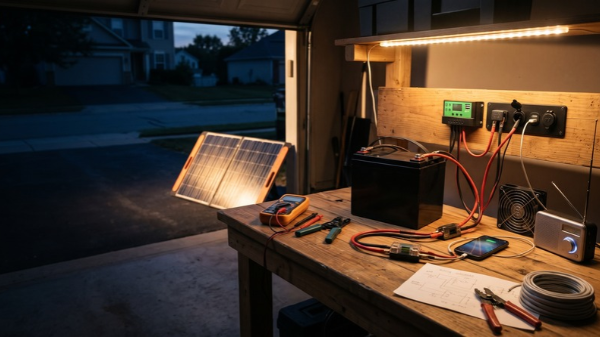
- The 12V Buffer Battery (Your Reservoir): The schematic routes charge through a bridge rectifier and smoothing capacitor. From there it goes into a 12V deep-cycle or LiFePO4 battery. Our Energy Revolution System materials list and cost review covers these parts in detail.
- Why the Buffer Battery Matters: Think of the charging source as a faucet dripping into a bucket. The battery is the bucket. A 12V 20Ah to 50Ah battery stores 240 to 600 Watt-hours (Wh). That is enough to run several small devices through an evening blackout.
Check Official Energy Revolution System Blueprints & Schematics Here
Realistic Loads: LED Lighting, Phone Charging, and 12V Fans
Imagine an ice storm or a transformer failure knocks out power for 24 to 48 hours. You won’t need to run the dishwasher. Instead, you need light to move safely, charged phones, some air circulation, and local news.

Low-voltage DC accessories use far less power than older 120V AC fixtures. For example, swapping a 60W incandescent lamp for a 5W 12V LED strip cuts power draw by more than 90%. As a result, a small battery can keep a living room lit all night.
Household Wattage Reference Chart: What Works vs. What Trips the Breaker
| Household Device / Appliance | Running Watts | Startup Surge Watts | Can a Small DIY 12V System Power It? |
|---|---|---|---|
| 12V LED Emergency Bulb or Light Strip | 4W – 9W | 0W (No surge) | Yes (Ideal) — Runs 15–40+ hours on a small 12V buffer battery |
| NOAA Weather Radio / AM-FM Radio | 2W – 5W | 0W (No surge) | Yes (Ideal) — Runs continuously for days during storms |
| Smartphone / Tablet USB Charger | 10W – 18W | 0W (No surge) | Yes (Ideal) — Recharges multiple phones daily via 12V USB buck converter |
| Home Wi-Fi Router & Cable Modem | 10W – 15W | 0W (No surge) | Yes — Keeps home internet and VoIP calling online during grid drops |
| 12V DC Portable Desk / Tent Fan | 12W – 20W | ~25W | Yes — Provides vital localized cooling or tent/bedroom airflow |
| CPAP Breathing Machine (Heated Humidifier Off) | 30W – 45W | 0W (DC adapter) | Yes (Short-Term) — Runs 1 night (8 hrs) on a 12V 35Ah–50Ah buffer battery |
| Laptop Computer (Via 12V USB-C Car Adapter) | 45W – 65W | 0W (No surge) | Yes (Intermittent) — Good for 2–4 hours of emergency work |
| Full-Size Kitchen Refrigerator | 120W – 200W | 1,200W – 1,800W | No — Compressor startup surge will instantly trip a small inverter |
| Portable Space Heater / Hair Dryer | 1,500W | 1,500W | No — Heating elements drain a small 12V battery in minutes |
| Central Air Conditioner / Electric Stove | 3,000W – 5,000W | 6,000W+ | No — Physically impossible for any small DIY coil or starter solar kit |
Why High-Draw Appliances (AC, Heaters, Stoves) Are Off the Table
Beginners often get frustrated when they plug a microwave, coffee maker, or refrigerator into a small DIY project. Two electrical barriers explain why.
- The Resistive Heating Penalty (P = I X V): Appliances that make heat convert electricity straight into thermal energy. Space heaters, toaster ovens, kettles, and irons all fall into this group. A 1,500W heater on a 12V battery needs 125 amps (1500W / 12V = 125A). That current will melt hobbyist hookup wire. It will also drain a 12V 20Ah battery in under 10 minutes.
- Inductive Motor Startup Surges: Motors and compressors need 3 to 7 times their running wattage for a split second at startup. A refrigerator may average only 150W while running. Even so, its compressor can demand a 1,200W to 1,800W surge. That surge shuts down a small 300W inverter at once. If you want to run larger daytime loads, see our Energy Revolution System vs. DIY Solar Kit comparison. You can also read our Best DIY Home Energy Guides for Beginners roundup.
3 Realistic Real-World Scenarios for Your DIY Build
When you match the Energy Revolution System to the loads it was actually engineered to handle, here are three practical ways homeowners use their completed build:
- Scenario 1: The 48-Hour Winter Blackout Kit. Two 5W LED strips run six hours each night, which uses 60Wh. Three smartphones recharge for about 45Wh. A weather radio and a Wi-Fi router stay on for several hours. Best of all, you never have to refuel a noisy gas generator in sub-zero weather.
- Scenario 2: The Off-Grid Workbench & Shed Charger. Hobbyists wire a 12V battery system in a shed or detached garage. It keeps cordless tool batteries, flashlights, and 12V task lights topped off. Consequently, they avoid trenching expensive 120V AC conduit.
- Scenario 3: Daily Micro-Device Offsetting. You can move daily USB charging and desk lighting onto a 12V circuit. Those small loads then come off your utility meter. Keep in mind that the savings are tiny. A 10W phone charger running four hours a day uses about 1.2 kWh a month, which costs roughly 25 cents.
How the Efficiency Strategies Deliver the Real Monthly Bill Drop
The vendor says builders save $20 to $35 per month. That claim is hard to support. A coil producing 12W to 18W, even if it worked, would offset at most about 13 kWh a month. At typical rates, that is $2 to $3.
The second half of the manual explains the likelier source of any savings. It is a Household Load-Reduction & Phantom Power Protocol.
In the average American home, many devices draw “vampire” standby power around the clock. Smart TVs, cable boxes, game consoles, and unswitched power bricks are common culprits. Together they can pull 50 to 100 Watts continuously.
- 100 Watts x 24 hours x 30 days = 72,000 Watt-hours (72 kWh) per month of pure wasted electricity.
- At $0.18 to $0.25 per kWh, eliminating those phantom loads alongside basic HVAC and water-heater timer adjustments included in the manual trims $15 to $25+ off your monthly bill immediately—before you even count the micro-loads shifted onto your DIY 12V bench unit.
Download The Energy Revolution System Blueprints & Efficiency Guide Here (60-Day Guarantee)
Interactive 12V DIY System Load & Runtime Calculator
Want to see exactly how long a small 12V DIY battery and trickle-charging coil setup will run your essential outage gear? Use the interactive calculator below to toggle common 12V micro-loads on or off, adjust your 12V buffer battery size (in Amp-hours), and see how continuous trickle input extends your emergency runtime:
⚡ Interactive 12V DIY Micro-Power Load & Runtime Calculator
Toggle your essential blackout gear and adjust your 12V buffer battery to see how a continuous DIY trickle charge stretches emergency runtime.
Key Takeaway from the Calculator: Notice what happens when you keep your active outage load around 30W to 33W (LED lighting + phone charger + Wi-Fi router + weather radio) while feeding a steady 14W trickle charge into a modest 20Ah 12V buffer battery: your net battery drain drops by nearly half, stretching a single overnight charge into 10 to 12+ hours of continuous emergency run time.
Final Verdict: Is a Small DIY Energy System Worth Building?
If someone promises you that a $39 PDF blueprint and $140 worth of hardware store copper wire will run your central air conditioning and put your utility company out of business, walk away—that violates basic physics.
However, when you evaluate The Energy Revolution System with realistic engineering expectations, the value proposition is clear:
- You learn how to wind and wire a real Nikola Tesla flat spiral bifilar coil on your own workbench for under $160 all-in (compared to $300–$500+ for outdoor Backyard Revolution or solar panel kits).
- You build a quiet, indoor-safe 12V micro-power station that keeps lights, phones, routers, and 12V fans running during blackouts.
- You get a practical Household Efficiency Protocol that cuts 50 to 100 Watts of 24/7 phantom load waste—delivering a real, measurable reduction on your very next utility bill.
Because your $39 order is protected by ClickBank’s 60-day money-back guarantee, you can download the 47-page PDF manual and 2-hour video series today, inspect the schematics and wattage calculations firsthand, and request a full refund within 60 days if it doesn’t meet your expectations.
Click Here to Download The Energy Revolution System Blueprints Risk-Free (60-Day Guarantee)
If you want a visual refresher on how 12-volt batteries, fuses, and DC loads are wired together in small off-grid setups, watching this 12V Van Wiring Diagram – Simplified Guide video provides a clear look at basic 12V DC circuit architecture.