
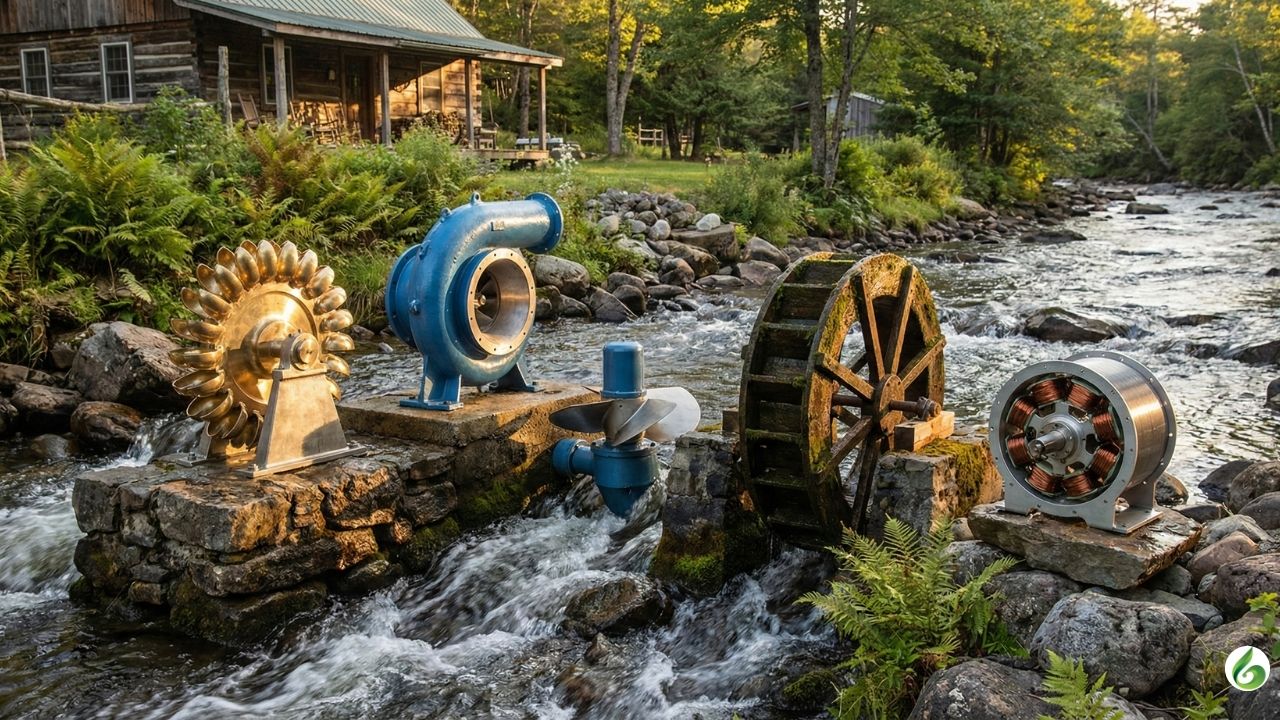
When implementing hydroelectric turbines for off-grid applications, we must first assess the site’s hydraulic potential by measuring the available head, which is the vertical distance the water falls, and the flow rate, which is the volume of water moving through the system per unit of time, typically expressed in gallons per minute or liters per second.
The hydroelectric efficiency depends on turbine selection, with Pelton wheels optimized for high-head installations, Francis turbines for medium-head scenarios, and Kaplan turbines for low-head configurations.
We calculate power output using the formula P = ρghQ, where ρ represents water density, g represents gravitational acceleration, h represents head, and Q represents flow rate.
The environmental impact remains minimal when we implement proper fish passage systems and maintain adequate downstream flow rates, ensuring ecosystem preservation while achieving energy independence.
⚡ Stay Powered When the Grid Goes Down
What if you could keep lights, devices, and even critical systems running during any blackout? That’s exactly what Dark Reset shows you how to do—using simple, proven methods. Discover lots of ways to prepare for energy independence.
Key Takeaways
- Hydroelectric turbines offer 80-90% efficiency with Pelton wheels for high-head, Francis for medium-head, and Kaplan for low-head applications.
- Water wheel generators provide reliable 65-85% efficiency, requiring 50-500 GPM flow rates and 3-15 feet head height for operation.
- Ram pumps generate power through water hammer effects, achieving 60-80% hydraulic efficiency while creating elevated water storage capability.
- Pelton wheel systems deliver 80-90% efficiency at heads over 15 meters, requiring minimal maintenance and precise jet alignment.
- Archimedes screw generators excel at low-head sites (1-10 meters), achieving 70-85% efficiency with fish-friendly, low-cost installation.
Hydroelectric Turbines
When implementing hydroelectric turbines for off-grid applications, we must first assess the site’s hydraulic potential by measuring the available head, which is the vertical distance the water falls, and the flow rate, which is the volume of water moving through the system per unit of time, typically expressed in gallons per minute or liters per second.
The hydroelectric efficiency depends on turbine selection, with Pelton wheels optimized for high-head installations, Francis turbines for medium-head scenarios, and Kaplan turbines for low-head configurations.
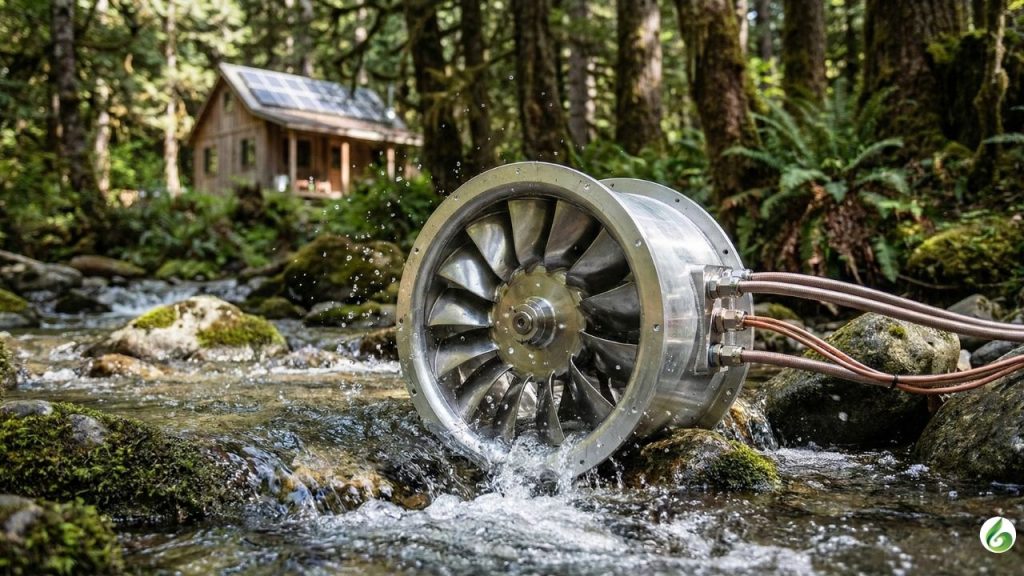
We calculate power output using the formula P = ρghQ, where ρ represents water density, g represents gravitational acceleration, h represents head, and Q represents flow rate.
The environmental impact remains minimal when we implement proper fish passage systems and maintain adequate downstream flow rates, ensuring ecosystem preservation while achieving energy independence.
Water Wheel Generators
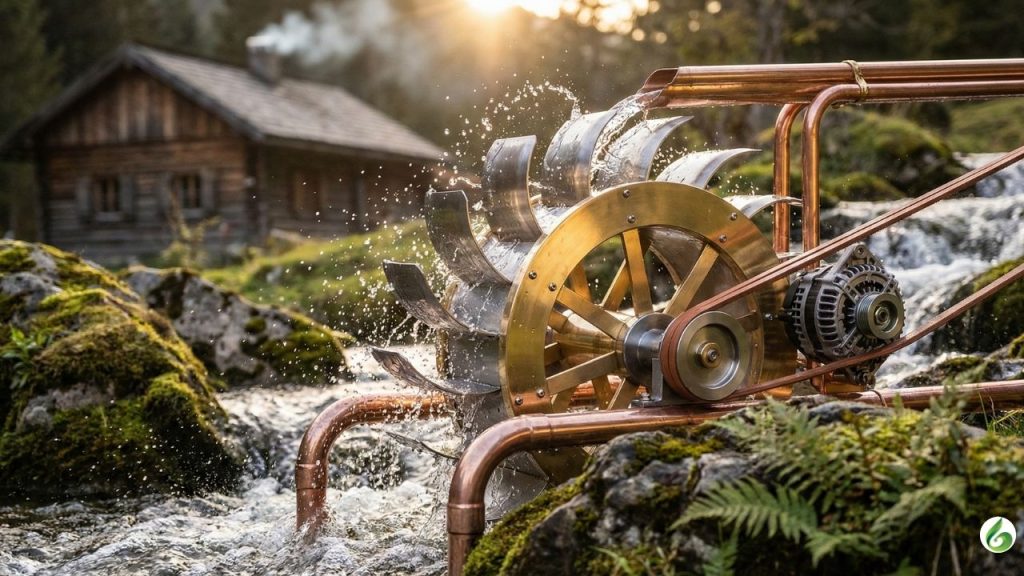
Water wheel generators represent one of the oldest and most mechanically straightforward methods for converting kinetic and potential energy from flowing water into electrical power, offering off-grid users a reliable alternative that doesn’t require the high-pressure systems associated with modern turbines. We’ve documented water wheel benefits across various implementations, noting that historical waterwheels demonstrate proven longevity spanning centuries.
| Component | Specification |
|---|---|
| Efficiency Range | 65-85% |
| Flow Rate Required | 50-500 GPM |
| Head Height | 3-15 feet |
| Power Output | 100W-5kW |
| Maintenance Interval | Quarterly |
We recommend overshot designs for maximum energy capture, as they utilize gravitational force effectively, ensuring consistent performance across varying flow conditions, which liberates users from grid dependency.
Ram Pumps for Power
Hydraulic ram pumps, which operate through cyclic pressure differentials created by water hammer effects, offer off-grid installations a method for simultaneously generating mechanical work and delivering pressurized water to elevated storage systems.
Though we’ll examine their adaptation for electrical generation through coupled alternators or generators. Ram pump applications extend beyond traditional water elevation, as mechanical energy extraction occurs during the compression cycle, enabling power generation when integrated with appropriate conversion mechanisms.
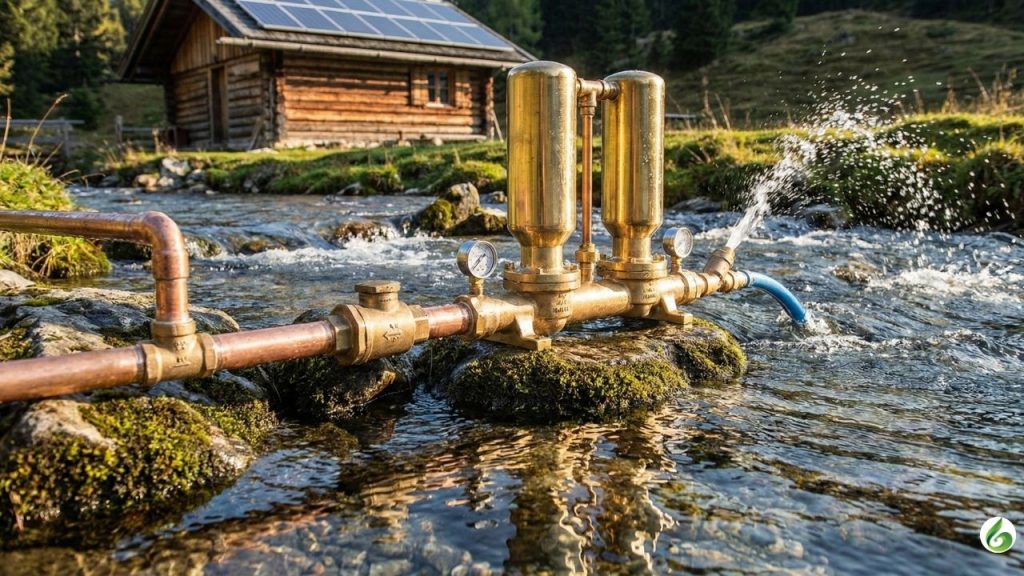
Ram pump efficiency typically ranges between 60-80% for hydraulic work, though electrical conversion introduces additional losses through mechanical coupling and alternator resistance.
- Install inline alternators on the drive pipe to capture kinetic energy during flow cycles
- Configure dual-chamber systems with pressure tanks for continuous power delivery
- Implement flywheel assemblies to smooth pulsating output and stabilize voltage generation
⚡ Stay Powered When the Grid Goes Down
What if you could keep lights, devices, and even critical systems running during any blackout? That’s exactly what Dark Reset shows you how to do—using simple, proven methods. Discover lots of ways to prepare for energy independence.
Pelton Wheel Systems
Although Pelton wheels represent mature technology dating to Lester Pelton’s 1878 patent, their relevance for contemporary off-grid electrical generation persists due to high efficiency rates of 80-90% when operating under ideal head conditions, typically requiring vertical drops exceeding 15 meters to achieve sufficient pressure for effective impulse turbine operation.

We recognize that pelton wheel efficiency depends on precise jet alignment with bucket configuration, necessitating careful site assessment before installation. The system liberates users from grid dependency through reliable mechanical energy conversion, transforming high-pressure water streams into rotational force.
Pelton wheel maintenance requires minimal intervention, limited to periodic bearing lubrication and nozzle inspection for sediment accumulation. We recommend installing filtration systems upstream to prevent particulate damage, ensuring sustained operational performance in remote installations where component replacement proves logistically challenging.
Archimedes Screw Generators
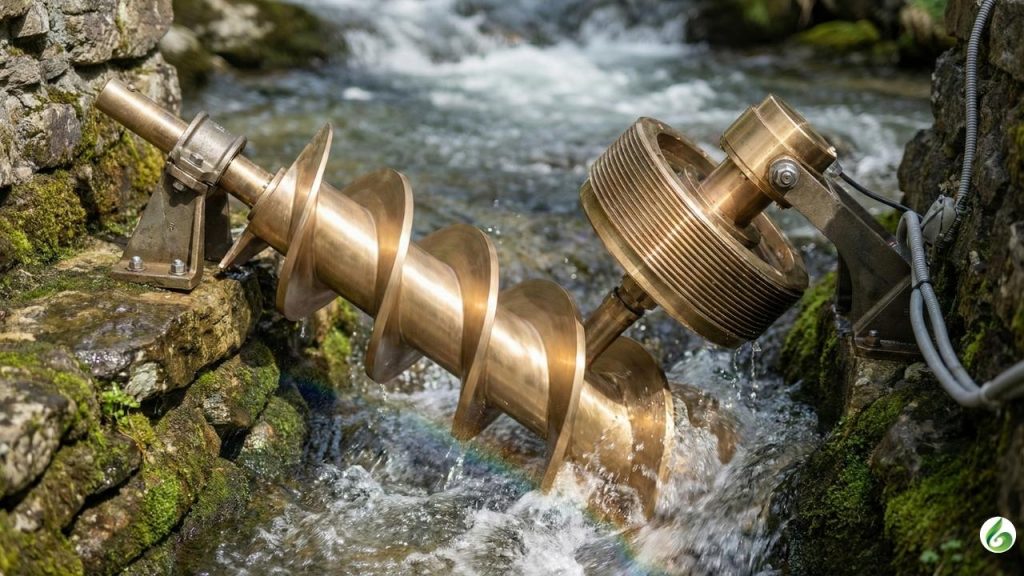
Screw-type hydropower generators, based on the ancient Archimedes screw principle reversed for electrical generation rather than water lifting, operate effectively at low-head installations between 1-10 meters where Pelton wheels demonstrate insufficient performance characteristics, filling a critical deployment gap in off-grid power infrastructure.
The screw mechanics enable continuous water flow through helical channels, converting gravitational potential energy into rotational kinetic energy with minimal environmental disruption, thereby liberating remote communities from centralized grid dependency.
- Efficiency rates reach 70-85% across variable water flow conditions, surpassing traditional turbine configurations in shallow-gradient streams
- Installation requires minimal civil engineering infrastructure, reducing capital expenditure barriers for autonomous energy projects
- Fish-friendly operation permits bidirectional passage through rotating chambers, maintaining ecological integrity while generating power
These systems democratize renewable energy access for decentralized populations. Like solar panel installations, the installation process for Archimedes screw generators can be straightforward when professionally managed, making them accessible for off-grid homesteaders seeking energy independence.
Frequently Asked Questions
What Permits or Regulations Apply to Installing Water-Powered Systems on Private Property?
We’ll need to verify water rights documentation with your jurisdiction’s natural resources department, as appropriative or riparian claims determine lawful diversion capacity.
Zoning laws typically mandate environmental impact assessments before installation, particularly regarding stream flow modification.
You’ll want to secure permits from state water boards and local building departments, which’ll evaluate hydraulic infrastructure against ecological preservation standards.
Federal Energy Regulatory Commission oversight applies when generation capacity exceeds specified thresholds, requiring thorough compliance documentation for grid independence.
How Much Does Professional Installation Typically Cost for These Systems?
Installation costs vary dramatically based on system complexity and site conditions, but we’ve observed professionals typically charging $5,000-$25,000 for micro-hydro setups.
Hiring professionals who understand turbine placement, penstock routing, and electrical integration proves essential, though it constrains your autonomy initially.
We recommend obtaining multiple quotes while verifying contractors possess experience with off-grid installations, as specialized knowledge regarding water rights, environmental compliance, and grid-independent electrical systems greatly impacts both initial expenses and long-term performance optimization.
What Is the Minimum Water Flow Rate Needed for Off-Grid Power Generation?
We’ll need a minimum flow of approximately 5-10 gallons per minute at sufficient head pressure to generate viable off-grid power, though this depends on turbine specifications and energy efficiency requirements.
Systems with optimized impeller designs can operate at lower thresholds, while maintaining adequate voltage regulation for battery charging circuits.
We recommend conducting site-specific hydrological assessments to determine whether your water source provides consistent volumetric flow rates that satisfy minimum operational parameters for sustained autonomous power generation.
Can Water-Powered Engines Provide Consistent Electricity During Winter Freeze Conditions?
We’ve observed that water-powered engines maintain hydro efficiency during winter freeze conditions only when implementing proper freeze resistance measures.
You’ll need to install heated intake systems, subsurface water draws below ice formation depth, or closed-loop glycol circulation systems to prevent operational disruption.
Without these modifications, ice accumulation will compromise turbine function, rendering your system unreliable.
We recommend deploying temperature monitoring alongside automated heating protocols to guarantee continuous winter electricity generation for your liberation from grid dependence.
How Do Maintenance Requirements Compare Between Different Water-Powered Engine Types?
We’ve observed that impulse turbines require minimal maintenance frequency, typically annual inspections, while reaction turbines demand quarterly servicing due to their pressurized systems.
Pelton wheels, operating with air-gap separation, demonstrate superior engine lifespan of 25-30 years, whereas Francis turbines, which involve submerged components, necessitate bearing replacements every 5-7 years.
Microhydro systems with fewer moving parts reduce dependency on external technical support, thereby enabling your autonomous operation.
Conclusion
As we’ve examined these five hydroelectric systems, ranging from traditional water wheels to contemporary turbine configurations, it’s evident that off-grid power generation requires careful assessment of site-specific parameters, including flow rate, head pressure, and deployment architecture.
While these mechanisms won’t integrate with your Kubernetes cluster’s containerized workloads or require OAuth authentication protocols, they’ll provide reliable kilowatt-hour production when properly configured.
We recommend conducting thorough hydraulic surveys before implementation, ensuring peak performance metrics align with your electrical load requirements and regulatory compliance standards.
⚡ Stay Powered When the Grid Goes Down
What if you could keep lights, devices, and even critical systems running during any blackout? That’s exactly what Dark Reset shows you how to do—using simple, proven methods. Discover lots of ways to prepare for energy independence.