You’ve likely assessed your kitchen’s environmental impact, yet shifting to sustainable alternatives requires systematic implementation, not merely good intentions. While you understand the necessity of reducing single-use plastics, the overwhelming array of eco-friendly products complicates prioritization, particularly when considering cost-effectiveness, durability metrics, and actual waste reduction per unit. Before you invest in sustainable kitchen products, you’ll need to evaluate which items provide the highest return on environmental investment, considering both immediate replacement of high-impact disposables and long-term maintenance requirements that determine true sustainability.
Key Takeaways
- Reusable silicone bags withstand 3,000 cycles and temperatures from -40°F to 425°F, eliminating single-use plastic dependency.
- Glass and stainless steel containers prevent chemical leaching while offering durability, thermal resistance, and complete recyclability.
- Beeswax wraps provide biodegradable, antimicrobial food coverage that composts at end-of-life, replacing petroleum-based plastic wraps.
- Swedish dishcloths absorb 15 times their weight, endure 200 washes, and compost afterward, reducing paper towel waste.
- Bamboo utensils mature in three years, offer antimicrobial properties, and replace plastic tools that leach microplastics into food.
Reusable Silicone Food Storage Bags vs. Plastic Baggies
No products found.
While traditional single-use plastic baggies have dominated food storage for decades due to their low cost and convenience, reusable silicone food storage bags present a sustainable alternative that addresses the environmental concerns associated with plastic waste accumulation in landfills and marine ecosystems.
You’ll find that these eco friendly materials, constructed from food-grade silicone polymers, offer comparable sealing capabilities while eliminating recurring disposal requirements. The shift enables you to implement kitchen organization systems that reduce dependency on petroleum-based products, thereby liberating your household from participating in cyclic consumption patterns that perpetuate environmental degradation.
These containers withstand temperature ranges from -40°F to 425°F, facilitate dishwasher cleaning, and maintain structural integrity through approximately 3,000 use cycles, representing significant lifecycle advantages over disposable alternatives.
Beeswax Wraps: The Plastic Wrap Alternative
No products found.
Although conventional plastic wrap has served as the default moisture barrier for food preservation in residential kitchens since its commercialization in the mid-twentieth century, beeswax-infused fabric wraps provide a biodegradable alternative that you can reuse across multiple storage applications without contributing to petrochemical waste streams.
The beeswax properties, which include natural antimicrobial compounds and moldable adhesion when warmed by hand contact, enable you to create custom-fitted coverings for containers, produce items, and bread loaves.
These wraps demonstrate eco friendly benefits through their complete compostability at end-of-life, elimination of single-use plastics from your household waste output, and reduced dependence on fossil fuel derivatives.
You’ll maintain food freshness through the breathable yet protective barrier that beeswax creates, while simultaneously breaking free from disposable consumption patterns that perpetuate environmental degradation.
Sustainable Food Containers (Glass and Stainless Steel)
No products found.
Beyond wrapping materials, durable food storage containers manufactured from glass or stainless steel eliminate the need for disposable plastic alternatives that leach chemical compounds into stored contents, particularly when subjected to temperature fluctuations or acidic foods.
Glass container benefits include non-porous surfaces that prevent bacterial accumulation, thermal resistance enabling oven-to-refrigerator shifts, and complete recyclability at end-of-life. Stainless steel longevity surpasses conventional options through corrosion resistance, impact durability, and maintenance-free operation requiring only standard washing protocols.
You’ll achieve independence from single-use packaging systems while maintaining food safety standards through inert material properties that preserve nutritional integrity without contamination risk.
These containers function across multiple temperature ranges, accommodate diverse food types, and provide transparent cost-benefit analysis through extended operational lifecycles, liberating you from repetitive purchasing cycles inherent to degradable alternatives.
Swedish Dishcloths and Reusable Cleaning Cloths
No products found.
How effectively can traditional paper towel consumption be eliminated through implementation of biodegradable cellulose-based Swedish dishcloths, which provide absorption capacity exceeding fifteen times their dry weight while maintaining structural integrity through approximately 200 wash cycles before requiring composting disposal?
You’ll find that eco friendly materials utilized in these cloths, specifically cotton and cellulose composites, deliver superior performance metrics compared to conventional alternatives. The dishcloth durability manifests through resistance to bacterial colonization, attributed to rapid drying characteristics that inhibit microbial proliferation.
You can sanitize these implements via dishwasher sterilization cycles or microwave treatment protocols, ensuring hygiene standards remain uncompromised. Upon reaching end-of-life parameters, you’ll dispose of these products through municipal composting infrastructure, thereby completing a circular resource management cycle that eliminates landfill contributions associated with paper-based disposable products.
Eco-Friendly Dish Soap Bars and Refill Stations
No products found.
While conventional liquid dish detergents necessitate petroleum-derived plastic packaging that contributes approximately 8 million metric tons annually to oceanic pollution loads, solid dish soap bars eliminate this dependency through minimal packaging requirements, typically consisting of recyclable cardboard or reusable containers.
You’ll discover that refill stations, which function through bulk dispensing systems, reduce packaging waste by 70-90% compared to single-use bottles. These bars incorporate plant-based surfactants, derived from coconut or palm kernel oils, which maintain cleaning efficacy while providing natural fragrance options through essential oils rather than synthetic compounds.
When you select products with eco friendly packaging, you’re actively disrupting conventional supply chains that perpetuate environmental degradation, thereby exercising consumer autonomy to restructure market dynamics toward regenerative practices.
Cloth Napkins and Unpaper Towels for Zero-Waste Kitchens
No products found.
Although single-use paper towels represent a seemingly innocuous household convenience, their aggregate environmental impact encompasses deforestation of approximately 51,000 trees daily in North America alone, water consumption exceeding 20,000 gallons per ton during manufacturing processes, and methane emissions from landfill decomposition that contribute measurably to atmospheric greenhouse gas concentrations.
Cloth napkin benefits include:
- Reduced waste streams through multi-year lifecycle utilization
- Cost optimization via elimination of recurring purchase requirements
- Enhanced durability specifications exceeding 500 wash cycles
- Superior absorption capacity metrics compared to disposable alternatives
An unpaper towels comparison demonstrates significant resource conservation, as reusable alternatives eliminate dependency on forestry extraction while maintaining functional parity with conventional products. You’ll achieve operational sustainability by implementing standardized laundering protocols, establishing rotation inventory management systems, and configuring designated storage infrastructure for clean and soiled materials.
Reusable Produce Bags for Plastic-Free Shopping
No products found.
Single-use plastic bags dispensed at grocery retail locations accumulate in global ecosystems at rates exceeding 160,000 units per second, constituting material waste streams that persist for centuries due to polymer degradation timelines extending beyond 400 years while simultaneously infiltrating marine environments where they fragment into microplastic particles that bioaccumulate through food chain trophic levels.
You’ll eliminate this dependency through reusable produce bags constructed from organic cotton, hemp, or recycled polyester mesh configurations. These implementations deliver produce bag benefits including washability, durability specifications exceeding 500 use cycles, and breathability parameters that extend refrigerated storage longevity by maintaining favorable humidity levels.
Eco friendly shopping protocols require lightweight designs, typically 0.5-1.0 ounces per unit, facilitating negligible tare weight impact during checkout weight measurements, while drawstring closure mechanisms guarantee secure containment across transportation phases.
Countertop Compost Bins for Small Kitchens
No products found.
Because household organic waste contributes approximately 30-40% of residential landfill mass where anaerobic decomposition generates methane emissions at concentrations 25 times more potent than carbon dioxide across 100-year global warming potential timescales, you’ll intercept these materials through countertop compost bins that transform kitchen scraps into nutrient-dense soil amendments. Compact composting solutions enable autonomous waste management, liberating you from municipal dependency while reclaiming environmental agency.
Consider these countertop bin materials:
- Stainless steel vessels with carbon filtration systems
- Ceramic containers featuring aeration mechanisms
- Bamboo-composite housings with integrated ventilation
- Food-grade polymer bins with odor-neutralizing technologies
These systems accommodate spatial constraints while maintaining aerobic decomposition processes, preventing anaerobic putrefaction. Selection criteria encompass volumetric capacity, filtration efficiency, material durability, and maintenance requirements, ensuring optimal functionality within confined environments.
Sustainable Bamboo Utensils and Cooking Tools
No products found.
Beyond waste management infrastructure, sustainable kitchen operations demand scrutiny of implements that contact food throughout preparation workflows, where conventional plastic utensils leach microplastics at rates exceeding 2.3 million particles per year per household according to peer-reviewed environmental chemistry studies, while metal alternatives require energy-intensive extraction processes that generate 1.67 tonnes of CO2-equivalent emissions per kilogram of stainless steel produced.
You’ll find bamboo utensils present minimal environmental impact through rapid regeneration cycles, achieving harvest maturity within three years without pesticide applications or irrigation systems.
The inherent bamboo durability stems from lignin content percentages ranging between 21-31%, providing mechanical strength comparable to hardwoods while maintaining antimicrobial properties that inhibit bacterial colonization.
These implements liberate your kitchen from petroleum-based dependencies, establishing autonomous food preparation systems aligned with ecological restoration principles.
Stainless Steel Straws and Travel Cutlery Sets
No products found.
The portable reusability paradigm manifests most explicitly in stainless steel straw implementations and modular cutlery assemblies, where food-grade 304 or 316 austenitic alloys—containing 18% chromium and 8-10% nickel in their crystalline structure—eliminate single-use plastic dependency while maintaining corrosion resistance through passive chromium oxide layer formation that occurs spontaneously upon atmospheric exposure.
Stainless steel benefits include:
- Non-reactive surface properties preventing flavor contamination
- Thermal conductivity specifications enabling beverage temperature maintenance
- Dishwasher-safe metallurgy supporting sanitization protocols
- Indefinite lifecycle duration reducing replacement frequency
Travel cutlery convenience empowers you to reject disposable implements across dining environments, as compact carrying cases, measuring 15-20 centimeters in length, facilitate transport within bags, backpacks, or vehicle compartments, thereby establishing personal infrastructure that liberates you from systemic waste generation inherent to conventional food service operations.
What These Sustainable Kitchen Swaps Actually Cost
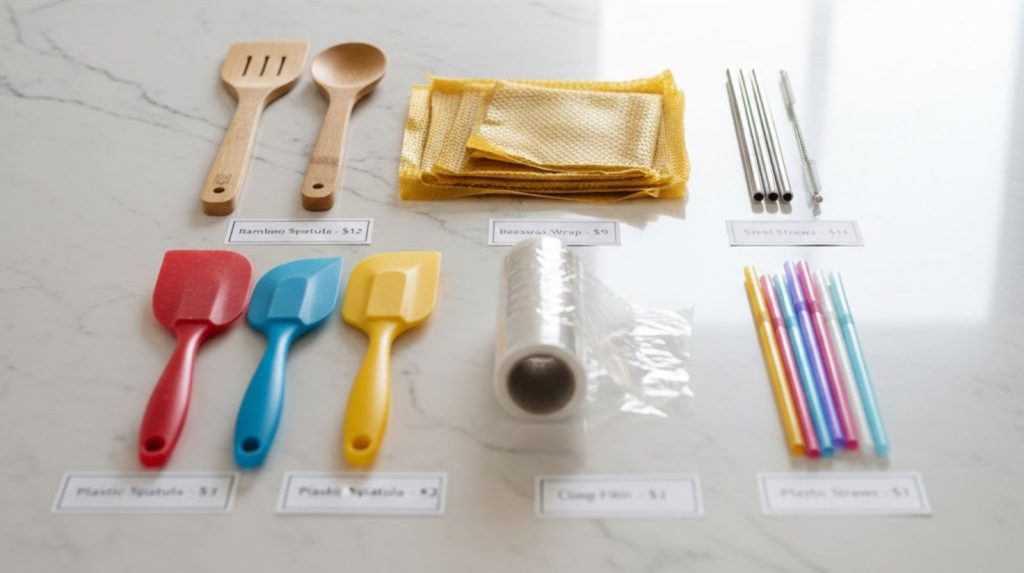
While transformative enthusiasm toward sustainable alternatives generates considerable momentum within consumer behavior patterns, financial barriers constitute legitimate evaluation criteria requiring quantitative analysis of acquisition costs, operational expenses, and lifetime value propositions across product categories.
You’ll find cost comparison methodologies reveal reusable alternatives, despite higher initial expenditures ranging from $15 to $150 per item, demonstrate superior return on investment through extended operational lifespans, eliminating recurring purchases of disposable equivalents.
Budget planning frameworks must incorporate amortization calculations, dividing total acquisition costs across projected usage cycles, typically spanning three to ten years depending on material composition and manufacturing quality standards.
Systematic evaluation of per-use costs, maintenance requirements, and replacement intervals enables accurate financial projections. You can leverage comparative analytics to identify ideal investment priorities, allocating resources toward highest-impact substitutions first, then progressively expanding sustainable infrastructure.
Which Eco-Friendly Products to Buy First?
How should consumers prioritize acquisition sequences when confronting extensive inventories of sustainable kitchen alternatives, each promising environmental benefits yet demanding immediate capital allocation?
Begin with reusable products replacing single-use items, as these generate immediate waste reduction. Focus on eco friendly brands displaying green certification from recognized third-party validators, which authenticate environmental claims through standardized audit protocols.
Priority acquisitions include:
- Silicone food storage containers eliminating plastic wrap dependency
- Stainless steel water filtration systems reducing bottled water consumption
- Bamboo utensil sets replacing disposable alternatives
- Compostable cleaning cloths substituting paper towel reliance
Select products offering measurable environmental impact metrics, quantifiable lifecycle assessments, and transparent supply chain documentation.
Consider that sustainable kitchen investments may qualify for federal solar tax credit programs when paired with renewable energy systems like solar panels, making the transition to eco-friendly living more financially accessible.
You’ll achieve maximum ecological benefit while maintaining budgetary constraints through strategic selection processes that emphasize longevity, functionality, and verified sustainability credentials.
How to Clean and Maintain Reusable Kitchen Products
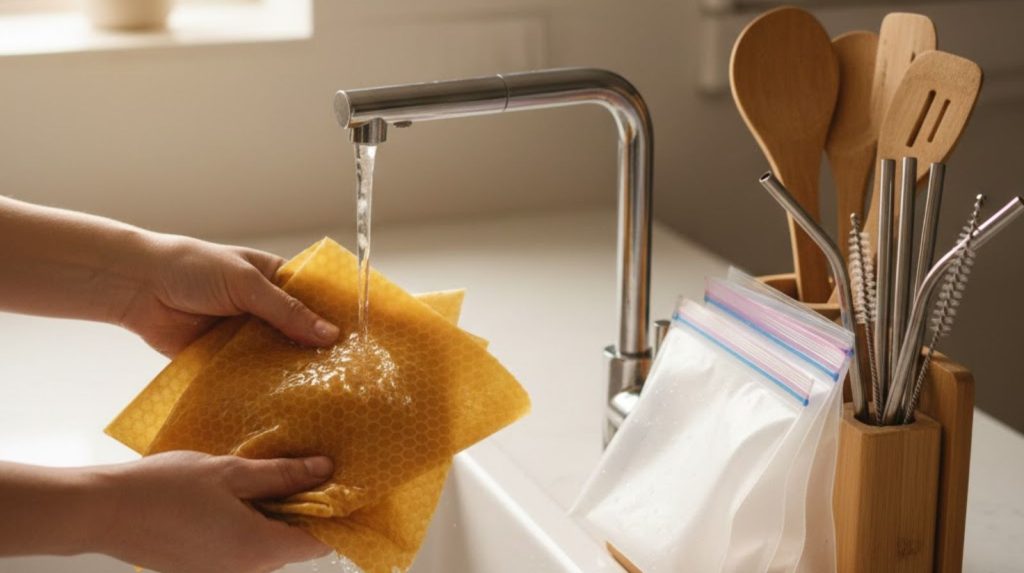
Proper maintenance protocols determine whether reusable kitchen products deliver their projected environmental benefits, as inadequate cleaning procedures compromise both hygiene standards and material longevity, ultimately necessitating premature replacement cycles that negate waste reduction objectives.
You’ll implement appropriate cleaning methods based on material composition, utilizing hot water sanitization cycles for silicone components, white vinegar solutions for mineral deposit removal on stainless steel surfaces, and baking soda applications for stubborn residue elimination.
Product longevity depends on your adherence to manufacturer-specified temperature thresholds during dishwasher operations, proper drying techniques that prevent bacterial proliferation, and periodic inspection routines that identify structural degradation before complete failure occurs.
You must establish systematic maintenance schedules, documenting cleaning frequencies and replacement intervals to optimize resource utilization while maintaining compliance with food safety requirements that protect household health.
How Long Do Sustainable Kitchen Products Last?
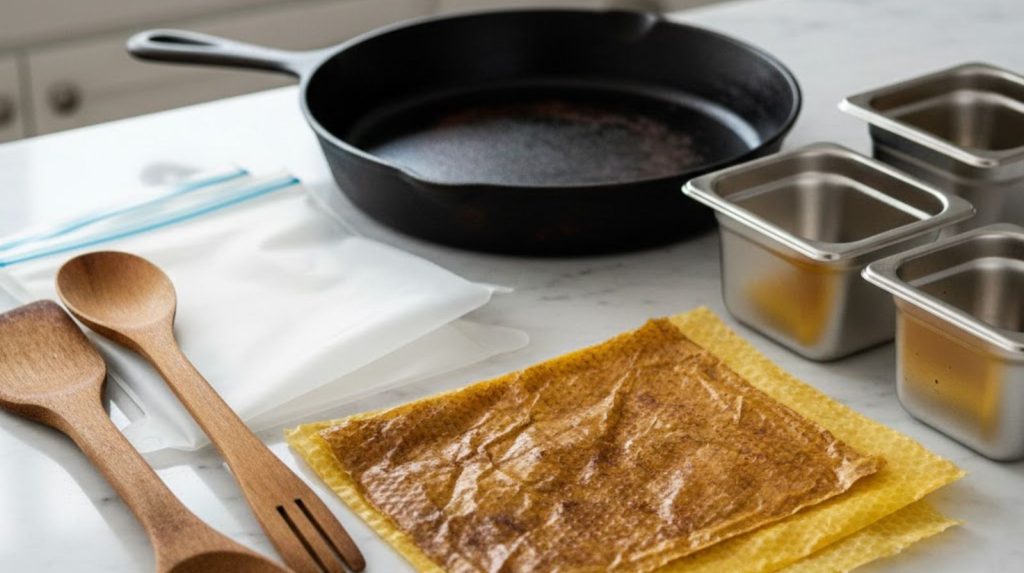
Understanding maintenance requirements naturally leads to questions about durability expectations, since your investment in sustainable alternatives requires quantifiable performance metrics that justify higher upfront costs through extended service life calculations.
Conducting thorough lifespan assessment enables you to make informed purchasing decisions, while durability comparison between conventional and eco-friendly options reveals significant variations in longevity potential.
Expected service durations include:
- Stainless steel containers maintain structural integrity for 10-15 years under standard use conditions
- Bamboo utensils typically function effectively for 3-5 years before degradation occurs
- Silicone baking mats withstand approximately 3,000 heating cycles before replacement becomes necessary
- Glass storage vessels demonstrate indefinite usability when handled properly, with failure occurring only through physical impact
These metrics provide concrete data for calculating total cost of ownership across product lifecycles.
Where to Buy Sustainable Kitchen Products Online

Where should you source your sustainable kitchen products once you’ve determined the appropriate specifications and longevity requirements? Online retailers specializing in eco-conscious merchandise provide extensive product catalogs, which enable you to evaluate materials, certifications, and manufacturing processes before purchase.
Sustainable shopping platforms, including Package Free Shop, EarthHero, and Life Without Plastic, offer transparent supply chain documentation and third-party verification credentials. These vendors maintain detailed product specifications, allowing you to assess material composition, durability metrics, and end-of-life disposal protocols.
Additionally, marketplaces such as Etsy facilitate direct transactions with artisan producers, who typically provide customized solutions that align with specific sustainability parameters. When selecting online retailers, verify their commitment to carbon-neutral shipping, minimal packaging waste, and ethical labor practices, ensuring your procurement decisions support extensive environmental and social governance standards throughout the entire transaction lifecycle.
Conclusion
You’ve now explored essential sustainable kitchen products that’ll substantially reduce your environmental footprint. Research indicates that Americans discard approximately 500 million plastic straws daily, which underscores the critical importance of shifting to reusable alternatives in your kitchen. By implementing these sustainable solutions, which include silicone storage bags, beeswax wraps, and glass containers, you’ll minimize plastic waste while creating a more environmentally responsible cooking space that contributes to long-term ecological preservation.