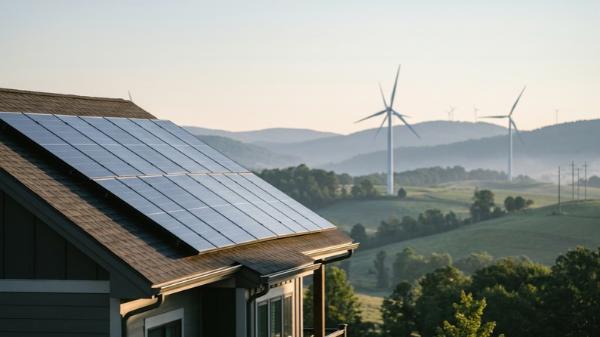
In the debate over solar vs wind energy, solar power is the stronger choice for most homeowners and businesses due to lower installation barriers, silent operation, minimal maintenance, and flexible rooftop sizing. Wind energy excels at utility scale—where tall turbines capture steady, round-the-clock breezes—but rarely fits residential lots or suburban zoning rules.
Choosing between these two clean energy leaders comes down to scale, location, and resource availability. While both technologies generate zero-emission electricity during operation, they perform very differently depending on whether you are powering a single home, a commercial warehouse, or a regional power grid.
Solar vs. Wind Energy: Side-by-Side Comparison
Before diving into the technical details, this comparison highlights how solar photovoltaic (PV) systems and wind turbines stack up across cost, performance, and practical site requirements.
| Factor | Solar Energy (PV) | Wind Energy (Onshore) |
|---|---|---|
| Cost (LCOE & Upfront) | Utility LCOE: $29–$92/MWh; residential rooftop LCOE: $122–$284/MWh (Lazard, 2024). Scales cleanly to small budgets. | Utility LCOE: $27–$73/MWh (Lazard, 2024). Small residential turbines carry high per-watt installation costs. |
| Efficiency | Modern residential panels convert roughly 19%–22%+ of sunlight into electricity (NREL). | Large turbines capture roughly 35%–45% of available kinetic wind energy, well below the theoretical Betz limit of 59.3%. |
| Capacity Factor | U.S. utility-scale solar averaged 23.3% in 2023 (U.S. EIA). | U.S. utility-scale wind averaged 33.5% in 2023 (U.S. EIA). |
| Lifespan | 25–30+ years, with most panels warrantied for 25 years and degrading slowly at 0.5%–0.8% per year (NREL). | 20–25 years for utility-scale turbines before major repowering or decommissioning (U.S. DOE). |
| Maintenance (O&M) | Very low; no moving parts. Occasional cleaning and an inverter replacement after 10–15 years. | Moderate to high; gearboxes, bearings, yaw drives, and blades require scheduled mechanical servicing. |
| Space & Siting | Fits on existing residential and commercial rooftops, carports, or compact ground mounts. | Residential turbines typically need at least 1 acre of open land and tall towers to clear turbulence (U.S. DOE). |
| Noise & Visual Impact | Silent operation with low-profile rooftop panels that blend into most neighborhoods. | Mechanical hum and aerodynamic blade whoosh; tall towers often face local height restrictions. |
| Environmental Impact | Low operational impact; requires mining and panel recycling at end of life. | Low operational emissions; poses documented collision risks to birds and bats if poorly sited. |
| Best-Fit Use Case | Homeowners, small-to-midsize businesses, urban/suburban roofs, and sunny off-grid properties. | Utility-scale power farms, coastal or plains regions, and large rural estates with steady winds. |
How Cost and LCOE Compare Between Solar and Wind
When evaluating renewable energy economics, analysts rely on Levelized Cost of Energy (LCOE)—the average total cost to build, operate, and maintain a power system divided by the total electricity it produces over its lifetime.
At the utility scale, onshore wind and solar are neck-and-neck as the cheapest sources of new electricity. According to Lazard’s 2024 LCOE+ report, unsubsidized utility-scale onshore wind ranges from $27 to $73 per megawatt-hour (MWh), while unsubsidized utility-scale solar PV ranges from $29 to $92 per MWh. Global cost data from the International Renewable Energy Agency (IRENA, 2023 data) similarly shows that utility-scale solar costs fell by roughly 90% between 2010 and 2023, while onshore wind costs dropped by about 70%.
At the residential scale, however, the economics shift sharply in favor of solar:
- Modular sizing: You can install a 4 kW, 8 kW, or 12 kW rooftop solar array tailored precisely to your household electricity bill.
- Lower soft and structural costs: Solar panels bolt directly onto an existing roof structure, whereas small wind turbines require engineered concrete foundations, guy wires, and tall towers.
- Favorable utility policies: Most utilities offer net metering—a billing mechanism that credits solar owners for excess electricity sent back to the grid—making residential payback periods more predictable.
Federal, state, and local clean energy incentives can further lower upfront costs for both technologies, though eligibility rules change over time and should be verified through the U.S. Department of Energy’s DSIRE database or a qualified tax advisor.
Want to lower the upfront cost of getting started with home renewables? Commercial installation quotes can feel steep if you are simply looking to offset a portion of your monthly utility bill or build backup power. If you are handy and want to understand how residential solar and small-scale wind systems can be assembled at home, explore this step-by-step DIY Home Energy guide to see what is realistically possible on a modest budget.
Efficiency, Capacity Factor, and Real-World Output
Two technical metrics frequently cause confusion when comparing renewables: efficiency (the percentage of raw natural energy converted into usable electricity) and capacity factor (the ratio of actual electricity generated over a year compared to running at maximum rated output 24/7).
Wind turbines generally outperform solar panels on both metrics at the utility level. Because wind can blow day and night—and often peaks during winter months—U.S. utility-scale wind farms achieved an average capacity factor of 33.5% in 2023, compared to 23.3% for utility-scale solar PV, according to the U.S. Energy Information Administration (EIA).
Solar panels have a lower raw conversion efficiency (typically 19% to 22%+ for modern monocrystalline panels, per NREL) and cannot generate power after sunset. Yet solar’s daily production curve is highly predictable. Output peaks during midday and sunny summer afternoons, which aligns closely with peak residential and commercial air-conditioning demand.
Why Solar Energy Wins for Most Homeowners and Businesses
Even though wind turbines can generate electricity around the clock, practical site constraints make solar far more accessible for everyday property owners.
1. Roof and Land Use Flexibility
Land use—the amount and type of ground area required to site an energy system safely—is wind power’s biggest residential hurdle. According to the U.S. Department of Energy’s WINDExchange program, a small residential wind turbine generally requires:
- An average annual wind speed of at least 10 miles per hour (4.5 meters per second).
- At least one acre of open, unobstructed land.
- A tower tall enough (often 80 to 120 feet) to clear nearby trees and buildings that create turbulent air.
Most suburban neighborhoods, townhomes, and commercial office parks cannot meet those requirements, and local zoning ordinances or HOA rules frequently ban tall towers. Solar panels, by contrast, turn idle roof space into a power plant without consuming usable yard or parking space.
2. Lower Maintenance and Longer Lifespan
O&M costs—the ongoing operations and maintenance expenses required to keep equipment running—strongly favor solar. Solar arrays have no moving parts. Aside from occasional rain-assisted or manual cleaning and replacing the inverter once during the system’s life, maintenance is minimal.
Wind turbines rely on mechanical components—rotors, bearings, yaw systems, and gearboxes—subject to constant weather stress and vibration. Over a 20-to-25-year lifespan (the expected operational life of the equipment before major replacement), those moving parts require periodic inspections and repairs, which are costly to perform at height on a residential tower.
3. Silent, Neighbor-Friendly Operation
Solar panels produce zero operational noise and minimal visual disruption. Even well-engineered small wind turbines generate aerodynamic blade noise and cast moving shadows, which can trigger neighbor disputes and permitting delays in residential zones.
Where Wind Energy Clearly Outperforms Solar
An honest comparison must acknowledge that wind power is not an inferior technology—it is simply built for a different scale and geography. Wind energy holds clear advantages in several areas:
- 24/7 and seasonal generation: Wind does not stop at sunset. In many northern regions, wind speeds are strongest at night and during winter, directly offsetting solar’s weakest production periods.
- Utility-scale land efficiency: While wind farms span large footprints, the turbine bases themselves occupy only a small fraction of the land, allowing farmers and ranchers to continue growing crops or grazing livestock right up to the towers.
- Grid-level economics: In high-wind corridors such as the U.S. Great Plains, coastal Europe, and offshore zones, large wind turbines deliver some of the lowest-cost bulk electricity available today.
Limitations of Solar Energy to Consider
Solar power is practical for most properties, but it is not without trade-offs:
- Intermittency: Like wind, solar suffers from intermittency—the natural variability of power output caused by weather, clouds, and the day-night cycle. Solar produces zero electricity at night.
- Battery storage costs: Achieving energy independence or backup power during outages requires lithium-ion battery storage, which adds significantly to upfront system costs.
- Upfront capital: Even with financing options and tax incentives, a residential solar installation requires a substantial initial investment before long-term utility savings accumulate.
- Roof and shading constraints: Heavily shaded properties, older roofs nearing replacement, or steeply north-facing roofs (in the Northern Hemisphere) reduce solar output and can lengthen payback timelines.
Don’t Let High Contractor Quotes Stall Your Energy Goals
Upfront installation costs are the #1 reason homeowners put off switching to solar—or abandon the idea of a rural hybrid setup altogether. Before committing to a multi-decade solar loan or lease, see how everyday homeowners are building smaller, modular renewable setups on their own terms.
- Learn the fundamentals of residential solar and small-scale wind setups
- Understand component sizing, wiring basics, and realistic output expectations
- Start with a manageable DIY project before scaling up
Educational DIY guide. Always verify local electrical codes and permitting requirements before connecting any system.
Grid Integration and the Power of Combining Both
Modern power grids increasingly rely on grid integration—the technical process of connecting variable renewable generators smoothly into existing transmission networks while keeping voltage and frequency stable.
At the utility level, solar and wind work better together than alone. Solar peaks during sunny afternoons, while wind frequently ramps up after sunset and during stormy or winter weather. Pairing both resources with utility-scale battery storage smooths out daily and seasonal supply gaps far more reliably than relying on a single technology.
Which Should You Choose? Scenario-Based Decision Guide
Use your property type, location, and energy goals to decide which option fits best:
- Suburban or Urban Homeowner: Choose solar energy. Rooftop panels comply with most local building codes, operate silently, require minimal upkeep, and scale cleanly to match household usage.
- Commercial Business or Warehouse Owner: Choose solar energy. Large, flat commercial roofs offer ideal real estate for high-capacity solar arrays that offset daytime operating loads and peak demand charges.
- Rural Property Owner (1+ Acre in a Windy Corridor): Start with solar, and evaluate hybrid solar-plus-wind only if local wind maps confirm sustained annual wind speeds above 10 mph and zoning allows tall towers.
- Utility-Scale Developer: Choose based on site-specific resource mapping. Onshore or offshore wind often wins in high-wind corridors and northern latitudes; utility-scale solar dominates in sunny regions with high daytime demand.
- Renewable-Limited Regions (Heavy Shade, Cloudy Climates, or Renters): If your roof is heavily shaded, your climate has prolonged winter cloud cover, or you do not own your roof, consider subscribing to a community solar program or purchasing green power through your utility rather than forcing an underperforming on-site installation.
- DIY-Minded Homeowner or Off-Grid Builder: If you prefer hands-on projects and want to learn how to assemble affordable home solar or small wind setups without relying entirely on turnkey installers, check out the DIY Home Energy system here to review the full project breakdown.
Conclusion
When weighing solar vs wind energy, the right answer depends on scale and site conditions—not hype. Wind turbines are a powerhouse for utility-scale electricity generation, offering higher capacity factors and valuable nighttime and winter output. For the vast majority of homeowners and commercial property owners, however, solar energy delivers far better practicality, lower maintenance, quieter operation, and stronger long-term financial value on existing roof space.
Frequently Asked Questions
Is solar or wind energy cheaper for homeowners?
Solar energy is significantly cheaper and more practical for most homeowners. Rooftop solar systems scale to fit modest budgets, bolt onto existing roofs, and require almost no ongoing maintenance. Residential wind turbines demand expensive towers, concrete foundations, open acreage, and regular mechanical servicing, which pushes their real-world cost per kilowatt-hour much higher than rooftop solar.
Which is more efficient: solar panels or wind turbines?
Utility-scale wind turbines are more efficient at converting raw natural energy into electricity, typically capturing 35% to 45% of available wind energy compared to 19% to 22%+ conversion efficiency for modern residential solar panels. Wind also averages higher annual capacity factors. However, solar remains more accessible because usable sunlight reaches far more rooftops than steady 10+ mph wind.
Can you use solar panels and wind turbines together at home?
Yes, rural off-grid properties with sufficient open land and steady wind speeds can run hybrid solar-and-wind systems. Solar panels generate power during sunny days, while a small wind turbine helps recharge batteries overnight or during stormy winter weather. For most suburban homes, however, adding a larger solar array with battery storage is more cost-effective than installing a residential turbine.
How long do solar panels and wind turbines last?
Most residential and commercial solar panels carry 25-year performance warranties and continue producing electricity for 30 years or more, degrading slowly at roughly 0.5% to 0.8% per year according to NREL. Utility-scale wind turbines typically operate for 20 to 25 years before requiring major repowering or component replacement, largely due to mechanical wear on moving parts.
Does solar energy work in cloudy or cold climates?
Yes. Solar panels actually operate more efficiently in cold temperatures than in extreme heat, and they still generate electricity on overcast days using diffused sunlight, though at reduced output. Countries with cool, cloudy climates—such as Germany and the United Kingdom—still deploy substantial solar capacity. Heavy tree shading or prolonged snow cover poses a bigger challenge than cold air alone.
Which renewable energy source is better for the environment?
Both solar and wind energy dramatically cut greenhouse gas emissions compared to fossil fuels and produce zero emissions during operation. Each has localized trade-offs: solar requires raw material mining and responsible end-of-life panel recycling, while wind turbines require careful siting to minimize collision risks to birds and bats. On residential rooftops, solar has an exceptionally small ecological footprint.
Build Practical Renewable Power Without the Contractor Markup
You now know why solar wins for most roofs—and where wind still has an edge. If you are ready to move from comparing specs to actually generating clean electricity at home, you do not have to start with a $20,000+ turnkey installation.
The DIY Home Energy guide walks you through practical, home-scale renewable projects designed for everyday property owners who want greater energy resilience and lower utility bills.
- Clear, step-by-step plans tailored for beginners and weekend DIYers
- Covers practical home energy fundamentals so you avoid costly trial-and-error
- Actionable path to test solar or hybrid power on your own property
Instant digital access via our affiliate partner.