Affiliate & Editorial Disclosure: This review contains affiliate links. If you purchase through our links, we may earn a commission at no extra cost to you. The vendor’s performance claims about The Energy Revolution System are unverified, and we treat them as experimental DIY claims. We do not guarantee any power output or electricity bill reduction. The blueprints are digital PDF and video instructions. Physical components are purchased separately.
Preparing for blackouts raises one big question. Should you spend $300 to $1,000+ on a commercial portable power station from Jackery, EcoFlow, or Bluetti? Or should you build a 12V DIY backup battery system at your workbench for much less?
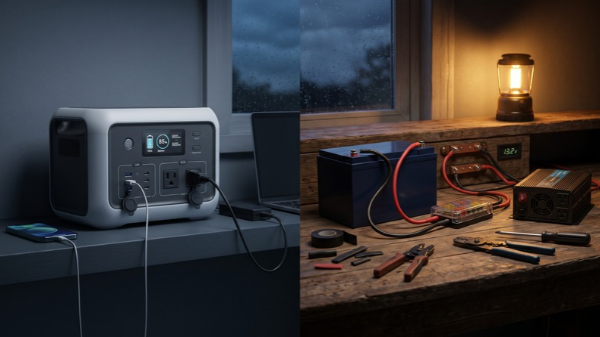
On one side, commercial portable power stations offer sleek plastic cases, digital LCD screens, and instant plug-and-play convenience. On the other side, experienced homesteaders and tinkerers point out a frustrating secret about pre-built “solar generators”: you are paying a 100% to 150% retail markup for a sealed plastic box that turns into an unrepairable paperweight if a single internal circuit board fails.
As we explored in our budget off-grid power system under $200 pillar guide, building a modular 12V micro-power system—or following a step-by-step electromagnetic blueprint like The Energy Revolution System—cuts your upfront cost in half while giving you 100% control over every wire, fuse, and battery cell.
In this portable power station vs. DIY backup generator review, we compare commercial lithium boxes against workbench builds across true cost per Watt-hour ($/Wh), repairability, indoor recharging during winter storms, and beginner assembly time.
Head-to-Head Comparison: Commercial Lithium Box vs. DIY 12V Systems
Here is how a commercial portable power station compares against both a DIY 12V LiFePO4 Battery Box and The Energy Revolution System (which combines a 12V buffer battery with a Tesla-inspired bifilar trickle-charging coil and household load audit):
| Comparison Metric | Commercial Portable Power Station (300Wh–1000Wh) | DIY 12V LiFePO4 Battery Box (“Milk Crate / Ammo Box”) | The Energy Revolution System (DIY Coil + 12V Buffer) |
|---|---|---|---|
| Total All-In Upfront Cost | $249 – $899 (Box only; solar panels cost $150–$400 extra) | $160 – $280 (12V LiFePO4 battery, case, inverter, fuses) | $111 – $186 ($39 PDF blueprint + ~$72–$147 in parts) |
| True Cost Per Watt-Hour ($/Wh) | $0.75 – $1.05 per Wh (High retail enclosure markup) | $0.28 – $0.42 per Wh (60% cheaper per Wh stored) | Lowest Entry Cost + ongoing household efficiency savings |
| Self-Generation Capability | 0 Watts (Pure battery storage until you buy external panels) | 0 Watts (Pure battery storage; requires external charger) | ~12W–18W DC Continuous Trickle + 12V buffer storage |
| Repairability & Modularity | Zero (Sealed Unit) — If the internal inverter dies, the whole unit is bricked | 100% Modular — Swap a $25 port or $60 inverter in 5 minutes | 100% Modular — Every coil, diode, capacitor, and battery is accessible |
| Inverter Idle Parasitic Drain | 12W – 25W wasted/hr whenever AC outlets are switched on | Adjustable (Wire loads straight to 12V DC to save 15% waste) | Runs native 12V DC micro-loads with near-zero inverter loss |
| Assembly Time Required | 0 Minutes (Unbox and charge from wall outlet) | 60 – 90 Minutes (Crimping ring terminals & fuse blocks) | 3 – 4 Hours (Winding flat bifilar coil + wiring 12V circuit) |
| Lowers Monthly Electric Bill? | No (Charges from your wall outlet unless paired with solar) | No (Storage only) | Yes — Includes household phantom-load audit ($20–$35/mo savings) |
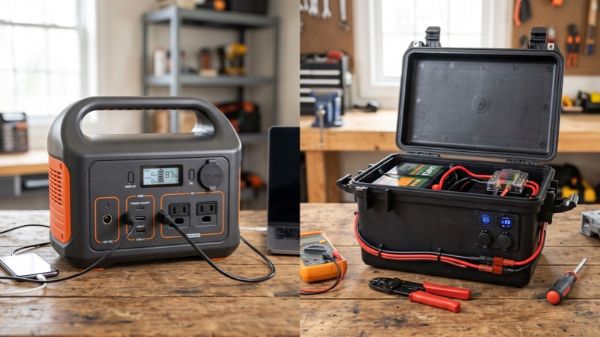
As seen in the side-by-side comparison above, a commercial unit like the Jackery Explorer packs the battery, charge controller, and inverter into one molded case. A DIY box, by contrast, uses larger, replaceable 12V components inside a rugged utility case.
The Hidden “Sealed Box Penalty” of Commercial Power Stations
There is nothing wrong with buying a plug-and-play power station if you value convenience above all else—in fact, we included entry-level 250Wh boxes in our cheap emergency backup power under $250 roundup.
However, before you spend $500 to $1,000 on a commercial unit, you need to understand three hidden drawbacks that marketing brochures never mention:
- A Single Point of Failure Bricks the Entire Machine: Inside a commercial portable power station, the LiFePO4 battery pack, the BMS (Battery Management System), the solar charge controller, and the AC inverter are soldered onto proprietary circuit boards. If a voltage surge from a refrigerator compressor blows a $4 MOSFET inside the inverter one day after your warranty expires, you cannot replace just the inverter—your expensive lithium battery stays trapped inside a dead plastic shell.
- You Pay Double per Watt-Hour ($0.85/Wh vs. $0.32/Wh): In 2026, a standalone 12V 50Ah LiFePO4 battery (640 Watt-hours of storage) costs roughly $115 to $135. Yet a commercial portable power station with that exact same 600Wh capacity retails for $450 to $599. You are paying a $350+ premium just to avoid connecting four colour-coded wires yourself.
- They Are Storage Buckets, Not Generators: Despite being marketed as “solar generators,” portable power stations do not generate a single Watt of electricity out of the box. Once your 300Wh or 500Wh battery hits 0% on Day 2 of a winter blizzard, it is completely dead unless you spend another $200 to $400 on external solar panels—and hope the sun comes out.
Check Official Energy Revolution System Blueprints & 60-Day Guarantee Here
Why DIY 12V Systems Win on Cost, Repairability & Micro-Generation
When you step up to your workbench and build your own system, you can choose between two distinct DIY paths depending on whether you want pure battery storage or an active electromagnetic charging project:
Path A: The Modular DIY 12V LiFePO4 Battery Box ($160–$280)
By placing a standalone 12V LiFePO4 battery inside a heavy-duty plastic battery box and wiring it to an external pure sine wave inverter, an inline fuse block, and a 12V USB/car-socket plate, you get twice the battery capacity per dollar compared to Jackery or EcoFlow. Better yet, if your inverter ever fails five years from now, you simply unbolt two wingnuts, swap in a new $55 inverter in three minutes, and keep going.
Path B: The Energy Revolution System (DIY Bifilar Coil + 12V Buffer Battery for $111–$186)
What if you want a workbench project that goes beyond passive battery storage—for under $190 all-in?
That is where The Energy Revolution System shines as our #1-ranked DIY home energy guide for beginners. For a one-time $39 digital download plus ~$72 to $147 in standard hardware store parts (broken down item-by-item in our Energy Revolution System materials list and cost review), the 47-page PDF manual and 2-hour video series teach you how to build two things:
- A Tesla-Inspired Bifilar Pancake Coil Trickle Circuit: Based on Nikola Tesla’s 1894 US Patent 512,340, you wind two parallel strands of enameled copper magnet wire into a flat spiral connected in series. This geometry increases turn-to-turn capacitance and neutralizes inductive drag, delivering a quiet 12W to 18W DC trickle charge into your 12V buffer battery indoors 24/7—even during nighttime ice storms when outdoor DIY solar kits or Backyard Revolution solar towers produce zero power.
- A Household Phantom-Load Reduction Protocol: While a commercial power station sits in your closet doing nothing to help your monthly budget, the second half of the Energy Revolution System manual walks you through auditing and cutting household phantom standby loads—saving $20 to $35 every month on your regular utility bill.
Realistic Output Check: What Each Option Powers During a Blackout
As we detailed in What Can a Small DIY Energy System Actually Power?, honest wattage math is essential before you buy or build:
- When a Large Commercial Power Station (1,000Wh+) Makes Sense: If you have $700 to $1,200 to spend and need a zero-effort box with a 1,800W AC inverter to run a microwave, medical CPAP with heated humidifier, or coffee maker during short outages, buy a commercial 1,000Wh+ LiFePO4 station.
- When The Energy Revolution System + 12V Buffer Battery Wins: If your budget is $115 to $185, you live in an apartment or condo where gas generators are banned, and your priority is keeping essential 12V micro-loads—LED room lighting (6W), smartphones and tablets (15W), Wi-Fi routers (12W), NOAA weather radios (3W), and 12V DC fans (15W)—running continuously while lowering your monthly electric bill, the DIY blueprint delivers unbeatable value per dollar.
Interactive Build vs. Buy Cost & Value Comparator
Want to see how much money you save per Watt-hour—and how your 1-year net cost changes when you factor in monthly household efficiency savings? Use the interactive comparator below to adjust your target storage capacity and compare a Commercial Portable Power Station, a Standard DIY 12V Battery Box, and The Energy Revolution System + 12V Buffer Setup:
💰 Emergency Power: Build vs. Buy Cost & Value Comparator
Adjust your target 12V storage capacity and monthly phantom-load audit savings to compare upfront hardware cost ($/Wh) against 1-year net out-of-pocket cost.
Ready to build your own 12V micro-backup & cut monthly phantom loads for $39?
Get The Energy Revolution System Blueprints →Key Takeaway from the Comparator: At the 300Wh beginner tier, a commercial portable power station costs roughly $0.95 to $1.00 per Watt-hour ($299 upfront) and generates $0 in monthly utility bill savings. Building your own 12V buffer + Energy Revolution System setup cuts your upfront hardware spend to $177—and once you apply the manual’s phantom-load reduction habits (saving even a modest $20/month), the entire project pays for itself inside 9 months.
Final Verdict: Should You Build or Buy Your Backup Power?
Here is the simplest rule of thumb to make the right call for your household today:
- Buy a Commercial Portable Power Station if: You don’t own a single screwdriver, refuse to strip a wire, and don’t mind paying a 100%+ retail markup for a sealed plastic box to keep in your hall closet for occasional phone and laptop charging.
- Build Your Own DIY 12V System with The Energy Revolution System if: You want to spend under $185 all-in, want a modular system you can actually repair and expand with standard hardware store parts, want to learn how Nikola Tesla’s flat spiral bifilar coil works on your workbench, and want a practical household audit that lowers your monthly electric bill right away.
Best of all, you don’t have to commit to the hardware build blind. When you order The Energy Revolution System ($39) through the official portal, your download is backed by ClickBank’s 60-day unconditional money-back guarantee. You can inspect the 47-page PDF schematic, review the complete materials list, and watch the 2-hour video tutorial series for 60 full days—and if you decide you’d rather just buy a pre-made box at retail price, you can get a 100% refund with one click.
Click Here to Download The Energy Revolution System Blueprints Risk-Free (60-Day Guarantee)