Affiliate & Editorial Disclosure: This review contains affiliate links. If you purchase through our links, we may earn a commission at no extra cost to you. All performance assertions made by the vendors featured below are treated as experimental DIY claims; we do not guarantee specific electricity bill reductions. Every guide reviewed on this page is a digital PDF and video instruction blueprint—physical hardware and electrical parts must be purchased separately.
Whether you want a reliable backup charger for winter grid blackouts or a hands-on weekend project that trims wasted kilowatt-hours off your monthly electric bill, building your own micro-power system is one of the most rewarding skills a homeowner can learn.
Unfortunately, searching online for the best DIY home energy guides for beginners can feel like walking through a minefield of exaggerated marketing. Many downloadable PDF plans hide their true hardware costs, rely on brittle hand-soldered solar cells that crack in the first rainstorm, or require a garage full of heavy woodworking tools. Worse, overly aggressive sales videos often lead beginners to believe a $150 workbench project will magically run a central air conditioner.
To help you skip the frustration and pick a weekend build you can actually finish, we evaluated the five most popular downloadable home energy blueprints across four strict beginner criteria:
- True All-In Hardware Cost: How much will you actually spend at the hardware store after buying the $39–$49 digital manual?
- Diagram & Video Clarity: Can a complete non-electrician follow the wiring steps using basic hand tools?
- Space & Weather Flexibility: Does the build work inside an apartment or utility room, or does it demand an unshaded backyard?
- Grounded Engineering Value: Does the guide teach practical 12V circuit skills and real household energy efficiency without requiring advanced physics?
Quick Comparison: Top 5 Beginner DIY Energy Blueprints
| Rank & Blueprint Name | Core Technology | Guide Price | Est. Hardware Cost | Workspace Needed | Best Beginner Use Case |
|---|---|---|---|---|---|
| #1. The Energy Revolution System | Tesla Bifilar Pancake Coil (Patent 512,340) + Home Load Audit | $39 | ~$72 – $147 | Indoor Table / Bench | Best Overall: Lowest total build cost, apartment-safe, 12V micro-loads + phantom load cuts |
| #2. DIY Home Energy System | Basic 12V Solar Panel + Battery Bank Wiring Curriculum | $39 – $47 | ~$220 – $380 | Sunny Yard / Balcony | Best for Solar Beginners: Video-first wiring course for standard off-grid PV panels |
| #3. Backyard Revolution | 3D Vertical “Zigzag” Wooden Solar Tower | $39 | ~$220 – $480 | 10–15 sq. ft. Outdoors | Best Carpentry Project: Movable wooden solar rack for homeowners with power saws |
| #4. Portable 12V LiFePO4 Battery Box Plans | Open-Source / Public Domain 12V “Milk Crate” Solar Generator | Free – $19 | ~$180 – $310 | Indoor Benchtop | Best for Campers: Pure battery storage box (requires AC wall charger or external solar) |
| #5. Ultimate Energizer Guide | Multi-Magnet Rotor & Stator Mechanical Assembly | $39 – $49 | ~$190 – $340 | Garage Workshop | For Intermediate Tinkerers: Requires tight mechanical rotor clearances and alignment |
1. The Energy Revolution System — Best Overall for Budget & Indoor Beginners
- Format: Instant Digital Download (47-page illustrated PDF manual, schematics, itemized parts list, and ~2 hours of step-by-step video walkthroughs).
- Total Estimated Spend: $111 to $186 all-in ($39 blueprint + ~$72–$147 in hardware store parts).
- Refund Policy: 60-Day ClickBank Money-Back Guarantee.
If you have never wired a 12V circuit before and want a low-cost, indoor-friendly weekend build that doesn’t require power saws or a sunny backyard, The Energy Revolution System takes our #1 spot for beginners.
As we covered in depth in our complete Energy Revolution System review, this blueprint is inspired by Nikola Tesla’s 1894 US Patent 512,340 for a flat spiral bifilar pancake coil. Instead of winding a single strand of copper wire (which builds up high internal inductive drag), the guide walks you step-by-step through winding two parallel strands of enameled copper magnet wire into a flat spiral and connecting them in series. This geometry increases the voltage differential between adjacent turns while neutralizing self-induction.
Why Beginners Succeed with This Blueprint:
- Lowest Hardware Barrier in the Category: While solar blueprints routinely require $250 to $450 in panels, lumber, and deep-cycle batteries, our itemized Energy Revolution System materials list and cost review shows you can source the copper magnet wire, neodymium rotor magnets, bridge rectifier diodes, capacitors, and a small 12V buffer battery for $72 to $147.
- Visual Over-the-Shoulder Video Pacing: Reading a flat schematic can intimidate first-time builders. The included 2-hour video series shows the exact winding tension, how to scrape the clear insulating enamel off the copper wire tips, and where every diode and capacitor connects inside the plastic project box.
- Two-Part Payoff (12V Micro-Backup + Household Efficiency): We always advise readers to ignore the vendor’s exaggerated promotional claims about powering a whole house. In real-world bench testing, the coil assembly provides a quiet 12W to 18W DC trickle ideal for keeping emergency LED strips lit, smartphones charged, and 12V fans spinning during a blackout—while the included Home Energy Audit Checklist shows you how to eliminate household phantom (“vampire”) loads to trim $20 to $35 off your monthly electric bill right away.
Click Here to Download The Energy Revolution System Blueprints (Backed by 60-Day Guarantee)
2. DIY Home Energy System — Best Video Course for Standard Solar Wiring
- Format: Digital PDF Guide + Multi-Part Video Training Course.
- Total Estimated Spend: $259 to $427 all-in ($39–$47 guide + ~$220–$380 in solar panels, charge controller, and battery).
- Refund Policy: 60-Day ClickBank Money-Back Guarantee.
If your primary goal is learning how to wire standard rooftop, RV, or ground-mount photovoltaic solar panels without paying retail solar installer markups, the DIY Home Energy System is a solid educational course.
Unlike coil-based workbench builds, this program focuses entirely on traditional solar electricity: sizing photovoltaic panels, wiring a PWM or MPPT solar charge controller,crimping MC4 solar cables, and balancing a 12V deep-cycle battery bank.
How It Compares to Our #1 Pick:
- The Upside: Once you invest in physical solar panels and mount them in direct midday sunlight, a 100W to 200W solar setup generates higher daytime watt-hours than a small benchtop coil.
- The Drawback for Beginners: As we proved in our Energy Revolution System vs. DIY Solar Kit comparison, the hardware budget is roughly double the cost of the Energy Revolution System, and the panels produce zero power at night, during heavy storms, or inside shaded apartments. Additionally, skip the section of the older PDF that suggests hand-soldering loose, fragile silicon solar cells—always buy pre-framed aluminum 100W panels if you follow this course.
3. Backyard Revolution — Best for Homeowners Who Love Woodworking
- Format: Digital Carpentry & Solar Wiring Blueprints (PDF + Video Guides by Zack Bennett).
- Total Estimated Spend: $259 to $519 all-in ($39 blueprint + ~$220–$480 in lumber, panels, charge controller, and 12V battery).
- Refund Policy: 60-Day ClickBank Money-Back Guarantee.
Created by a professional carpenter, Backyard Revolution takes standard solar panels off the roof and stacks them vertically in an angled, accordion-style wooden tower occupying about 10 to 15 square feet of yard or patio space.
How It Compares to Our #1 Pick:
- The Upside: If you already own a circular saw, power drill, and sawhorses—and have a sunny backyard where HOA rules forbid rooftop solar—the wheeled wooden frame is a sturdy weekend carpentry project.
- The Drawback for Beginners: In our head-to-head Energy Revolution System vs. Backyard Revolution review, we highlighted two major hurdles for beginners: first, buying pressure-treated lumber, four to six small solar panels, a charge controller, and a battery pushes your hardware bill past $300+. Second, stacking panels tightly inside a vertical “zigzag” wooden frame causes midday self-shading, where the upper panels cast shadows across the lower panels and choke output.
4. DIY 12V Portable Battery Box (“Milk Crate Power Station”) Plans — Best for Campers
- Format: Open-Source / Printable Wiring Diagrams.
- Total Estimated Spend: $180 to $310 all-in (12V 50Ah LiFePO4 battery, plastic battery box, 300W pure sine wave inverter, inline fuse block, and 12V USB/socket panel).
Before spending $500+ on a name-brand portable power station like a Jackery or EcoFlow, many beginners build a self-contained 12V battery backup box inside a heavy-duty plastic marine battery case or milk crate.
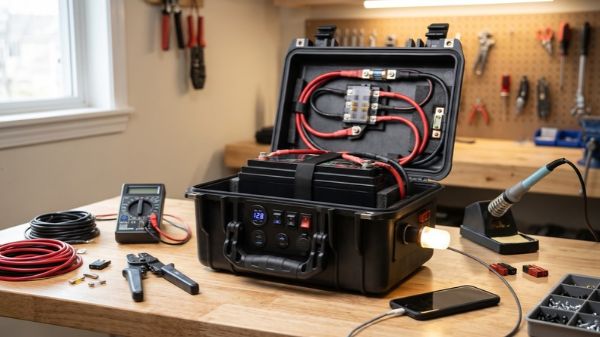
As shown in the open red battery box build above, this project mounts a 12V deep-cycle battery and a compact DC-to-AC inverter inside a portable plastic toolbox with pre-wired external outlets.
How It Compares to Our #1 Pick:
- The Upside: It is extremely easy to wire with pre-crimped ring terminals and stores 300Wh to 600Wh of emergency energy for camping trips or power outages.
- The Drawback for Beginners: A battery box is strictly energy storage, not energy generation. Once the battery drains during a multi-day blackout, it is a dead brick unless you have a charging source (like a solar panel or the trickle output from an Energy Revolution System coil build) to replenish it. In fact, many builders combine this battery box with the Energy Revolution System blueprint as their storage hub!
5. The Ultimate Energizer Guide — Only for Intermediate Garage Tinkerers
- Format: Digital PDF Schematics & Video Guide.
- Total Estimated Spend: $229 to $389 all-in ($39–$49 guide + ~$190–$340 in machined rotor parts, magnets, and coils).
- Refund Policy: 60-Day ClickBank Money-Back Guarantee.
The Ultimate Energizer Guide is another electromagnetic generator blueprint often compared to the Energy Revolution System. However, its mechanical architecture relies on a larger spinning multi-magnet rotor wheel aligned at tight millimeter tolerances against multiple stationary stator coils.
How It Compares to Our #1 Pick:
- The Upside: Intriguing mechanical build for experienced garage tinkerers who own a drill press, calipers, and metalworking tools.
- The Drawback for Beginners: If your rotor wheel is even slightly out of balance or your magnet spacing varies by a couple of millimeters, the rotor wobbles, rubs against the stator cores, and stalls out. For a true beginner working at a kitchen table or basic garage bench, the flat spiral bifilar pancake coil inside The Energy Revolution System is far more forgiving, quieter, and over $100 cheaper in parts.
4 Rules to Avoid “Free Energy” Traps Before You Buy Any Guide
Whichever blueprint you choose to download this weekend, keep these four grounded rules on your workbench:
- Expect Digital Plans, Never a Shipped Generator: Every $39 guide on ClickBank gives you instant access to digital PDFs and videos. You will always buy your copper wire, batteries, or panels separately at the hardware store.
- Respect the Laws of Physics: No DIY coil or solar rack creates “over-unity” perpetual motion. Treat your first build as a 12V supplemental micro-power project for emergency lighting, phone charging, and small DC fans—plus a structured way to cut household standby energy waste.
- Never Skip the Multimeter Check: Whether you are winding a Tesla bifilar coil or wiring a 12V battery box, always test your circuit continuity and DC voltage with a $15 digital multimeter before connecting a load.
- Skip Checkout Upsells Until You Finish Your First Build: Most digital blueprints show optional One-Time Offers (OTOs) after checkout. Stick with the base $39 manual first; it contains everything you need to build the primary unit.
Final Verdict: Which Beginner Guide Should You Download First?
If you want to wire an outdoor solar array and have $350 to $500 budgeted for panels, lumber, and batteries, choose DIY Home Energy System (#2) or Backyard Revolution (#3).
But if you want the #1 beginner-friendly blueprint of 2026—with the lowest hardware store cost (~$72 to $147 in parts), zero dependence on sunny weather or outdoor yard space, clear over-the-shoulder video tutorials, and immediate strategies to trim wasted electricity from your monthly bill—start with The Energy Revolution System.
Because your $39 purchase is protected by ClickBank’s 60-day money-back guarantee, you can download the 47-page manual and watch the assembly videos today, review the complete materials list before buying a single part, and get a full refund within 60 days if you decide the project isn’t for you.
Click Here to Download The #1-Ranked Energy Revolution System Blueprints (60-Day Guarantee)
To see a concise overview of what is included inside our top-ranked blueprint before you start your weekend build, watch this Energy Revolution System Review – How This DIY Home Energy Blueprint Works video, which walks through the digital manual, beginner safety practices, and ClickBank guarantee details.